The Margin That Moved by the Hour
Clinical Vignette
A 52-year-old man with no significant medical history scrapes his left shin on a rose trellis while gardening. He rinses the abrasion at home and thinks little of it. He takes no medications, drinks alcohol in moderation, and has no history of diabetes, immunosuppression, or chronic liver or kidney disease.
Roughly thirty hours later he presents to the emergency department with severe, unremitting leg pain that seems far worse than the wound appears, along with fevers and shaking chills. Over the next six hours the erythema advances across his shin at a rate the nurses document in centimeters per hour, crossing the knee and creeping up the thigh despite elevation, and he becomes increasingly confused.
On examination his temperature is 39.4 °C, heart rate 132/min, blood pressure 82/50 mmHg, and respiratory rate 26/min. The left leg is tense, hot, and wood-hard to palpation, with a dusky violaceous patch and a flaccid hemorrhagic bulla; tenderness extends well beyond the visible margin, yet light touch over the central area is paradoxically blunted, suggesting cutaneous nerve destruction. Laboratory studies show a white blood cell count of 27.5 × 10³/µL with 19% bands, sodium 131 mmol/L, creatinine 2.3 mg/dL (baseline 0.9), INR 1.7, platelets 88 × 103/µL, lactate 4.8 mmol/L, and creatine kinase 2,400 U/L.
Blood cultures and fluid aspirated from a fresh bulla are obtained. Within twelve hours the blood culture bottles flag positive, and the Gram stain is shown below.
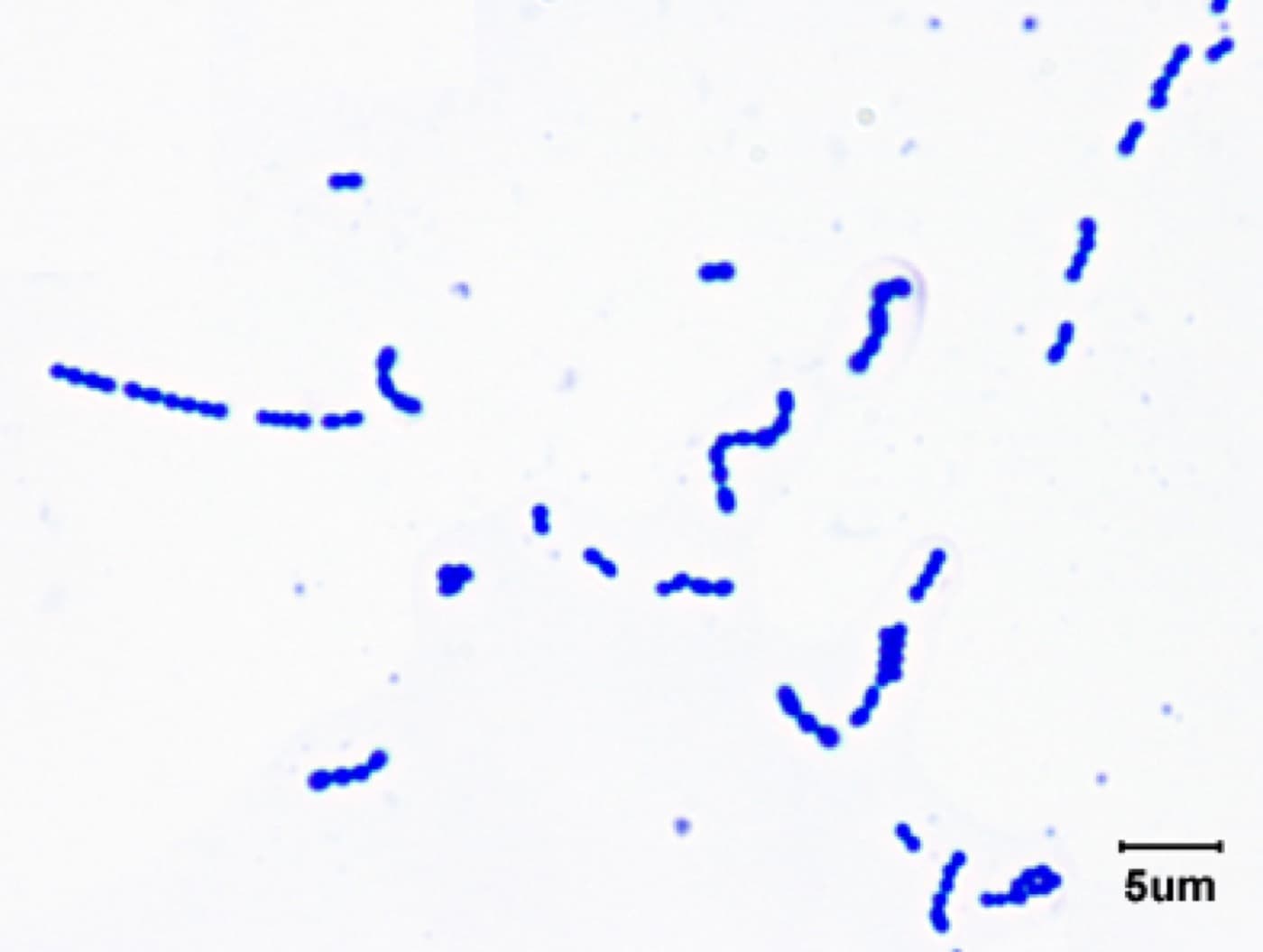
Gram stain of the positive blood culture demonstrating gram-positive cocci in chains. Credit: Gary E. Kaiser, Ph.D., via Wikimedia Commons (CC BY 3.0).
Question 1
Which organism is most likely responsible for this patient's necrotizing fasciitis and toxic shock?
Select one option to submit your answer and view live poll results.
Question 2
Which virulence mechanism of S. pyogenes best explains the patient's rapid progression to hypotension and multi-organ failure?
Select one option to submit your answer and view live poll results.
Question 3
In addition to aggressive fluid resuscitation and vasopressor support, which intervention is most critical for this patient?
Select one option to submit your answer and view live poll results.
References
Stevens DL, Bisno AL, Chambers HF, et al. Practice Guidelines for the Diagnosis and Management of Skin and Soft Tissue Infections: 2014 Update by the Infectious Diseases Society of America. Clinical Infectious Diseases. 2014;59(2):e10-52.
Stevens DL, Bryant AE. Necrotizing Soft-Tissue Infections. New England Journal of Medicine. 2017;377(23):2253-2265.
The Working Group on Severe Streptococcal Infections. Defining the Group A Streptococcal Toxic Shock Syndrome: Rationale and Consensus Definition. Journal of the American Medical Association. 1993;269(3):390-391.
Kaul R, McGeer A, Low DE, Green K, Schwartz B. Intravenous Immunoglobulin Therapy for Streptococcal Toxic Shock Syndrome — A Comparative Observational Study. Clinical Infectious Diseases. 1999;29(4):800-807.