Salt and Iron
Clinical Vignette
A 52-year-old man presents to the emergency department in Galveston, Texas, with 12 hours of rapidly progressive pain, swelling, and discoloration of his right lower leg. He was wading in the Gulf of Mexico two days ago when he sustained a small laceration on his right shin from a seashell. The wound was minor and he did not clean or dress it. Approximately 24 hours after the injury, he noticed increasing pain and redness around the wound site, and over the past 12 hours the area has expanded dramatically, with the development of dark purple discoloration and fluid-filled blisters. He now reports fever, chills, nausea, and dizziness when standing.
His past medical history is notable for hereditary hemochromatosis, diagnosed three years ago after an elevated ferritin was found on routine laboratory testing. Genetic testing confirmed HFE C282Y homozygosity. He was advised to undergo regular therapeutic phlebotomy but has been non-compliant, attending only two sessions in the past year. His most recent ferritin level was 1,842 ng/mL with a transferrin saturation of 92%. He takes no medications. He does not drink alcohol. He works as a commercial fisherman.
On examination his temperature is 39.4 C, heart rate 118/min, blood pressure 88/52 mmHg, respiratory rate 22/min, and oxygen saturation 96% on room air. He is diaphoretic, confused, and answers questions slowly. The right lower leg from the mid-shin to the ankle shows a 15 by 12 cm area of violaceous discoloration with overlying hemorrhagic bullae filled with dark fluid. The surrounding skin is erythematous, warm, and exquisitely tender. Crepitus is palpable on gentle compression. Sensation is diminished over the violaceous area. The dorsalis pedis pulse is palpable but diminished compared to the left.
Laboratory studies show white blood cells 22.4 x 10^3/uL with 85% neutrophils, 6% bands, hemoglobin 12.1 g/dL, platelets 110 x 10^3/uL, creatinine 2.1 mg/dL (baseline 0.9), BUN 38 mg/dL, lactate 4.8 mmol/L, procalcitonin 48.6 ng/mL, CRP 312 mg/L, and INR 1.4. Total bilirubin is 1.8 mg/dL, ALT 62 U/L, and AST 78 U/L. Two sets of blood cultures are drawn. A Gram stain of fluid aspirated from one of the hemorrhagic bullae shows curved gram-negative rods, some in pairs with a seagull-wing morphology.
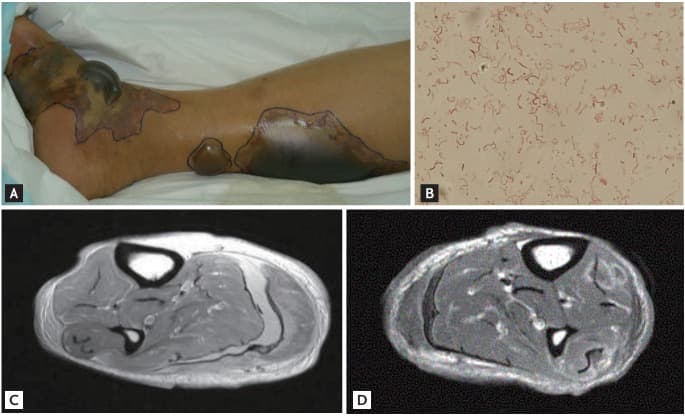
Clinical, microscopic, and radiographic findings in a patient with necrotizing soft-tissue infection and septic shock. Image from Yun & Kim, Korean J Intern Med, 2018, CC BY-NC 4.0.
Question 1
What is the most likely causative organism?
Select one option to submit your answer and view live poll results.
Question 2
Which mechanism best explains why hemochromatosis and other iron overload states dramatically increase susceptibility to severe infection with this organism?
Select one option to submit your answer and view live poll results.
Question 3
The microbiology laboratory reports that the curved gram-negative rods grew on blood agar but failed to grow on standard MacConkey agar. When subcultured onto blood agar with added NaCl, growth was robust. What explains this growth pattern?
Select one option to submit your answer and view live poll results.
Question 4
Which approach to treatment is most appropriate?
Select one option to submit your answer and view live poll results.
References
Oliver JD. Wound infections caused by Vibrio vulnificus and other marine bacteria. Epidemiology and Infection. 2005;133(3):383-391.
Hor LI, Chang TT, Wang ST. Survival of Vibrio vulnificus in whole blood from patients with hemochromatosis: implication for pathogenesis. Journal of Infectious Diseases. 1999;180(6):1951-1956.
Liu JW, Lee IK, Tang HJ, et al. Prognostic factors and antibiotics in Vibrio vulnificus septicemia. Archives of Internal Medicine. 2006;166(19):2117-2123.
Yun NR, Kim DM. Vibrio vulnificus infection: a persistent threat to public health. Korean Journal of Internal Medicine. 2018;33(6):1070-1078.
Webster AC, Gottfried E, Bopp C. Vibrio vulnificus wound infections from the Mississippi Gulf Coastal waters. Journal of Clinical Microbiology. 1991;29(10):2323-2325.