The Culture That Changed the Scope
Clinical Vignette
A 67-year-old man with hypertension and hyperlipidemia presents to the emergency department with three weeks of low-grade fever, drenching night sweats, progressive fatigue, and a 15-pound unintentional weight loss over two months. He denies recent travel, sick contacts, dental procedures, intravenous drug use, or animal exposures. His only medications are lisinopril and atorvastatin. He has not seen a primary care physician in over five years and has never undergone colorectal cancer screening.
On examination he is febrile to 38.4°C, heart rate 94 bpm, blood pressure 138/82 mmHg, respiratory rate 18 breaths per minute, and oxygen saturation 97% on room air. He appears chronically ill with temporal wasting. Cardiac auscultation reveals a new harsh diastolic murmur best heard at the right second intercostal space. Conjunctival petechiae are present bilaterally. Splinter hemorrhages are noted on the right index and middle fingernails. The abdomen is soft and non-tender. No hepatosplenomegaly is appreciated. The remainder of the examination is unremarkable.
White blood cell count is 13,200/μL with 80% neutrophils. Hemoglobin is 10.1 g/dL with a mean corpuscular volume of 76 fL. Platelet count is 385,000/μL. ESR is 78 mm/hr and CRP is 62 mg/L. Iron studies reveal a ferritin of 18 ng/mL, consistent with iron deficiency anemia. Basic metabolic panel and liver function tests are within normal limits. Two sets of blood cultures are drawn from separate peripheral sites 30 minutes apart before antibiotics are administered. Both sets flag positive at 20 hours with gram-positive cocci in pairs and short chains on Gram stain. Transthoracic echocardiography demonstrates a 1.2 cm mobile echodense mass on the aortic valve with moderate aortic regurgitation.
Subculture onto sheep blood agar reveals small, gray-white, alpha-hemolytic colonies. The organism is catalase-negative, bile esculin-positive, PYR-negative, and not susceptible to optochin.
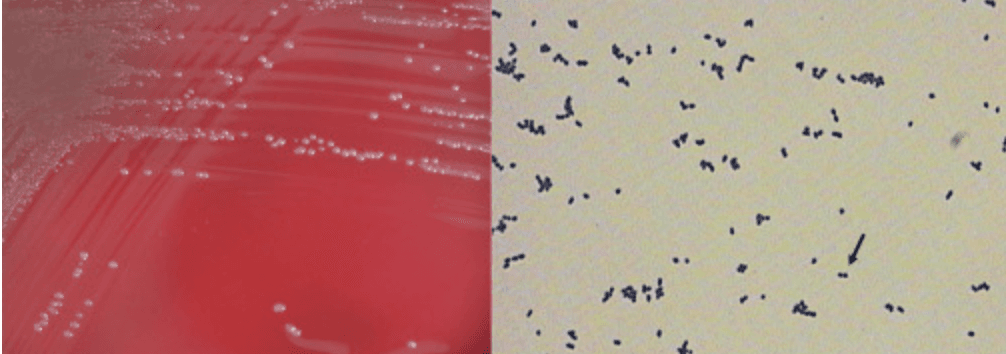
Sheep blood agar: subculture from positive blood culture bottles.
Question 1
Based on the Gram stain morphology, colony characteristics, and biochemical profile (catalase-negative, bile esculin-positive, PYR-negative, optochin-resistant, alpha-hemolytic), which of the following organism groups is most likely responsible for this patient's bacteremia?
Select one option to submit your answer and view live poll results.
Question 2
MALDI-TOF mass spectrometry further identifies the organism as Streptococcus gallolyticus subsp. gallolyticus (formerly Streptococcus bovis biotype I). In addition to endocarditis, which of the following underlying conditions is most strongly associated with bacteremia caused by this specific organism?
Select one option to submit your answer and view live poll results.
Question 3
Which of the following best explains the biological mechanism linking Streptococcus gallolyticus subsp. gallolyticus to colorectal neoplasia?
Select one option to submit your answer and view live poll results.
Question 4
The patient is started on intravenous ceftriaxone 2 g every 24 hours for streptococcal endocarditis. Regarding colorectal evaluation, which of the following is the most appropriate next step in management?
Select one option to submit your answer and view live poll results.
References
Schlegel L, Grimont F, Ageron E, Grimont PAD, Bouvet A. Reappraisal of the taxonomy of the Streptococcus bovis/Streptococcus equinus complex and related species: description of Streptococcus gallolyticus subsp. gallolyticus subsp. nov., S. gallolyticus subsp. macedonicus subsp. nov. and S. gallolyticus subsp. pasteurianus subsp. nov. International Journal of Systematic and Evolutionary Microbiology. 2003;53(Pt 3):631-645.
Corredoira-Sánchez J, García-Garrote F, Rabuñal R, et al. Association between bacteremia due to Streptococcus gallolyticus subsp. gallolyticus (Streptococcus bovis I) and colorectal neoplasia: a case-control study. Clinical Infectious Diseases. 2012;55(4):491-496.
Boleij A, van Gelder MMHJ, Swinkels DW, Tjalsma H. Clinical importance of Streptococcus gallolyticus infection among colorectal cancer patients: systematic review and meta-analysis. Clinical Infectious Diseases. 2011;53(9):870-878.
Baddour LM, Wilson WR, Bayer AS, et al. Infective endocarditis in adults: diagnosis, antimicrobial therapy, and management of complications. Circulation. 2015;132(15):1435-1486.
Tjalsma H, Boleij A, Marchesi JR, Dutilh BE. A bacterial driver-passenger model for colorectal cancer: beyond the usual suspects. Nature Reviews Microbiology. 2012;10(8):575-582.