The Dust That Wouldn't Settle
Clinical Vignette
A 34-year-old Filipino-American construction worker from Phoenix, Arizona presents to the emergency department with six weeks of progressively worsening headache. The pain is bifrontal, constant, and worse in the morning. Over the past two weeks he has developed horizontal diplopia and intermittent nausea without vomiting. He reports three months of intermittent low-grade fevers, drenching night sweats, and an 8-pound unintentional weight loss. Three months earlier he had a self-resolved "chest cold" with dry cough and pleuritic chest pain that began the day after a major dust storm at a excavation site. He takes no medications, has no significant medical history, and is not immunosuppressed.
On examination his temperature is 37.8 °C, heart rate 92/min, blood pressure 124/78 mmHg. He is alert but mildly slow in his responses. Cranial nerve examination reveals bilateral sixth nerve palsies. There is mild nuchal rigidity without photophobia; Kernig and Brudzinski signs are absent. The remainder of the neurologic and general examination is unremarkable.
Laboratory studies show a peripheral white blood cell count of 9.8 × 10³/µL with a normal differential, hemoglobin 13.1 g/dL, and a normal basic metabolic panel. HIV serology is negative. A contrast MRI of the brain is obtained and is shown below.
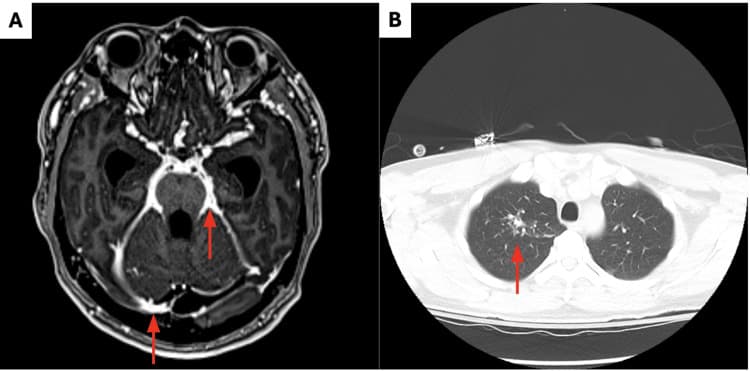
Axial T1 post-contrast MRI demonstrating leptomeningeal enhancement in the basal cisterns (arrows), characteristic of chronic granulomatous basilar meningitis. Image from Smith AD, Lauinger AR, Goel M, et al. Management of Coccidioidal Meningitis Outside the Endemic Region. Cureus. 2026;18(3):e105643. CC BY 4.0.
Lumbar puncture reveals an opening pressure of 28 cm H2O. Cerebrospinal fluid analysis shows 220 white blood cells/µL with 68% lymphocytes, 14% eosinophils, and 18% neutrophils; glucose 22 mg/dL (serum 98 mg/dL); protein 168 mg/dL; and a Gram stain with no organisms. Serum Coccidioides enzyme immunoassay is IgM-positive and IgG-positive, with a complement-fixation titer of 1:64. CSF Coccidioides complement-fixation antibody is positive at a titer of 1:8. CSF bacterial and fungal cultures are pending.
Question 1
Which organism is most likely responsible for this patient's basilar meningitis?
Select one answer to view the rationale and peer response data.
Question 2
What is the most appropriate initial treatment approach for this patient?
Select one answer to view the rationale and peer response data.
Question 3
How should this patient's response to therapy be monitored?
Select one answer to view the rationale and peer response data.
Rationale locked
Answer the question above to reveal the rationale.
Rationale locked
Answer the question above to reveal the rationale.
References
Galgiani JN, Ampel NM, Blair JE, et al. 2016 Infectious Diseases Society of America (IDSA) Clinical Practice Guideline for the Treatment of Coccidioidomycosis. Clinical Infectious Diseases. 2016;63(6):e112-e146.
Johnson R, Ho J, Fowler P, Heidari A. Coccidioidal Meningitis: A Review on Diagnosis, Treatment, and Management of Complications. Current Neurology and Neuroscience Reports. 2018;18(4):19.
Tucker RM, Williams PL, Arathoon EG, et al. Pharmacokinetics of fluconazole in cerebrospinal fluid and serum in human coccidioidal meningitis. Antimicrobial Agents and Chemotherapy. 1988;32(3):369-373.
Crum NF, Lederman ER, Stafford CM, et al. Coccidioidomycosis: a descriptive survey of a reemerging disease. Medicine (Baltimore). 2004;83(3):149-175.
Centers for Disease Control and Prevention. Valley Fever (Coccidioidomycosis): Clinical Overview. Updated January 2025.