When Mechanisms Collide
Clinical Vignette
A 55-year-old man with decompensated cirrhosis (MELD-Na 22) and type 2 diabetes presents to the emergency department with eighteen hours of severe diffuse abdominal pain, fever to 39.4°C, and hypotension. His abdomen is rigid and diffusely tender. He takes no immunosuppressive medications. CT of the abdomen and pelvis demonstrates pneumoperitoneum with moderate free fluid consistent with a perforated sigmoid diverticulum.
He undergoes emergency laparotomy with Hartmann's procedure. Intraoperative findings include frank purulent peritonitis with fecal contamination throughout the peritoneal cavity. Two sets of blood cultures drawn in the emergency department before any antibiotics are administered become positive at 24 hours. The Gram stain of the blood culture bottle shows gram-negative rods, gram-positive cocci in pairs and short chains, and budding yeast forms. Final identification reveals three organisms: an extended-spectrum beta-lactamase (ESBL)-producing Escherichia coli, vancomycin-resistant Enterococcus faecium (VRE), and Candida glabrata.
The infectious diseases team recommends a three-drug regimen: meropenem for the ESBL-producing E. coli, linezolid for the VRE, and micafungin for the C. glabrata. Each drug was chosen not only for its spectrum but for its mechanism of action, which targets a fundamentally different microbial structure.
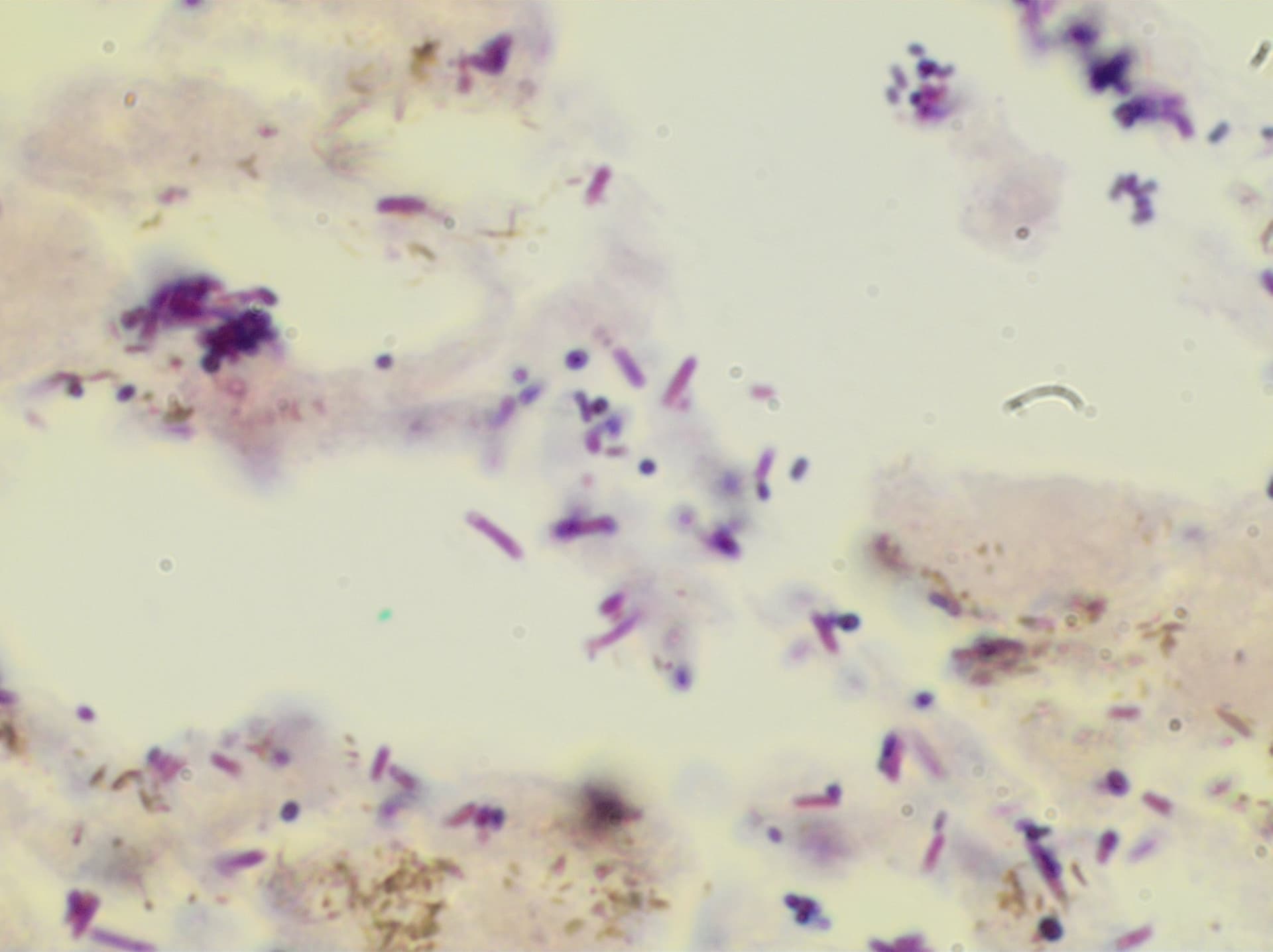
Gram stain of a positive blood culture demonstrating gram-negative rods and gram-positive cocci in polymicrobial bacteremia.
Question 1
By what mechanism does meropenem achieve bactericidal activity against the ESBL-producing E. coli?
Select one option to submit your answer and view live poll results.
Question 2
By what mechanism does linezolid inhibit protein synthesis in vancomycin-resistant E. faecium?
Select one option to submit your answer and view live poll results.
Question 3
By what mechanism does micafungin kill Candida glabrata?
Select one option to submit your answer and view live poll results.
References
Lade H, Kim JS. Bacterial targets of antibiotics in methicillin-resistant Staphylococcus aureus. Antibiotics (Basel). 2021;10(4):398.
Zhanel GG, Love R, Adam H, et al. Tedizolid: a novel oxazolidinone with potent activity against multidrug-resistant gram-positive pathogens. Drugs. 2015;75(3):253-270.
Emri T, Majoros L, Tóth V, Pócsi I. Echinocandins: production and applications. Applied Microbiology and Biotechnology. 2013;97(8):3267-3284.
Aruanno M, Glampedakis E, Lamoth F. Echinocandins for the treatment of invasive aspergillosis: from laboratory to bedside. Antimicrobial Agents and Chemotherapy. 2019;63(8):e00399-19.
Kurup A, Liau KH, Ren J, et al. Antibiotic management of complicated intra-abdominal infections in adults: the Asian perspective. Annals of Medicine and Surgery. 2014;3(3):85-91.