The Fluke in the Bile Duct
Clinical Vignette
A 58-year-old man who immigrated to the United States from South Korea twelve years ago presents with three months of progressive yellowing of his skin and eyes, generalized pruritus, pale stools, dark urine, and a 15-pound unintentional weight loss. He denies abdominal pain, fever, or night sweats. He has no history of hepatitis, alcohol use disorder, gallstones, or metabolic liver disease. He takes no medications and has no surgical history.
On examination he is deeply icteric with excoriations on his extremities from scratching. His temperature is 36.9 °C, heart rate 78/min, blood pressure 132/82 mmHg. The abdomen is soft and non-tender. The liver span is 14 cm on percussion; no Murphy sign is elicited. Laboratory studies show total bilirubin 14.2 mg/dL (direct 11.8), AST 124 U/L, ALT 156 U/L, alkaline phosphatase 620 U/L, and CA 19-9 842 U/mL. Viral hepatitis serologies are negative.
Contrast CT of the abdomen reveals a 3-cm perihilar mass causing upstream dilation of the intrahepatic biliary ducts, with diffuse, uniform dilation extending to the periphery of both lobes. The gallbladder and extrahepatic ducts are normal in caliber. ERCP is performed for biliary decompression, and during the procedure several small, translucent, leaf-shaped flukes measuring approximately 15 mm are extracted from the common bile duct. When asked about dietary habits, the patient reports that he ate raw freshwater fish (hoe) regularly while living in Korea, a practice he continued on annual visits home.
Stool examination for ova and parasites is sent, and the microscopy is shown below.
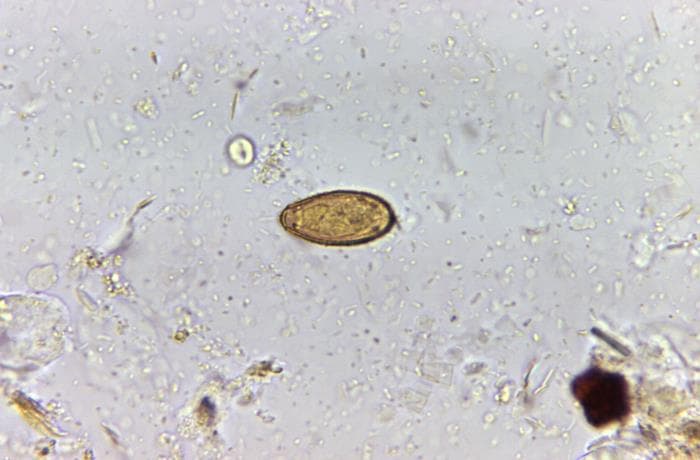
Stool microscopy demonstrating a small operculate egg measuring approximately 29 × 16 µm, with characteristic opercular shoulders and a terminal knob at the abopercular end. Image from the CDC Public Health Image Library (#659), public domain.
Question 1
Which organism is most likely responsible for this patient's biliary infestation, and how was it acquired?
Select one answer to view the rationale and peer response data.
Question 2
By what mechanism does chronic Clonorchis sinensis infection lead to cholangiocarcinoma?
Select one answer to view the rationale and peer response data.
Question 3
Praziquantel is prescribed to treat the fluke infection. Which statement best describes the role of deworming in this patient's cancer risk?
Select one answer to view the rationale and peer response data.
Rationale locked
Answer the question above to reveal the rationale.
Rationale locked
Answer the question above to reveal the rationale.
References
Qian MB, Utzinger J, Keiser J, Zhou XN. Clonorchiasis. Lancet. 2016;388(10066):800-810.
Bouvard V, Baan R, Straif K, et al. A review of human carcinogens — Part B: Biological agents. Lancet Oncology. 2009;10(4):321-322.
Hong ST, Fang Y. Clonorchis sinensis and cholangiocarcinoma, an update. Parasitology International. 2008;57(2):89-94.
Valle JW, Wasan H, Palmer DH, et al. Cisplatin plus gemcitabine versus gemcitabine for biliary tract cancer (ABC-02). New England Journal of Medicine. 2010;362(14):1273-1281.
Centers for Disease Control and Prevention. Clonorchis (Liver Flukes): Clinical Overview. Updated February 2024.