The Cavity That Came Back
Clinical Vignette
A 54-year-old man from Lima, Peru presents to the emergency department after coughing up approximately 50 mL of frank blood. He was treated for pulmonary tuberculosis eight years ago with a standard six-month regimen of rifampin, isoniazid, pyrazinamide, and ethambutol and was declared cured, with residual right upper lobe fibrocavitary scarring on follow-up imaging. He has a 30 pack-year smoking history but no other medical problems and takes no medications.
Over the past four months he has noticed progressive daily productive cough, drenching night sweats, fatigue, and a 12-kg unintentional weight loss. Six weeks ago he had a single episode of blood-streaked sputum that he attributed to coughing. He did not seek care until the larger bleed three days ago. At a local clinic three weeks ago, tuberculosis recurrence was suspected; three consecutive sputum acid-fast bacillus smears were negative and a single Xpert MTB/RIF was negative. A course of amoxicillin-clavulanate produced no improvement.
On examination his temperature is 37.6 °C, heart rate 94/min, blood pressure 118/74 mmHg, respiratory rate 18/min, and oxygen saturation 95% on room air. He appears cachectic (BMI 18.2). Coarse crackles are present over the right upper lung field. There is no lymphadenopathy, no clubbing, and no peripheral stigmata of endocarditis. He is not immunosuppressed.
Laboratory studies show a peripheral white blood cell count of 9.4 × 10³/µL with 64% neutrophils (no neutropenia), hemoglobin 11.4 g/dL, platelets 312 × 103/µL, and C-reactive protein 78 mg/L. HIV serology is negative. Serum Aspergillus galactomannan is 0.2 optical density index (negative, cutoff < 0.5). A contrast chest CT is obtained and is shown below.
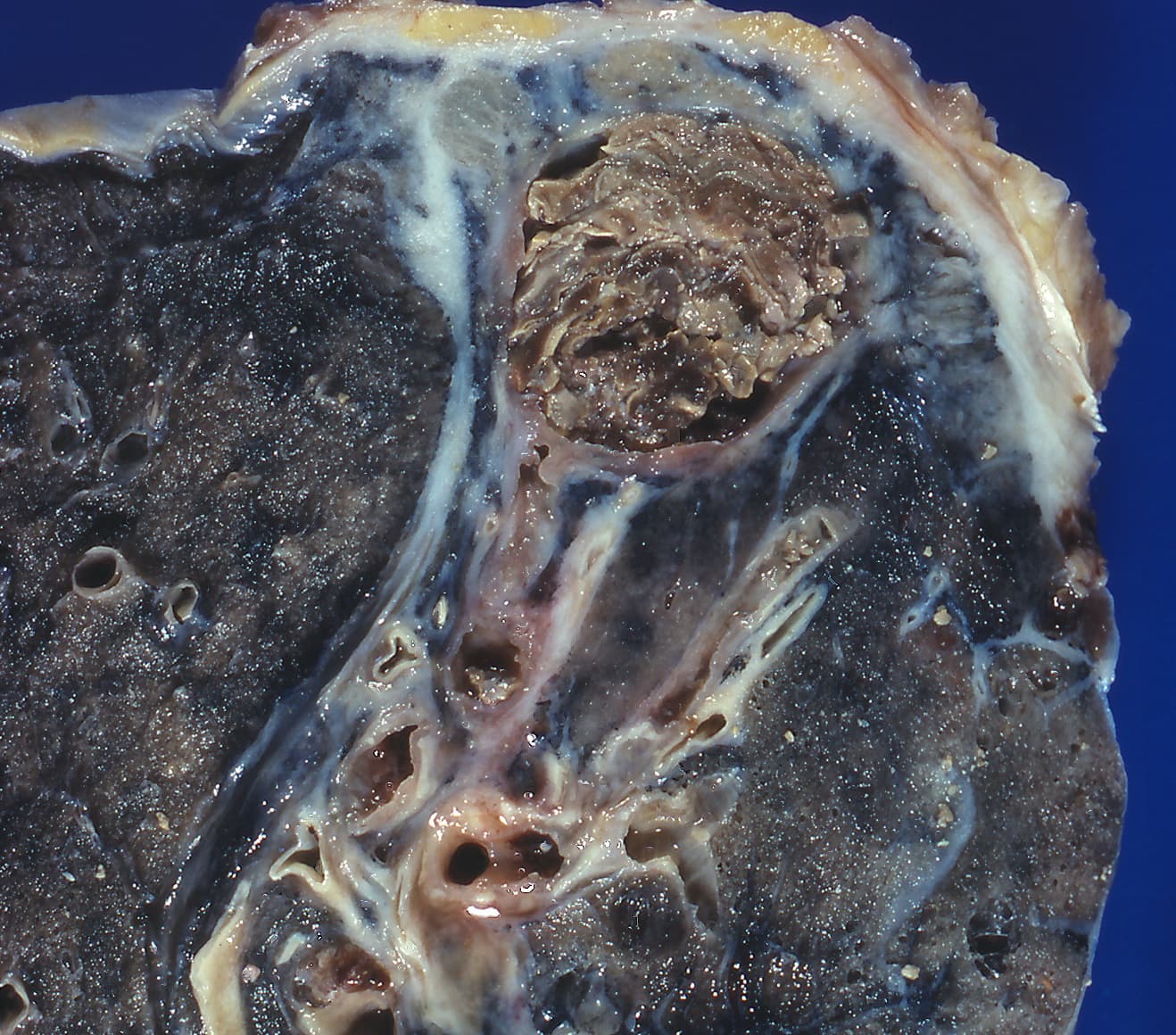
Chest CT demonstrated an enlarging thin-walled right upper lobe cavity containing a dependent rounded soft-tissue mass surrounded by a crescent of air (air-crescent sign), with adjacent pleural thickening and a new second cavity. Pictured: gross pathology of a pulmonary aspergilloma (fungal ball) lying free within an old tuberculous cavity — the pathologic correlate of the air-crescent sign. Image: Dr. Yale Rosen, Atlas of Pulmonary Pathology. CC BY-SA 2.0.
Three sputum fungal cultures grow Aspergillus fumigatus. Serum Aspergillus-specific IgG (precipitins) returns strongly positive. Serum 1,3-beta-D-glucan is 92 pg/mL (indeterminate). Repeat sputum AFB smear and mycobacterial culture remain negative at six weeks.
Question 1
Which diagnosis best unifies the chronic weight loss, hemoptysis, the intracavitary mass, and the laboratory findings?
Select one answer to view the rationale and peer response data.
Question 2
Given the clinical picture, which single test most strongly supports the diagnosis of chronic pulmonary aspergillosis?
Select one answer to view the rationale and peer response data.
Question 3
What is the most appropriate initial management for this patient, given the progressive disease and recurrent hemoptysis?
Select one answer to view the rationale and peer response data.
Rationale locked
Answer the question above to reveal the rationale.
Rationale locked
Answer the question above to reveal the rationale.
References
Denning DW, Cadranel J, Beigelman-Aubry C, et al. Chronic pulmonary aspergillosis: rationale and clinical guidelines for diagnosis and management. European Respiratory Journal. 2016;47(1):45-68.
World Health Organization. WHO guide for the diagnosis and management of chronic pulmonary aspergillosis. Geneva: World Health Organization; 2024.
Evans TJ, Lawal A, Kosmidis C, Denning DW. Chronic Pulmonary Aspergillosis: Clinical Presentation and Management. Seminars in Respiratory and Critical Care Medicine. 2024;45(1):88-101.
Patterson TF, Thompson GR 3rd, Denning DW, et al. Practice Guidelines for the Diagnosis and Management of Aspergillosis: 2016 Update by the Infectious Diseases Society of America. Clinical Infectious Diseases. 2016;63(4):e1-e60.
Denning DW, Pleuvry A, Cole DC. Global burden of chronic pulmonary aspergillosis as a sequel to pulmonary tuberculosis. Bulletin of the World Health Organization. 2011;89(12):864-872.