The Mulberry Wound
Clinical Vignette
A 49-year-old man presents to his primary care physician with a slowly enlarging lesion involving his lips and the inside of his mouth that he first noticed four months ago. He was born and raised in the Andean foothills of Mérida state, Venezuela, where he worked as a coffee farmer for more than twenty years, with daily exposure to moist soil and decaying vegetation. He immigrated to California eight months ago.
He reports fatigue, drenching night sweats, and unintentional weight loss of approximately 9 kg over the preceding five months, along with intermittent low-grade fevers. He has no cough, hemoptysis, or dyspnea. He denies HIV risk factors; a fourth-generation HIV antigen-antibody test returns negative. He takes no medications, has no known immunodeficiency, and does not use tobacco or alcohol.
On examination, temperature is 37.8°C and remaining vital signs are normal. The lips and oral mucosa demonstrate a painless, granular, vegetating ulceration with a distinctive mulberry-like surface punctuated by small hemorrhagic dots, shown below. Bilateral submandibular and cervical lymph nodes are palpable and firm. Chest auscultation reveals diminished breath sounds bilaterally at the bases.
Chest radiography shows bilateral interstitial and nodular infiltrates distributed predominantly in the perihilar and lower lung zones, sparing the apices and costophrenic angles. A biopsy of the oral lesion is performed; Grocott methenamine silver staining reveals large yeast forms measuring 15 to 30 μm in diameter, each bearing multiple peripheral buds attached by narrow necks in a pattern resembling a pilot wheel.
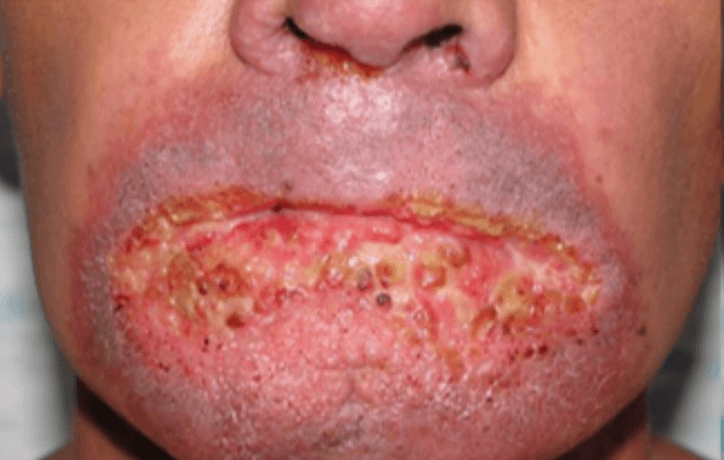
Oral mucosal lesion (moriform stomatitis)
Question 1
Which organism is responsible for this patient's presentation?
Select one answer to view the rationale and peer response data.
Question 2
There is no evidence of CNS or adrenal involvement and his clinical status is stable. Which treatment is most appropriate?
Select one answer to view the rationale and peer response data.
Rationale locked
Answer the question above to reveal the rationale.
Rationale locked
Answer the question above to reveal the rationale.
References
Shikanai-Yasuda MA, Mendes RP, Colombo AL, et al. Brazilian guidelines for the clinical management of paracoccidioidomycosis. Revista da Sociedade Brasileira de Medicina Tropical. 2017;50(5):715–740.
Shikanai-Yasuda et al.: Brazilian Guidelines for Paracoccidioidomycosis (2017)
Queiroz-Telles F, Fahal AH, Falci DR, Caceres DH, Chiller T, Pasqualotto AC. Neglected endemic mycoses. The Lancet Infectious Diseases. 2017;17(11):e367–e377.
Queiroz-Telles et al.: Neglected Endemic Mycoses (Lancet ID 2017)
Colombo AL, Tobón A, Restrepo A, Queiroz-Telles F, Nucci M. Epidemiology of endemic systemic fungal infections in Latin America. Medical Mycology. 2011;49(8):785–798.
Colombo et al.: Epidemiology of Endemic Mycoses in Latin America (2011)
Martinez R. Paracoccidioidomycosis: the dimorphic fungus Paracoccidioides brasiliensis and host-pathogen interactions. In: Bennett JE, Dolin R, Blaser MJ, eds. Mandell, Douglas, and Bennett's Principles and Practice of Infectious Diseases. 10th ed. Elsevier; 2026.