Positive, But Wrong
Clinical Vignette
A 44-year-old man with acute myeloid leukemia presents on day 28 following allogeneic hematopoietic stem cell transplantation with persistent fever despite five days of piperacillin-tazobactam and vancomycin. He underwent myeloablative conditioning with busulfan and fludarabine and received a matched unrelated donor graft. Tacrolimus and methotrexate are in use for graft-versus-host disease prophylaxis. He has remained profoundly neutropenic with an absolute neutrophil count of 80 cells/μL.
Over the past 48 hours he has developed multiple skin lesions: firm, erythematous papules 3 to 8 mm in diameter scattered across his trunk and proximal extremities, several with a central umbilication and pale necrotic center. He reports no pain at the sites. Two sets of blood cultures obtained at the onset of fever are still without growth at 72 hours. Serum (1→3)-β-D-glucan is 480 pg/mL (reference: less than 80 pg/mL). Serum cryptococcal antigen by lateral flow assay (IMMY CrAg LFA) returns positive at a titer of 1:8.
The team considers starting empiric liposomal amphotericin B for presumed cryptococcosis. On examination, the patient is febrile to 39.2°C, heart rate 104 bpm, and blood pressure 108/66 mmHg. He is alert and oriented. No meningismus is present. The skin lesions are as described, without fluctuance. There is no hepatosplenomegaly. CT of the chest, abdomen, and pelvis shows no pulmonary nodules and no hepatic or splenic lesions. Chest X-ray is unremarkable.
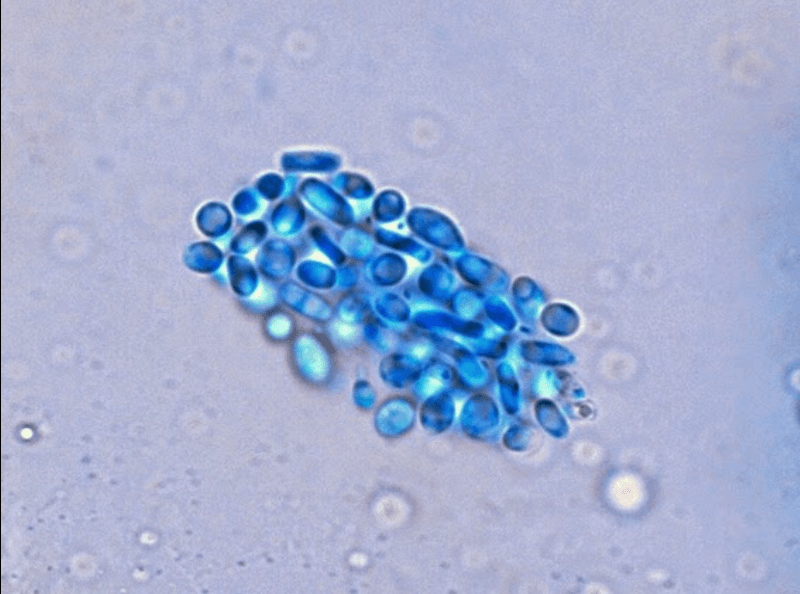
Trichosporon asahii on Sabouraud dextrose agar: white, dry, cerebriform colony. Microscopy reveals hyaline hyphae, pseudohyphae, barrel-shaped arthroconidia, and blastoconidia.
Question 1
The team is considering empiric treatment for Cryptococcus based on the positive CrAg. What is the most important next step before initiating antifungal therapy?
Select one option to submit your answer and view live poll results.
Question 2
Skin biopsy is performed. Histology shows hyaline septate hyphae, pseudohyphae, and barrel-shaped arthroconidia. Culture of the biopsy specimen and a repeat blood culture both grow the same organism. What is the best explanation for the positive serum CrAg?
Select one option to submit your answer and view live poll results.
Question 3
What is the treatment of choice?
Select one option to submit your answer and view live poll results.
References
Ruan SY, Chien JY, Hsueh PR. Invasive trichosporonosis caused by Trichosporon asahii and other unusual Trichosporon species at a medical center in Taiwan. Clinical Infectious Diseases. 2009;49(1):e11-e17.
Chagas-Neto TC, Chaves GM, Melo AS, Colombo AL. Bloodstream infections due to Trichosporon spp.: species distribution, Trichosporon asahii genotypes determined on the basis of ribosomal DNA intergenic spacer 1 sequencing, and antifungal susceptibility testing. Journal of Clinical Microbiology. 2009;47(4):1074-1081.
Liao Y, et al. Trichosporon asahii: a review of the literature on molecular characterization of the fungus and antifungal treatment. Mycopathologia. 2019;184(4):449-456.
Fonseca BO, et al. Cryptococcal antigen cross-reactivity with Trichosporon species: a systematic review. Medical Mycology. 2022.