The Right Lower Quadrant in the Wrong White Count
Clinical Vignette
A 59-year-old woman with metastatic poorly differentiated neuroendocrine carcinoma of the pancreas is on day 12 after cycle 2 of cisplatin and etoposide. Her course has been complicated by febrile neutropenia, and empiric cefepime monotherapy was started 48 hours ago when she first spiked a fever; blood cultures drawn at that time remain negative. She had been afebrile for a day, but overnight she developed worsening crampy abdominal pain that has localized to the right lower quadrant, along with six episodes of non-bloody diarrhea and new nausea. She has no vomiting, no recent antibiotic exposure beyond the chemotherapy and cefepime, and no sick contacts.
On examination she is ill-appearing. Temperature 38.9 °C, heart rate 112, blood pressure 104/64 mmHg, respiratory rate 20. The abdomen is soft but markedly tender in the right lower quadrant with voluntary guarding; there is no rigidity and no rebound. Bowel sounds are hypoactive. Laboratory studies: WBC 0.4 k/mcL with an absolute neutrophil count of 180 cells/mcL, hemoglobin 9.8 g/dL, platelets 42 k/mcL, serum creatinine 1.1 mg/dL, lactate 2.1 mmol/L. A stool Clostridioides difficile nucleic acid amplification test is negative. Blood cultures are redrawn.
Because she remains febrile on cefepime and has developed focal right lower quadrant tenderness during profound neutropenia, a contrast-enhanced CT of the abdomen and pelvis is performed. It demonstrates marked circumferential wall thickening of the cecum and terminal ileum measuring up to 14 mm, surrounding peri-cecal fat stranding, and curvilinear foci of gas within the dependent cecal wall consistent with pneumatosis intestinalis. There is no portomesenteric venous gas and no free intraperitoneal air or fluid. The appendix is separately identified and normal. The imaging is shown below.
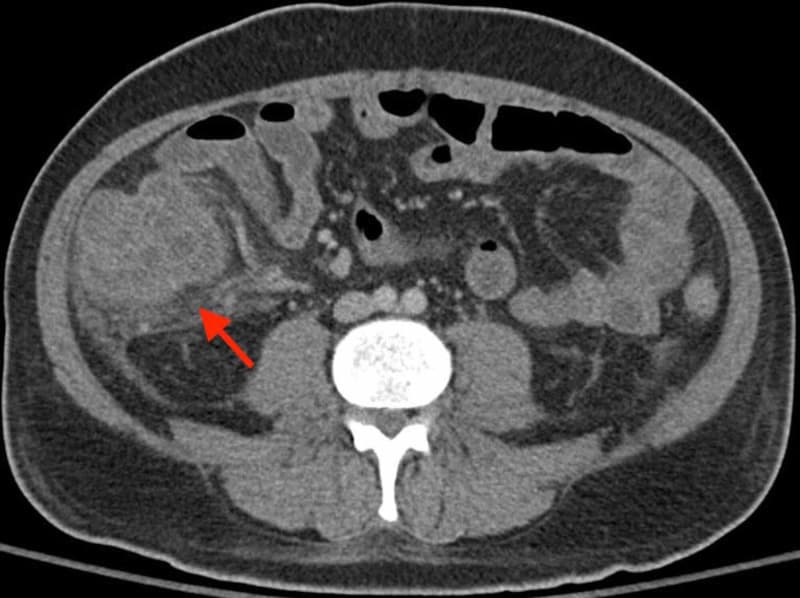
Axial contrast-enhanced CT of the abdomen: marked circumferential wall thickening of the cecum and right hemicolon with peri-colonic inflammatory stranding — the hallmark imaging pattern of neutropenic enterocolitis (typhlitis).
Question 1
In this profoundly neutropenic patient on chemotherapy, what is the most likely diagnosis?
Select one option to submit your answer and view live poll results.
Question 2
Which statement best describes the microbiology and evaluation of this condition?
Select one option to submit your answer and view live poll results.
Question 3
The patient remains febrile with worsening right lower quadrant pain on cefepime. What is the most appropriate change in her antimicrobial and overall management?
Select one option to submit your answer and view live poll results.
References
Nesher L, Rolston KV. Neutropenic enterocolitis, a growing concern in the era of widespread use of aggressive chemotherapy. Clinical Infectious Diseases. 2013;56(5):711-717.
Freifeld AG, Bow EJ, Sepkowitz KA, et al. Clinical practice guideline for the use of antimicrobial agents in neutropenic patients with cancer: 2010 update by the Infectious Diseases Society of America. Clinical Infectious Diseases. 2011;52(4):e56-e93.
Rodrigues FG, Dasilva G, Wexner SD. Neutropenic enterocolitis. World Journal of Gastroenterology. 2017;23(1):42-47.
King A, Rampling A, Wight DG, et al. Neutropenic enterocolitis due to Clostridium septicum infection. Journal of Clinical Pathology. 1984;37(3):335-343.
Groudan K, Ready A, Sabir R. Neutropenic enterocolitis complicating induction chemotherapy in an acute myeloid leukemia patient. Cureus. 2021;13(1):e13029. [CT figure source — CC BY.]