The Nodules Before the Headache
Clinical Vignette
A 58-year-old woman with end-stage kidney disease secondary to hypertensive nephrosclerosis underwent deceased-donor kidney transplantation six months ago. Her baseline immunosuppression includes tacrolimus 3 mg twice daily (trough 6.2 ng/mL at last check), mycophenolate mofetil 1000 mg twice daily, and prednisone 5 mg daily. Six weeks ago, a surveillance biopsy showed Banff grade IB acute cellular rejection, treated with three days of intravenous methylprednisolone 500 mg daily. Her creatinine improved from 2.1 to 1.5 mg/dL and she was discharged on her prior oral regimen.
Twelve days ago she developed right-sided pleuritic chest pain, a dry cough, and low-grade fevers to 38.2 C. She attributed the symptoms to a viral illness and did not seek care. Over the next week the fevers continued, fatigue worsened, and she noticed mild dyspnea climbing stairs. Two days ago she developed a new frontal headache that woke her from sleep, accompanied by difficulty concentrating and word-finding pauses during conversation. Her husband noted she seemed confused about the date.
In the emergency department her temperature is 38.6 C, heart rate 96/min, blood pressure 142/88 mmHg, respiratory rate 20/min, and oxygen saturation 94% on room air. She is alert but mildly disoriented to time. There are fine crackles at the right base. No focal motor deficits are present, but she pauses mid-sentence and occasionally substitutes incorrect words. Neck is supple. There is no skin rash.
Laboratory studies show white blood cells 11.4 x 10^3/uL with 78% neutrophils, hemoglobin 10.8 g/dL, platelets 198 x 10^3/uL, creatinine 1.7 mg/dL (up from 1.5 mg/dL baseline), and C-reactive protein 12.4 mg/dL. Tacrolimus trough is 8.4 ng/mL (elevated from her usual 6 to 7). Serum galactomannan returns at 0.3 optical density index (negative cutoff less than 0.5). 1,3-beta-D-glucan is pending. Blood cultures show no growth at 48 hours.
Chest CT reveals multiple bilateral peripheral nodules ranging from 0.8 to 2.4 cm, at least two of which are cavitary with thin walls, surrounded by rimming ground-glass attenuation. There is no pleural effusion or mediastinal adenopathy. Brain MRI with contrast demonstrates a 1.8-cm ring-enhancing lesion in the right frontal white matter with surrounding vasogenic edema and a second 1.1-cm enhancing lesion in the left cerebellar hemisphere.
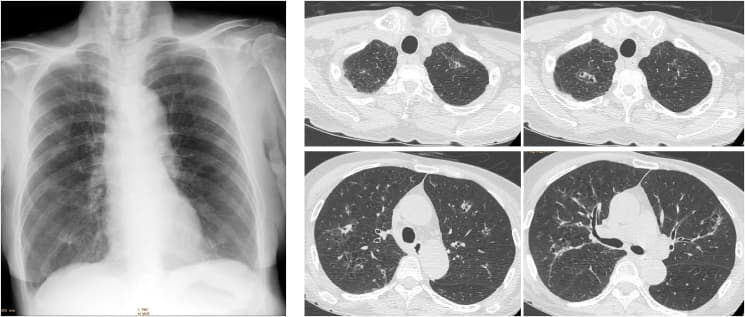
Chest CT showing small thin-walled cavitary nodules surrounded by ground-glass opacity.
Question 1
Which diagnosis most likely unifies the pulmonary nodules and the brain lesions?
Select one option to submit your answer and view live poll results.
Question 2
Serum galactomannan is negative at 0.3 ODI. Which diagnostic step is most likely to establish the diagnosis?
Select one option to submit your answer and view live poll results.
Question 3
BAL galactomannan returns at 3.2 ODI and fungal culture grows Aspergillus fumigatus. Brain MRI confirms the lesions described. Which is the most appropriate initial management?
Select one option to submit your answer and view live poll results.
References
Patterson TF, Thompson GR 3rd, Denning DW, et al. Practice guidelines for the diagnosis and management of aspergillosis: 2016 update by the Infectious Diseases Society of America. Clinical Infectious Diseases. 2016;63(4):e1-e60.
Herbrecht R, Denning DW, Patterson TF, et al. Voriconazole versus amphotericin B for primary therapy of invasive aspergillosis. New England Journal of Medicine. 2002;347(6):408-415.
Pappas PG, Alexander BD, Andes DR, et al. Invasive fungal infections among organ transplant recipients: results of the Transplant-Associated Infection Surveillance Network (TRANSNET). Clinical Infectious Diseases. 2010;50(8):1101-1111.
Singh N, Paterson DL. Aspergillus infections in transplant recipients. Clinical Microbiology Reviews. 2005;18(1):44-69.
Maertens JA, Rahav G, Lee DG, et al. Posaconazole versus voriconazole for primary treatment of invasive aspergillosis: a phase 3, randomised, controlled, double-blind trial. The Lancet. 2021;397(10273):464-473.
Pfeiffer CD, Fine JP, Safdar N. Diagnosis of invasive aspergillosis using a galactomannan assay: a meta-analysis. Clinical Infectious Diseases. 2006;42(10):1417-1427.
Ihori A, Watanabe T, Yamashita T, et al. Multiple cavities with halo sign in a case of invasive pulmonary aspergillosis during therapy for drug-induced hypersensitivity syndrome. Respiratory Medicine Case Reports. 2017;21:124-128.