The Negative CrAg
Clinical Vignette
A 52-year-old man with newly diagnosed acute myeloid leukemia is admitted 28 days ago for induction chemotherapy with cytarabine and daunorubicin. He developed profound neutropenia with an absolute neutrophil count below 100 cells/μL lasting 18 days. On day 14 of neutropenia, two sets of blood cultures grew Candida tropicalis, later confirmed susceptible to fluconazole (MIC 0.5 mcg/mL), micafungin, and amphotericin B. Micafungin 100 mg IV daily was started, the tunneled central venous catheter was removed, and repeat blood cultures cleared by day 17. He received filgrastim and achieved neutrophil recovery on hospital day 23 with an ANC of 1,200.
Five days after neutrophil recovery, on hospital day 28, he develops a new fever to 39.2°C, severe holocranial headache, photophobia, and progressive confusion. He is oriented to person but not to place or date and cannot recall his hematologist's name. He reports nausea without vomiting. There is no cough, dysuria, diarrhea, or new skin rash. The oncology team obtains blood cultures, starts vancomycin and meropenem empirically, and consults neurology and infectious diseases.
On examination, temperature is 39.2°C, heart rate 104 bpm, blood pressure 112/68 mmHg, and oxygen saturation 97% on room air. He is alert but confused, oriented only to person. Nuchal rigidity is present with positive Kernig and Brudzinski signs. Right cranial nerve VI palsy is noted with inability to abduct the right eye. Motor strength is 5/5 throughout, and sensory examination is intact. There are no skin lesions, no oral thrush, and no retinal lesions on bedside fundoscopy. White blood cell count is 4,200/μL (ANC 1,800, lymphocytes 1,400), hemoglobin 8.1 g/dL, platelet count 42,000/μL, CRP 88 mg/L, and creatinine 1.1 mg/dL. Serum (1,3)-beta-D-glucan returns at >500 pg/mL (positive, cutoff 80 pg/mL). Two sets of blood cultures show no growth at 48 hours.
Lumbar puncture reveals an opening pressure of 28 cm H₂O. CSF analysis shows WBC 185/μL (72% lymphocytes, 18% neutrophils, 10% monocytes), RBC 12/μL, protein 124 mg/dL, and glucose 28 mg/dL (simultaneous serum glucose 104 mg/dL). CSF Gram stain shows no organisms. CSF India ink preparation is negative. CSF cryptococcal antigen lateral flow assay is negative. CSF bacterial culture shows no growth at 48 hours. CSF fungal culture is pending. MRI brain with gadolinium contrast is performed.
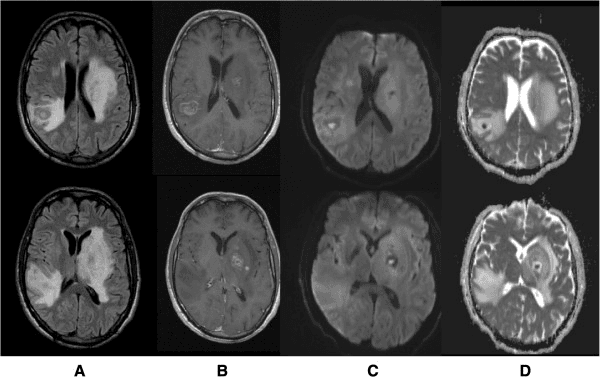
Brain MRI showing multiple rounded ring-enhancing lesions in the basal ganglia and right parietal white matter, with fungal abscess morphology in confirmed cerebral candidiasis. Image: Neves N et al., BMC Res Notes 2014;7:837 (doi:10.1186/1756-0500-7-837), CC-BY 4.0.
Question 1
Given the clinical presentation, CSF findings, negative cryptococcal antigen, and MRI, what is the most likely diagnosis?
Select one option to submit your answer and view live poll results.
Question 2
The patient was receiving micafungin 100 mg IV daily at the time meningitis developed, and blood cultures had cleared. Which statement best explains why this regimen failed to prevent CNS involvement?
Select one option to submit your answer and view live poll results.
Question 3
CSF fungal culture grows Candida tropicalis (fluconazole MIC 0.5 mcg/mL, susceptible). What is the most appropriate antifungal regimen?
Select one option to submit your answer and view live poll results.
References
Pappas PG, Kauffman CA, Andes DR, Clancy CJ, Marr KA, Ostrosky-Zeichner L, et al. Clinical Practice Guideline for the Management of Candidiasis: 2016 Update by the Infectious Diseases Society of America. Clinical Infectious Diseases. 2016;62(4):e1-50.
Pappas PG, Lionakis MS, Arendrup MC, Ostrosky-Zeichner L, Kullberg BJ. Invasive candidiasis. Nature Reviews Disease Primers. 2018;4:18026.
Góralska K, Blaszkowska J, Dzikowiec M. Neuroinfections caused by fungi — a review. Infection. 2018;46(4):443-459.
Sigera LSM, Denning DW. Flucytosine (5-FC) and its clinical usage. Therapeutic Advances in Infectious Disease. 2023;10:20499361231161387.
Davis C, Wheat LJ, Myint T, Barros S, Bamberger DM, Spec A, et al. Efficacy of Cerebrospinal Fluid Beta-d-Glucan Diagnostic Testing for Fungal Meningitis: a Systematic Review. Journal of Clinical Microbiology. 2020;58(4):e02094-19.
Snarr BD, Drummond RA, Lionakis MS. It's all in your head: antifungal immunity in the brain. Current Opinion in Microbiology. 2020;58:41-46.