The Summer Temporal Lobe Trap
Clinical Vignette
A 17-year-old previously healthy boy is brought to the emergency department in late July after a witnessed focal seizure at home. Four days earlier he developed fever, bifrontal headache, repeated emesis, malaise, and increasing somnolence. He lives in rural western North Carolina and has spent the past two weekends helping his uncle clear brush around a wooded property, including hauling out several water-filled discarded tires. He recalls frequent daytime mosquito bites while working near the tree line. He has not traveled outside the state, denies tick attachment, and has had no freshwater exposure, rash, or sick contacts.
On the day of admission, his mother noticed that he was answering questions slowly and searching for words. Minutes later he had rightward head deviation followed by rhythmic clonic jerking of the right arm and face that generalized secondarily and lasted approximately 90 seconds. In the emergency department his temperature is 39.3 C, heart rate 118/min, blood pressure 132/78 mmHg, respiratory rate 20/min, and oxygen saturation 98% on room air. He is lethargic but arousable, oriented only to name, and has sparse speech with mild expressive aphasia. Neck is supple. There is no rash, conjunctivitis, or focal weakness.
Laboratory studies show white blood cells 12.6 x 10^3/uL, hemoglobin 14.1 g/dL, platelets 228 x 10^3/uL, sodium 129 mEq/L, creatinine 0.8 mg/dL, AST 24 U/L, and ALT 19 U/L. MRI of the brain demonstrates subtle bilateral frontotemporal T2/FLAIR hyperintensity without abscess, hemorrhage, or ring enhancement. Continuous EEG reveals left temporal periodic lateralized epileptiform discharges. Lumbar puncture yields an opening pressure of 235 mmH2O, cerebrospinal fluid white blood cells 118/mm3 (86% lymphocytes), protein 72 mg/dL, and glucose 64 mg/dL with a simultaneous serum glucose of 101 mg/dL. CSF Gram stain is negative.
Empiric acyclovir, ceftriaxone, and vancomycin are started. The CSF meningitis-encephalitis PCR panel returns negative, including HSV-1, HSV-2, VZV, and enterovirus. Because the combination of geography, season, seizure-predominant encephalitis, and temporal-lobe EEG abnormalities remains unexplained, additional arboviral testing is pursued.
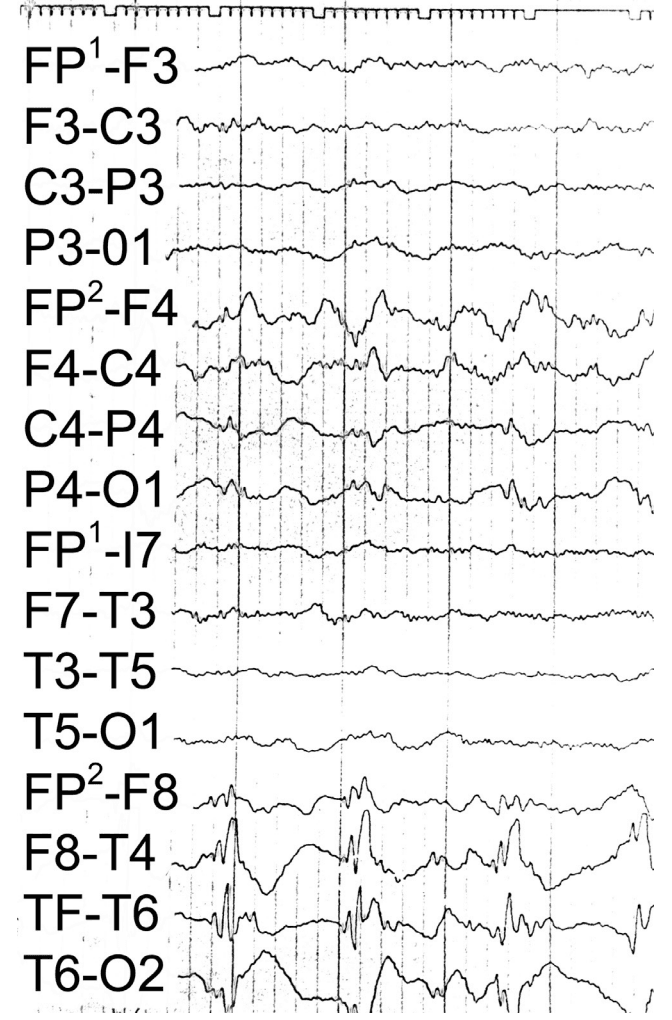
EEG demonstrating left temporal periodic lateralized epileptiform discharges.
Question 1
What is the most likely diagnosis?
Select one option to submit your answer and view live poll results.
Question 2
Which diagnostic approach is most appropriate to confirm this suspected etiology in this immunocompetent patient?
Select one option to submit your answer and view live poll results.
Question 3
Which in-hospital development should most increase concern for impending clinical deterioration and need for intensified neurocritical supportive care?
Select one option to submit your answer and view live poll results.
References
McJunkin JE, de los Reyes EC, Irazuzta JE, et al. La Crosse encephalitis in children. New England Journal of Medicine. 2001;344(11):801-807.
de los Reyes EC, McJunkin JE, Glauser TA, Tomsho M, O'Neal J. Periodic lateralized epileptiform discharges in La Crosse encephalitis, a worrisome subgroup: clinical presentation, electroencephalogram patterns, and long-term neurologic outcome. Journal of Child Neurology. 2008;23(2):167-172.
Sokol DK, Kleiman MB, Garg BP. LaCrosse viral encephalitis mimics herpes simplex viral encephalitis. Pediatric Neurology. 2001;25(5):413-415.
Centers for Disease Control and Prevention. Clinical signs and symptoms of La Crosse virus disease. Updated May 15, 2024.
Centers for Disease Control and Prevention. Clinical testing and diagnosis for La Crosse virus disease. Updated Nov 19, 2025.