Undercooked
Clinical Vignette
A 26-year-old veterinary technician presents with three weeks of low-grade fevers, fatigue, and progressive swelling on both sides of her neck. She reports temperatures to 38.3 °C each evening, generalized myalgias, and a 2.7 kg weight loss despite a stable appetite. She denies sore throat, rash, night sweats, cough, and genital symptoms. Her past medical history is notable only for mild persistent asthma managed with an albuterol inhaler. She takes no other medications and has no known allergies. She was born in the United States and has not traveled internationally in the past two years.
She owns two indoor-outdoor cats and estimates she has prepared steak tartare at home roughly once per week for the past year, using commercially sourced beef. She does not consume unpasteurized dairy products, does not hunt or eat wild game, and has no occupational needlestick or animal-bite exposures. She is sexually active with one male partner and uses oral contraceptives. Her last menstrual period was nine days ago.
On examination, temperature is 37.9 °C, heart rate 88 beats per minute, blood pressure 118/74 mmHg, respiratory rate 14 breaths per minute, and oxygen saturation 99% on room air. The oropharynx is clear without exudate or petechiae. Bilateral posterior cervical lymph nodes are palpable, measuring 2 to 3 cm each, firm, mobile, and non-tender. No axillary or inguinal lymphadenopathy is appreciated. The abdomen is soft and non-tender with no hepatosplenomegaly. Skin examination is unremarkable without rash, eschar, or inoculation lesion. The remainder of the examination is normal.
Laboratory studies show a white blood cell count of 6.8 x 10³/uL with 48% neutrophils, 40% lymphocytes, 9% monocytes, and 3% eosinophils. No atypical lymphocytes are identified on the peripheral smear. Hemoglobin is 13.4 g/dL and platelet count is 228 x 103/uL. Comprehensive metabolic panel is notable for an AST of 68 U/L and ALT of 72 U/L; the remaining values are within normal limits. Erythrocyte sedimentation rate is 32 mm/hr. A heterophile antibody test (Monospot) is negative. EBV viral capsid antigen IgM is negative and IgG is positive, consistent with prior remote infection. CMV IgM is negative. HIV fourth-generation antigen-antibody combination test is negative. Blood cultures show no growth at five days. Toxoplasma gondii IgM is reported as positive and Toxoplasma IgG is positive at 8.4 IU/mL (reference less than 1.1 IU/mL). Contrast-enhanced CT of the neck is performed.
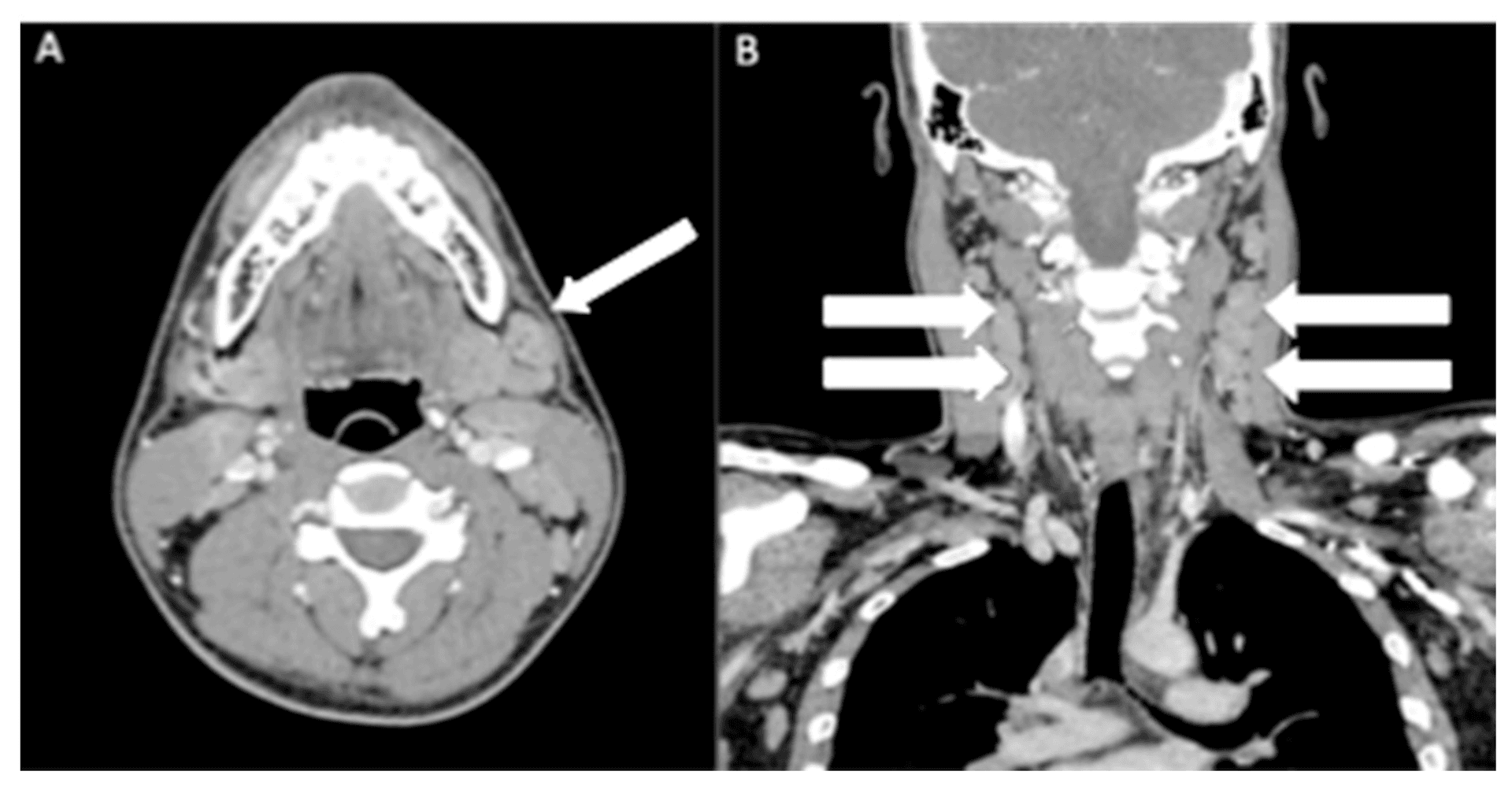
Contrast-enhanced CT of the neck, axial and coronal planes, demonstrating bilateral cervical lymphadenopathy (arrows). Image adapted from Leong et al., Diagnostics 2023; CC BY 4.0.
Question 1
Given the clinical presentation and initial laboratory results, which of the following is the most likely diagnosis?
Select one option to submit your answer and view live poll results.
Question 2
Serology returns positive Toxoplasma IgM and positive IgG. Which additional test best confirms that this represents a recently acquired infection rather than a past exposure?
Select one option to submit your answer and view live poll results.
Question 3
IgG avidity returns low, confirming recent acquisition. The patient's symptoms are moderately bothersome but she has no evidence of chorioretinitis, myocarditis, pneumonitis, or other organ involvement. She is not pregnant. Which of the following is the most appropriate management?
Select one option to submit your answer and view live poll results.
References
Montoya JG, Liesenfeld O. Toxoplasmosis. Lancet. 2004;363(9425):1965-1976.
Robert-Gangneux F, Dardé ML. Epidemiology of and diagnostic strategies for toxoplasmosis. Clin Microbiol Rev. 2012;25(2):264-296.
Garnaud C, Fricker-Hidalgo H, Brenier-Pinchart MP, Pelloux H. Toxoplasma gondii-specific IgG avidity testing in pregnant women. Clin Microbiol Infect. 2020;26(9):1155-1160.
Hurt C, Tammaro D. Diagnostic evaluation of mononucleosis-like illnesses. Am J Med. 2007;120(10):911.e1-911.e8.
Jones JL, Dargelas V, Roberts J, et al. Foodborne toxoplasmosis. Clin Infect Dis. 2012;55(6):845-851.