The Nerve Below the Surface
Clinical Vignette
A 38-year-old man originally from rural Maharashtra, India, presents to a neurology clinic in Houston with eight months of progressive right foot weakness and left hand numbness. He has lived in the United States for five years and works as a software engineer. He has no significant past medical history, takes no medications, and does not use tobacco or alcohol. He was born and raised in a village near Nagpur where several neighbors were known to have chronic skin disease, though he never received a formal diagnosis himself. He recalls no rashes, skin patches, or nodules at any point in his life.
The right foot weakness began as occasional tripping on curbs and progressed to catching his toes on stairs and frequent near-falls. He can no longer walk on his right heel. Concurrently, he developed numbness in the left little finger and half of the ring finger, with dropping objects and difficulty buttoning shirts. He also reports intermittent burning pain in both feet that worsens at night. He denies back pain, bowel or bladder dysfunction, fevers, weight loss, rash, or skin changes. His primary care physician obtained a complete blood count, comprehensive metabolic panel, hemoglobin A1c, thyroid-stimulating hormone, and vitamin B12 level, all of which were normal, and referred him to neurology.
On examination, right foot dorsiflexion is 3/5 and eversion is 3+/5. Left first dorsal interosseous and abductor digiti minimi strength is 4-/5. Sensory testing reveals decreased pinprick sensation in the right lateral leg and dorsum of the foot in an L5 distribution and in the left little finger and medial half of the ring finger in an ulnar distribution. Bilateral ulnar nerves are palpably thickened and mildly tender at the olecranon grooves. The right common peroneal nerve is palpably enlarged behind the fibular head. No hypopigmented patches, erythematous plaques, nodules, or skin lesions are found on full-body skin examination. The remainder of the neurological examination is normal, with no upper motor neuron signs, no cranial nerve deficits, and no detectable sensory level. Laboratory studies show ESR 28 mm/hr, CRP 12 mg/L, ANA negative, ANCA negative, serum protein electrophoresis without monoclonal protein, RPR nonreactive, HIV antigen/antibody negative, fasting glucose 86 mg/dL, and hemoglobin A1c 5.1%. Lumbar puncture yields clear CSF with protein 38 mg/dL, glucose 62 mg/dL, and 2 white blood cells; oligoclonal bands are absent.
Electromyography and nerve conduction studies demonstrate a mononeuritis multiplex pattern with demyelinating features and secondary axonal loss in the right common peroneal and left ulnar nerves. Sensory nerve action potentials are absent in the right sural and left ulnar distributions. High-resolution nerve ultrasound is performed.
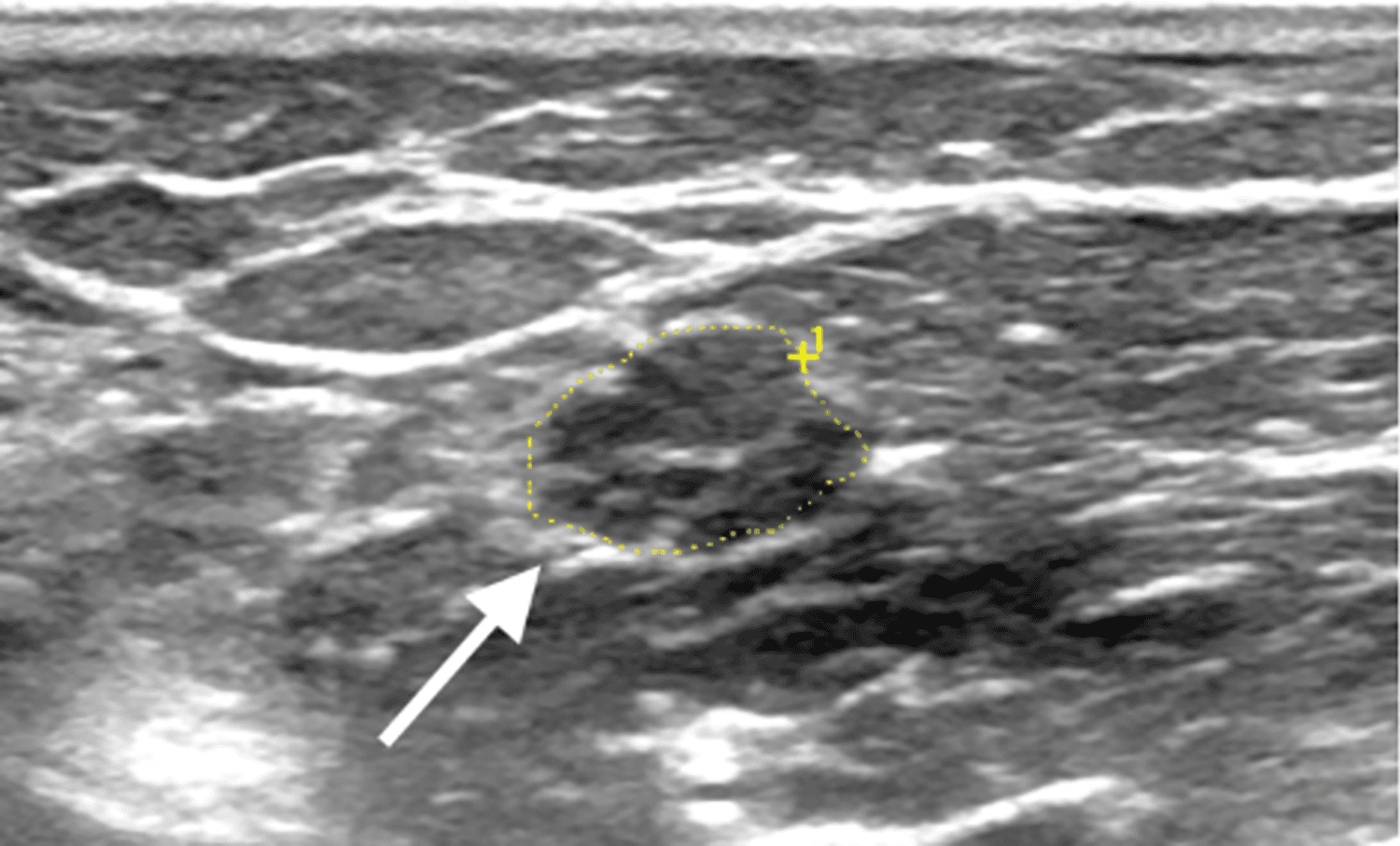
High-resolution ultrasound of the ulnar nerve (transverse view) proximal to the cubital tunnel showing neural thickening and enlarged fascicles in a leprosy patient. Image adapted from De Martino Luppi et al., PLoS ONE (2024), CC BY 4.0.
Question 1
What is the most likely diagnosis?
Select one option to submit your answer and view live poll results.
Question 2
Slit-skin smears obtained from three sites (both earlobes and the forehead) are negative for acid-fast bacilli. Nerve conduction studies confirm the mononeuritis multiplex pattern. What is the most appropriate next diagnostic step?
Select one option to submit your answer and view live poll results.
Question 3
Sural nerve biopsy shows epithelioid non-caseating granulomas within the endoneurium and perineurium with perineurial thickening and rare acid-fast bacilli on Fite-Faraco stain. What is the most appropriate treatment regimen?
Select one option to submit your answer and view live poll results.
References
Shukla B, Verma R, Kumar V, Kumar M, Malhotra KP, Garg RK, et al. Pathological, ultrasonographic, and electrophysiological characterization of clinically diagnosed cases of pure neuritic leprosy. Journal of the Peripheral Nervous System. 2020;25(2):154-163.
Roy U, Panwar A, Cartwright MS, Srivastava AK, Mukherjee B, Vaibhaw H, et al. High resolution nerve ultrasound in the diagnosis of pure neuritic leprosy. Journal of Clinical Ultrasound. 2025;53(6):748-757.
Jardim MR, Illarramendi X, Nascimento OJM, Nery JAC, Sales AM, Sampaio EP, Sarno EN. Pure neural leprosy: steroids prevent neuropathy progression. Arquivos de Neuro-Psiquiatria. 2007;65(4):969-973.
AlOtaibi MK, AlQahtani BG, AlQawahmed RM. Unmasking the mimic: Leprosy neuropathy misdiagnosed as chronic inflammatory demyelinating polyneuropathy. Neurosciences. 2025;30(2):128-131.
Hui M, Uppin MS, Challa S, Meena AK, Kaul S. Pure neuritic leprosy: resolving diagnostic issues in acid fast bacilli (AFB)-negative nerve biopsies. Annals of Indian Academy of Neurology. 2015;18(3):306-312.
Razdan N, V B, Sadhu S. Pure neuritic leprosy: latest advancements and diagnostic modalities. Diagnostic Microbiology and Infectious Disease. 2024;100(4):116529.