The Water Was Warm
Clinical Vignette
A previously healthy 28-year-old man presents to a Texas emergency department in late July with two days of severe frontal headache, fever to 40.2 C, nausea, and three episodes of vomiting. This morning he developed worsening confusion and his wife noticed he was no longer able to identify familiar smells. He swam in a warm, stagnant lake four days ago while on a weekend camping trip.
On examination his temperature is 39.8 C, heart rate 118/min, blood pressure 142/88 mmHg, and respiratory rate 20/min. He is lethargic and oriented only to person. Nuchal rigidity and a positive Kernig's sign are present. Cranial nerve examination is otherwise intact, and there are no focal motor deficits. He reports complete loss of smell since yesterday.
Laboratory studies show white blood cells 22.4 x 10^3/uL with 88% neutrophils, sodium 128 mEq/L, glucose 142 mg/dL, creatinine 1.1 mg/dL, and C-reactive protein 84 mg/L. CT head without contrast shows no acute intracranial abnormality. Lumbar puncture reveals an opening pressure of 320 mm H2O. Cerebrospinal fluid analysis shows white blood cells 4,200/uL with 91% neutrophils, 450 red blood cells, glucose 24 mg/dL (serum glucose 142), and protein 410 mg/dL. Gram stain shows no organisms.
Empiric ceftriaxone, vancomycin, and acyclovir are started for presumed bacterial meningitis with HSV encephalitis coverage. Thirty minutes later, the microbiology laboratory calls the clinical team: the technician prepared a wet mount from the patient's fresh, room-temperature CSF and observed several large, slowly motile cells with blunt lobate pseudopods and a prominent central karyosome.
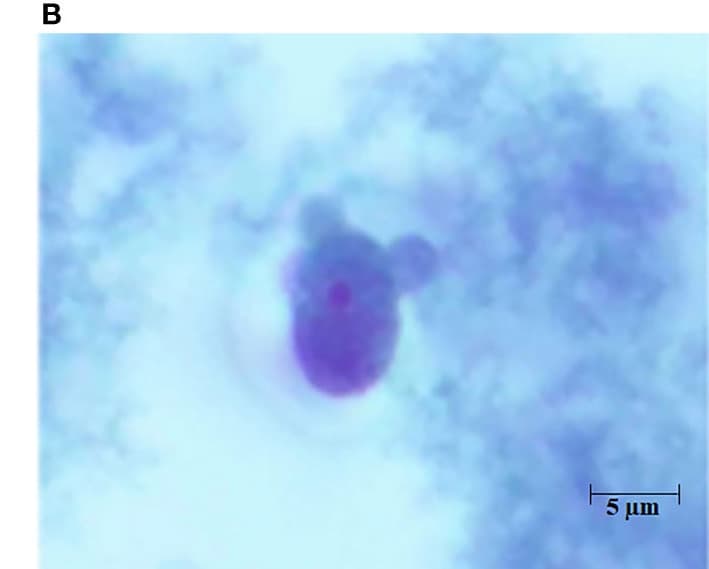
Trichrome-stained cerebrospinal fluid specimen demonstrating trophozoites with lobate pseudopods and a prominent central karyosome. Image from Channoi et al., Frontiers in Cellular and Infection Microbiology, 2022, CC BY 4.0.
Question 1
What is the most likely diagnosis?
Select one option to submit your answer and view live poll results.
Question 2
Which statement about the CSF wet mount finding is most accurate?
Select one option to submit your answer and view live poll results.
Question 3
Which treatment regimen is most appropriate?
Select one option to submit your answer and view live poll results.
References
Gharpure R, Bliton J, Goodman A, Ali IKM, Yoder J, Cope JR. Epidemiology and clinical characteristics of primary amebic meningoencephalitis caused by Naegleria fowleri: a global review. Clinical Infectious Diseases. 2021;73(1):e19-e27.
Centers for Disease Control and Prevention. Naegleria fowleri — clinical care and treatment. Updated November 2025. Available at: https://www.cdc.gov/naegleria/
Channoi T, Sribharat P, Thiptanapoj N, et al. Fatal Naegleria fowleri primary amebic meningoencephalitis in Thailand. Frontiers in Cellular and Infection Microbiology. 2022;12:931546.
Linam WM, Ahmed M, Cope JR, et al. Successful treatment of an adolescent with Naegleria fowleri meningoencephalitis. Pediatrics. 2015;135(3):e744-e748.
Qvarnstrom Y, Visvesvara GS, Sriram R, da Silva AJ. Multiplex real-time PCR assay for simultaneous detection of Acanthamoeba spp., Balamuthia mandrillaris, and Naegleria fowleri. Journal of Clinical Microbiology. 2006;44(10):3589-3595.