The Scarlet Mimic
Clinical Vignette
A 17-year-old high school student presents to urgent care in February with 5 days of worsening sore throat, fever, malaise, and a new rash. He first noticed throat pain and fatigue after a weekend basketball tournament. Two days later he developed fevers to 38.8 C, odynophagia, and tender swelling in the front of his neck. This morning, a fine red rash appeared across his chest and upper arms. Several teammates have had "strep throat" this month.
He has no significant past medical history and takes no medications. He has no known drug allergies. He denies cough, rhinorrhea, conjunctivitis, oral ulcers, genital lesions, abdominal pain, vomiting, diarrhea, or recent travel. He is sexually active with one partner and reports condom use. He has not taken antibiotics.
On examination, temperature is 38.6 C, heart rate 104/min, blood pressure 116/68 mmHg, respiratory rate 16/min, and oxygen saturation 99% on room air. He appears uncomfortable but non-toxic. The tonsils are enlarged with patchy gray-white exudates. The uvula is midline. There is tender bilateral anterior cervical lymphadenopathy. No hepatosplenomegaly is present. Skin examination shows a diffuse, blanching, finely papular erythematous eruption over the trunk, neck, and proximal upper extremities with a sandpaper texture. The palms, soles, and mucous membranes are spared.
A rapid group A streptococcal antigen test is negative, and a group A streptococcal NAAT is also negative. Heterophile antibody testing is negative. Because of the prominent exudative pharyngitis and scarlatiniform rash, a throat culture is sent. After 48 hours, the laboratory reports small beta-hemolytic colonies on sheep blood agar. Gram stain from the colonies shows pleomorphic gram-positive rods and short coccobacillary forms. The organism is catalase negative.
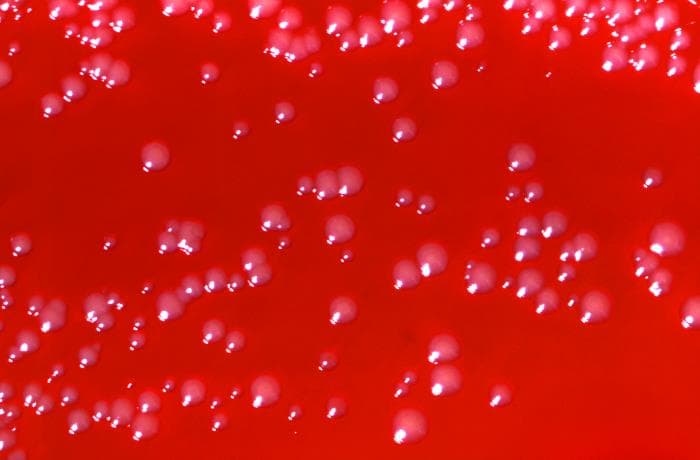
Arcanobacterium haemolyticum on agar plate. Image from CDC PHIL, Public Domain, via Wikimedia Commons.
Question 1
What is the most likely cause of this illness?
Select one answer to view the rationale and peer response data.
Question 2
Which laboratory issue most commonly contributes to missed diagnosis of this organism?
Select one answer to view the rationale and peer response data.
Question 3
The patient remains symptomatic and the culture is reported as Arcanobacterium haemolyticum. Which directed treatment is most appropriate?
Select one answer to view the rationale and peer response data.
Rationale locked
Answer the question above to reveal the rationale.
Rationale locked
Answer the question above to reveal the rationale.
References
Sayad E, Zeid CA, Hajjar RE, et al. The burden of Arcanobacterium haemolyticum pharyngitis: A systematic review and management algorithm. International Journal of Pediatric Otorhinolaryngology. 2021;146:110759.
Gaston DA, Zurowski SM. Arcanobacterium haemolyticum pharyngitis and exanthem. Three case reports and literature review. Archives of Dermatology. 1996;132(1):61-64.
Vu MLD, Rajnik M. Arcanobacterium haemolyticum Infections. StatPearls. Treasure Island (FL): StatPearls Publishing; updated 2024.
Consonni A, Briozzo E, Giubbi C, Tonolo S, Luzzaro F, Mauri C. Insights into Arcanobacterium haemolyticum: A narrative review of an emerging pathogen revisited. Pathogens. 2026;15(3):335.