The Color of the Cure
Clinical Vignette
A 29-year-old man from Manila, Philippines, presents to the drug-resistant tuberculosis clinic for a routine month 4 follow-up. He was diagnosed with pulmonary multidrug-resistant tuberculosis four months ago after presenting with three months of productive cough, night sweats, and a 6-kilogram weight loss. Sputum culture grew Mycobacterium tuberculosis resistant to rifampin and isoniazid and susceptible to fluoroquinolones, aminoglycosides, ethionamide, and clofazimine. Chest radiograph at diagnosis showed bilateral upper lobe cavitary infiltrates with apical pleural thickening. He was started on an all-oral World Health Organization longer regimen consisting of levofloxacin 750 mg daily, bedaquiline 200 mg three times weekly after a two-week daily loading phase, linezolid 600 mg daily, clofazimine 100 mg daily, and cycloserine 500 mg twice daily. His baseline QTc was 410 milliseconds. He has no other medical conditions and takes no other medications.
His tuberculosis treatment is succeeding. By the end of month 2, sputum smears converted from 3+ positivity to negative, and cultures obtained at that time are now finalized as negative. He has gained 5 kilograms, his cough has resolved, and he no longer reports night sweats or fever. He tolerates the regimen without nausea, peripheral neuropathy, or psychiatric symptoms. Linezolid was reduced to 300 mg daily at month 3 after he developed mild distal paresthesias and a platelet count of 118,000 per microliter. The rest of the regimen has been unchanged since initiation.
The reason for today's visit is not his tuberculosis. Over the past six weeks, his family and coworkers have noticed a progressive darkening of his skin. It began as a faint reddish tint on the face and ears and has spread to the neck, trunk, arms, and hands, deepening to a reddish-brown and violaceous hue that prompted a coworker to ask whether he had been bruised. His nails have turned brownish-black. He has developed dry, scaly, flaky skin on both shins and forearms that cracks with minor friction. He also reports a three-week history of intermittent crampy periumbilical abdominal pain with two to three loose stools per day, without blood or fever. He is increasingly distressed about his appearance and asks whether the medication is poisoning him.
On examination, temperature is 36.9 C, heart rate 78/min, blood pressure 118/74 mmHg, and oxygen saturation 98% on room air. The skin shows a diffuse reddish-brown to violaceous discoloration most pronounced on the face, pinnae, neck, and dorsal hands, with relative sparing of the palms and soles. There is no oral mucosal pigmentation, no palmar crease darkening, and no scar hyperpigmentation. Ichthyotic scaling with fine fissures is present on the bilateral anterior shins and volar forearms. The nails of the hands and feet show brownish-gray discoloration. The bulbar conjunctivae have a faint brown tint without injection. The abdomen is soft with mild epigastric tenderness and normal bowel sounds, without guarding, rigidity, or organomegaly. Neurologic examination is intact. Laboratory studies show sodium 138 mEq/L, potassium 4.0 mEq/L, magnesium 1.8 mg/dL, calcium 8.9 mg/dL, blood urea nitrogen 12 mg/dL, creatinine 0.9 mg/dL, AST 28 U/L, ALT 22 U/L, alkaline phosphatase 85 U/L, total bilirubin 0.6 mg/dL, hemoglobin 13.2 g/dL, white blood cell count 6.8 x 10^3/uL with normal differential, and platelet count 145,000/uL. Thyroid-stimulating hormone is 1.8 mIU/L. A morning serum cortisol is 22 mcg/dL with an ACTH of 30 pg/mL. Stool studies including culture, Clostridioides difficile testing, ova and parasites, and fecal leukocytes are negative. An electrocardiogram demonstrates a QTc of 476 milliseconds.
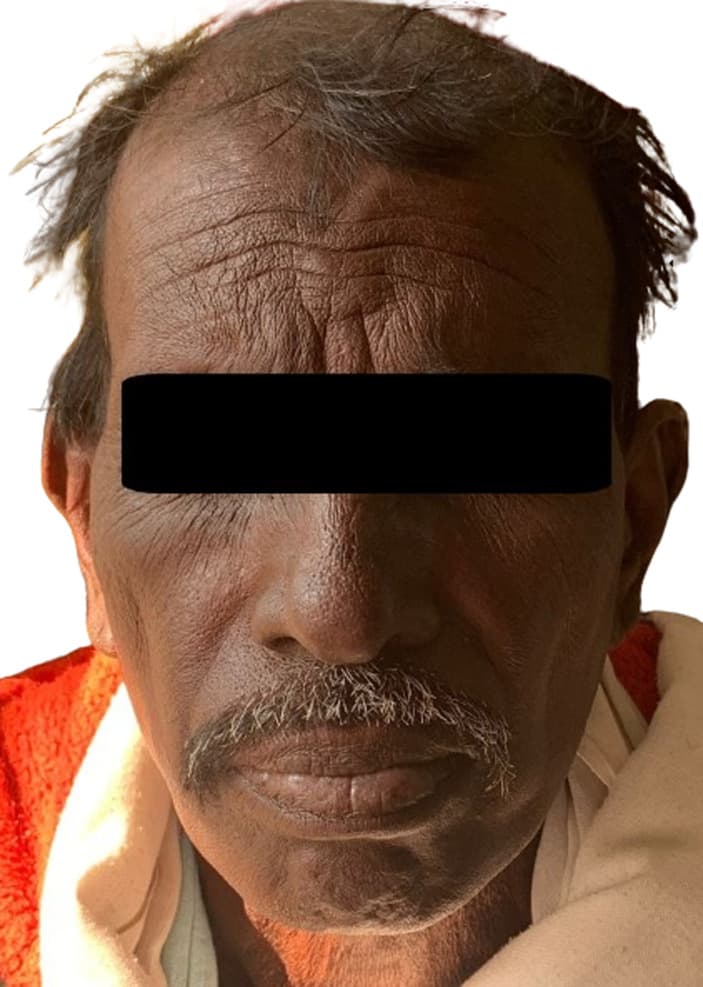
Generalized reddish-brown to black skin hyperpigmentation in a patient receiving clofazimine for multidrug-resistant tuberculosis. Image adapted from Karnan & Ledwani, Pan African Medical Journal (2024), CC BY 4.0.
Question 1
What best explains the patient's skin discoloration?
Select one option to submit your answer and view live poll results.
Question 2
What is the primary mechanism by which clofazimine produces skin discoloration?
Select one option to submit your answer and view live poll results.
Question 3
Given the QTc of 476 milliseconds, the intermittent abdominal cramping with loose stools, and the patient's distress about his appearance, what is the best management approach?
Select one option to submit your answer and view live poll results.
References
Stadler JAM, Maartens G, Meintjes G, Wasserman S. Clofazimine for the treatment of tuberculosis. Frontiers in Pharmacology. 2023;14:1100488.
Stadler et al.: Clofazimine for the Treatment of Tuberculosis (Front Pharmacol 2023)
Murashov MD, LaLone V, Rzeczycki PM, et al. The physicochemical basis of clofazimine-induced skin pigmentation. Journal of Investigative Dermatology. 2018;138(3):697-703.
Murashov et al.: Physicochemical Basis of Clofazimine Skin Pigmentation
Karnan A, Ledwani A. Clofazimine-induced skin pigmentation. Pan African Medical Journal. 2024;47:86.
Karnan & Ledwani: Clofazimine-Induced Skin Pigmentation (image source, CC BY 4.0)
Szeto W, Garcia-Buitrago MT, Abbo L, et al. Clofazimine enteropathy: a rare and underrecognized complication of mycobacterial therapy. Open Forum Infectious Diseases. 2016;3(3):ofw004.
Szeto et al.: Clofazimine Enteropathy (Open Forum Infect Dis 2016, CC BY 4.0)
Brust JCM, Gandhi NR, Wasserman S, et al. Effectiveness and cardiac safety of bedaquiline-based therapy for drug-resistant tuberculosis: a prospective cohort study. Clinical Infectious Diseases. 2021;73(11):2083-2092.
Lin CJ, Chen JH, Chien ST, et al. Clofazimine and QT prolongation in the treatment of rifampicin-resistant tuberculosis: findings of aDSM in Taiwan. Journal of Microbiology, Immunology and Infection. 2024;57(5):791-800.
Lange C, Dheda K, Chesov D, et al. Management of drug-resistant tuberculosis. Lancet. 2019;394(10202):953-966.
Lange et al.: Management of Drug-Resistant Tuberculosis (Lancet 2019)