The Creek Cut
Clinical Vignette
A 58-year-old man presents to the emergency department in rural Missouri in July with rapidly progressive pain, swelling, and dark discoloration of his left calf. Thirty-six hours earlier, he slipped while fishing in a creek and scraped his shin on a submerged rock. He rinsed the wound briefly with creek water, covered it with a bandage, and continued fishing. By the next morning, the area was red and painful. Over the past 12 hours, the pain has become severe and out of proportion to the appearance of the wound, and he has developed fever, chills, vomiting, and lightheadedness.
His history is notable for type 2 diabetes mellitus with peripheral neuropathy, alcohol-associated cirrhosis with prior ascites, and chronic kidney disease stage 3. He takes metformin, spironolactone, furosemide, and lactulose. He has no drug allergies. He has not traveled recently and denies saltwater exposure, oyster ingestion, animal bites, or injection drug use.
On examination, temperature is 39.2 C, heart rate 126/min, blood pressure 86/48 mmHg, respiratory rate 24/min, and oxygen saturation 96% on room air. He appears toxic and confused. The left anterior shin has a 2-cm abrasion with surrounding tense edema, violaceous skin, and several serosanguinous bullae extending toward the ankle. The calf is exquisitely tender, and pain worsens with passive dorsiflexion of the foot. No crepitus is appreciated. Distal pulses are palpable.
Laboratory studies show white blood cells 23.1 x 10^3/uL with 12% bands, hemoglobin 10.8 g/dL, platelets 78 x 10^3/uL, sodium 129 mmol/L, creatinine 2.3 mg/dL, total bilirubin 3.1 mg/dL, INR 1.8, lactate 5.2 mmol/L, and CRP 286 mg/L. Two sets of blood cultures are obtained. Aspiration of fluid from a bulla shows many neutrophils and gram-negative rods on Gram stain. The surgical team is called for suspected necrotizing soft-tissue infection.
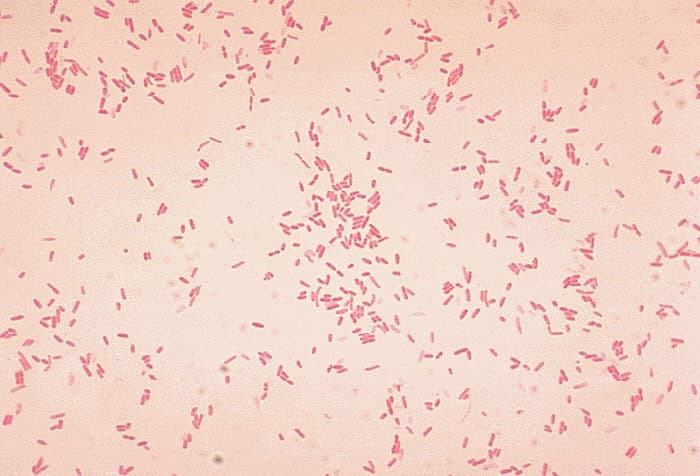
Gram stain of Aeromonas hydrophila. Image from CDC/Dr. W.A. Clark, Public Domain, via Wikimedia Commons.
Question 1
Which organism best explains this presentation?
Select one answer to view the rationale and peer response data.
Question 2
While awaiting operative exploration and final cultures, which antimicrobial issue is most important to recognize?
Select one answer to view the rationale and peer response data.
Question 3
Which management step is most important at this point?
Select one answer to view the rationale and peer response data.
Rationale locked
Answer the question above to reveal the rationale.
Rationale locked
Answer the question above to reveal the rationale.
References
Gold WL, Salit IE. Aeromonas hydrophila infections of skin and soft tissue: report of 11 cases and review. Clinical Infectious Diseases. 1993;16(1):69-74.
Jones BL, Wilcox MH. Aeromonas infections and their treatment. Journal of Antimicrobial Chemotherapy. 1995;35(4):453-461.
Vasagar B, Jain V, Germinario A, et al. Approach to aquatic skin infections. Primary Care. 2018;45(3):555-566.
Huang TY, Kuo SF, Tsai YH, et al. The impact of cefuroxime susceptibility on Aeromonas necrotizing fasciitis outcomes. Microorganisms. 2023;11(11):2776.