The Fog Behind the Eye
Clinical Vignette
A 34-year-old man presents to the emergency department with 12 days of progressive blurred vision and floaters in his right eye. Over the past 3 days, the left eye has also become hazy, and bright light causes deep aching discomfort. He has no trauma history. Artificial tears prescribed at an urgent care visit did not help.
Three months earlier, he noticed a painless penile ulcer that healed on its own after about 2 weeks. One month later, he developed a diffuse, non-pruritic rash on his trunk, arms, and palms, accompanied by malaise and swollen neck nodes. The rash faded without treatment. He has sex with men and reports two new partners in the past 6 months. He has never been diagnosed with syphilis or HIV.
On examination, temperature is 37.4 C, heart rate 84/min, blood pressure 122/76 mmHg, respiratory rate 14/min, and oxygen saturation 99% on room air. Visual acuity is 20/100 in the right eye and 20/60 in the left eye. Pupils are equal and reactive without an afferent pupillary defect. Extraocular movements are intact. Slit-lamp examination by ophthalmology shows anterior chamber cells and flare in both eyes. Dilated funduscopic examination shows vitritis with yellow-white chorioretinal lesions and inflammatory aggregates in the inferior vitreous.
Laboratory testing shows HIV antigen/antibody testing is reactive, with HIV-1 confirmed on differentiation assay. CD4 count is 428 cells/uL and HIV RNA is 36,400 copies/mL. RPR is reactive at 1:128, and a treponemal antibody test is reactive. He has no headache, meningismus, hearing loss, cranial nerve deficit, weakness, numbness, ataxia, or altered mental status.
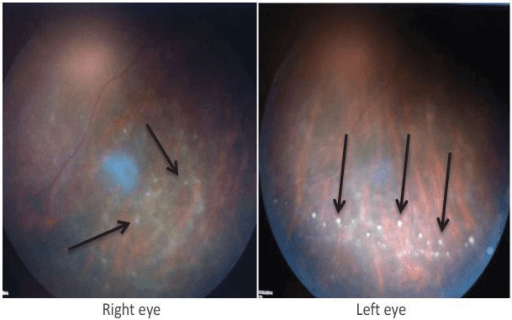
Bilateral fundus photographs in ocular syphilis showing inferior vitreous inflammatory aggregates. Image from Lee et al., West J Emerg Med, 2016, CC BY 4.0.
Question 1
What is the most likely diagnosis?
Select one answer to view the rationale and peer response data.
Question 2
Which diagnostic and management principle is most appropriate?
Select one answer to view the rationale and peer response data.
Question 3
What is the most appropriate antimicrobial treatment?
Select one answer to view the rationale and peer response data.
Rationale locked
Answer the question above to reveal the rationale.
Rationale locked
Answer the question above to reveal the rationale.
References
Lee MI, Lee AW, Sumsion SM, Gorchynski JA. Don't forget what you can't see: a case of ocular syphilis. Western Journal of Emergency Medicine. 2016;17(4):473-476.
Tsan GL, Claiborne RT. Ocular syphilis. Clinical and Experimental Optometry. 2021;104(7):756-759.
Chao JR, Khurana RN, Fawzi AA, Reddy HS, Rao NA. Syphilis: reemergence of an old adversary. Ophthalmology. 2006;113(11):2074-2079.
Centers for Disease Control and Prevention. Neurosyphilis, ocular syphilis, and otosyphilis. Sexually Transmitted Infections Treatment Guidelines. 2021.