A Firestorm After the Cure
Clinical Vignette
A 36-year-old man from the Peruvian Amazon presents for evaluation of a new febrile illness several months after completing treatment for multibacillary Hansen disease. His original diagnosis had evolved over more than a year: he developed numerous annular and infiltrated plaques on the trunk and extremities, diffuse thickening of the earlobes and eyebrows, palpably thickened ulnar and posterior tibial nerves, and glove-and-stocking hypoesthesia with intermittent burning pain in both feet. A slit-skin smear showed a bacteriological index of 4.5, and skin biopsy demonstrated a diffuse dermal infiltrate of foamy macrophages packed with acid-fast bacilli. He completed 12 months of multidrug therapy with monthly rifampin, monthly clofazimine, daily clofazimine, and daily dapsone under supervision. During treatment, the infiltrated plaques flattened progressively and his sensory symptoms stabilized.
At the end of treatment, a repeat slit-skin smear returned with a bacteriological index of 3 and a very low morphological index. The treating team counseled him that bacillary antigen persists and clears slowly in highly bacilliferous disease, and that a positive smear without rising index or solid-staining bacilli does not constitute relapse. He was discharged from supervised treatment feeling clinically improved, with residual hyperpigmented plaques but without new lesions.
Several months later, following a gastrointestinal illness and a period of emotional stress, he develops abrupt onset fever to 38.8°C, diffuse myalgias, bilateral ankle edema, testicular pain diagnosed clinically as epididymo-orchitis, and new crops of exquisitely tender erythematous nodules on the face, extensor surfaces of the arms, and trunk. Several nodules become pustular and ulcerate. He reports worsening tenderness over both ulnar nerves but denies new weakness in the hands, foot drop, or new areas of numbness. The old plaques remain flat rather than newly infiltrated. Motor testing of the small muscles of the hands and feet is preserved bilaterally.
Laboratory studies show neutrophilic leukocytosis, mild normocytic anemia, and elevated C-reactive protein. Creatinine is normal, urinalysis is bland, complement levels are normal, and ANCA is negative. Repeat slit-skin smear shows a bacteriological index of 3, unchanged from the end of treatment, with a persistently low morphological index. He also reports a history of intermittent abdominal cramping and loose stools over the past year. Prednisolone 60 mg/day is started. After 48 hours, fever and nerve pain improve substantially, but he develops refractory hyperglycemia requiring an insulin infusion. Thalidomide becomes available.
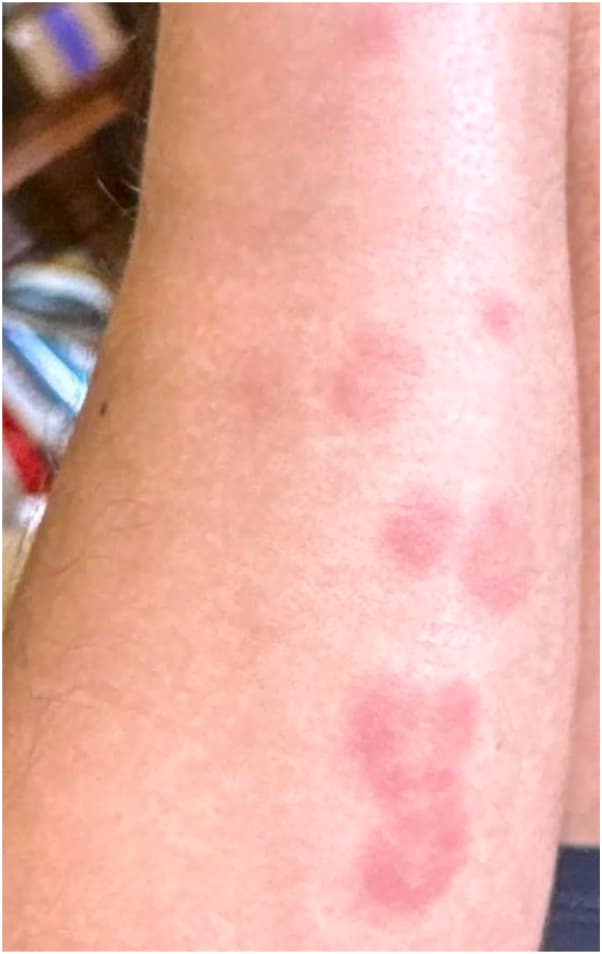
Erythematous, edematous papules and nodules on the upper extremity. Image adapted from Puri et al., IDCases (2024), CC BY 4.0.
Question 1
Which diagnosis best explains the patient's new febrile illness?
Select one answer to view the rationale and peer response data.
Question 2
Which finding would most strongly support relapse or drug-resistant leprosy rather than ENL?
Select one answer to view the rationale and peer response data.
Question 3
Prednisolone 60 mg/day improved fever and nerve pain but caused refractory hyperglycemia requiring insulin. The patient has a history of abdominal symptoms and lives in a region where intestinal parasites are endemic. Thalidomide is now available. Which plan is safest?
Select one answer to view the rationale and peer response data.
Rationale locked
Answer the question above to reveal the rationale.
Rationale locked
Answer the question above to reveal the rationale.
References
Grijsen ML, Nguyen TH, Pinheiro RO, et al. Leprosy. Nature Reviews Disease Primers. 2024;10(1):90.
Grijsen et al.: Leprosy Disease Primer (Nature Reviews 2024)
Voorend CGN, Post EB. A systematic review on the epidemiological data of erythema nodosum leprosum, a type 2 leprosy reaction. PLOS Neglected Tropical Diseases. 2013;7(10):e2440.
Nabarro LEB, Aggarwal D, Armstrong M, Lockwood DNJ. The use of steroids and thalidomide in the management of erythema nodosum leprosum: 17 years at the Hospital for Tropical Diseases, London. Leprosy Review. 2016;87(2):221-231.
Wasser M, Nguyen QD, Ghadersohi S, et al. Erythema nodosum leprosum. Journal of General Internal Medicine. 2021;36(9):2788-2790.
Wasser et al.: Erythema Nodosum Leprosum (image source, CC BY 4.0)
Centers for Disease Control and Prevention. Strongyloides: Clinical Care and Treatment.