The Scar That Never Healed
Clinical Vignette
A 19-year-old man born in Jalisco, Mexico, who moved to California three years ago, is admitted with three weeks of fevers, night sweats, productive cough, and a 5 kg weight loss. His past medical history is startling for his age: at 10 months he developed suppurative left axillary lymphadenitis following neonatal BCG vaccination, requiring surgical drainage — pathology showed necrotizing granulomatous lymphadenitis and culture grew Mycobacterium bovis BCG, treated with nine months of antituberculous therapy. At age 6 he was hospitalized with a right middle lobe pneumonia complicated by a 3 cm lung abscess; bronchoalveolar lavage grew Serratia marcescens, and he received six weeks of intravenous antibiotics. At age 11 he underwent percutaneous drainage of a hepatic abscess that grew Staphylococcus aureus. He has also had recurrent perianal abscesses. His mother recalls that her brother died in childhood of "pneumonia" in rural Mexico. The patient has no history of HIV, diabetes, or immunosuppressive medications, and he completed childhood immunizations without other complications.
His current illness began insidiously with low-grade fevers and a cough that became productive of purulent sputum, occasionally blood-streaked, associated with drenching night sweats and exertional dyspnea. A walk-in clinic prescribed seven days of amoxicillin-clavulanate for community-acquired pneumonia, but he continued to decline. On transfer he is thin and chronically ill-appearing.
On examination: temperature 38.7 °C, heart rate 108, blood pressure 102/64 mmHg, respiratory rate 22, oxygen saturation 93% on room air. There is a healed BCG scar over the left deltoid and a surgical scar in the left axilla. Crackles are audible over the right upper chest; the liver edge is palpable 3 cm below the costal margin, non-tender. No active lymphadenopathy. Laboratories: WBC 14.2 k/mcL with 82% neutrophils, hemoglobin 10.4 g/dL, platelets 480 k/mcL, CRP 148 mg/L, ESR 92 mm/h; HIV serology negative. Sputum Gram stain shows gram-negative rods, and cultures grow Serratia marcescens. A contrast-enhanced CT of the chest shows dense right upper lobe consolidation with a 4.2 cm cavitary lesion containing an air-fluid level. The organism recovered from his respiratory cultures is shown below.
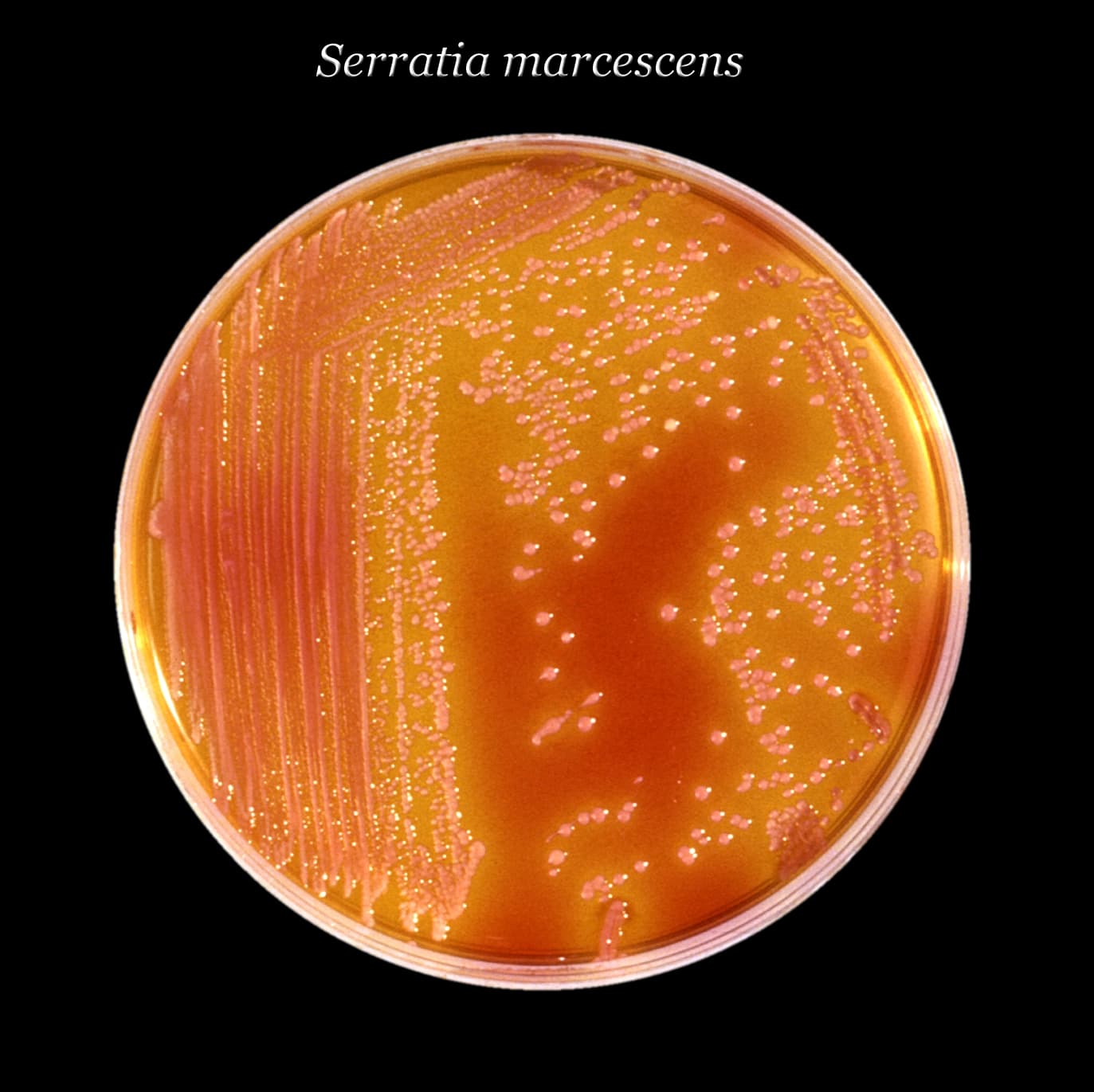
Serratia marcescens on xylose lysine deoxycholate (XLD) agar, displaying the red pigmentation (prodigiosin) classically seen when plates are held at room temperature. Many clinical isolates are non-pigmented at 37 °C, so a pale plate does not exclude the organism. Image: CDC Public Health Image Library (#6620), public domain.
Question 1
Which host defense defect best explains this patient's lifelong pattern of infections with these particular organisms?
Select one option to submit your answer and view live poll results.
Question 2
Which diagnostic study best confirms the suspected diagnosis and can simultaneously inform genetic counseling about inheritance?
Select one option to submit your answer and view live poll results.
Question 3
After directed therapy and drainage of the current abscess, which long-term management strategy is most appropriate?
Select one option to submit your answer and view live poll results.
References
Winkelstein JA, Marino MC, Johnston RB Jr, et al. Chronic granulomatous disease. Report on a national registry of 368 patients. Medicine (Baltimore). 2000;79(3):155–169.
Holland SM. Chronic granulomatous disease. Hematol Oncol Clin North Am. 2013;27(1):89–99.
Zhou Q, Hui X, Ying W, et al. A cohort of 169 chronic granulomatous disease patients exposed to BCG vaccination: a retrospective study. J Clin Immunol. 2018;38(3):260–272.
Vowells SJ, Sekhsaria S, Malech HL, Shalit M, Fleisher TA. Flow cytometric analysis of the granulocyte respiratory burst: a comparison study of fluorescent probes. J Immunol Methods. 1995;178(1):89–97.
The International Chronic Granulomatous Disease Cooperative Study Group. A controlled trial of interferon gamma to prevent infection in chronic granulomatous disease. N Engl J Med. 1991;324(8):509–516.
Margolis DM, Melnick DA, Alling DW, Gallin JI. Trimethoprim-sulfamethoxazole prophylaxis in the management of chronic granulomatous disease. J Infect Dis. 1990;162(3):723–726.
Gallin JI, Alling DW, Malech HL, et al. Itraconazole to prevent fungal infections in chronic granulomatous disease. N Engl J Med. 2003;348(24):2416–2422.
Güngör T, Teira P, Slatter M, et al. Reduced-intensity conditioning and HLA-matched haemopoietic stem-cell transplantation in patients with chronic granulomatous disease: a prospective multicentre study. Lancet. 2014;383(9915):436–448.
Kohn DB, Booth C, Kang EM, et al. Lentiviral gene therapy for X-linked chronic granulomatous disease. Nat Med. 2020;26(2):200–206.