The Wrong Host
Clinical Vignette
A 19-year-old pre-medical student with no significant past medical history presents with six weeks of fatigue, right upper quadrant discomfort, dry cough, and recurrent urticarial rash. He takes no medications and is not immunosuppressed. Over the past two years he has participated in three international medical volunteer programs: four months in rural Vietnam (two years ago), two months in Costa Rica (eighteen months ago), and three months in Andean communities in the Bolivian altiplano (returned six weeks before presentation). He ate local and street food throughout his travels. He also volunteers weekly at a local dog rescue shelter and has done so for the past year, often eating lunch on the shelter grounds.
He first noticed the urticarial rash and fatigue approximately two weeks after returning from Bolivia and was seen at student health, where a viral upper respiratory infection was diagnosed and the rash was attributed to seasonal allergies. Over the following month his symptoms persisted and worsened. He developed right upper quadrant heaviness and the dry cough became more prominent, occasionally waking him from sleep. He denies fever, night sweats, hemoptysis, jaundice, diarrhea, or weight loss. He denies consumption of raw or undercooked freshwater fish, raw shellfish, or unwashed aquatic plants during any of his travels.
On examination, temperature is 37.6°C, heart rate 88/min, blood pressure 118/72 mmHg, respiratory rate 14/min, and oxygen saturation 98% on room air. He appears well but mildly fatigued. The liver edge is palpable 3 cm below the right costal margin and is smooth and non-tender. No splenomegaly, no jaundice, no scleral icterus, and no lymphadenopathy. Urticarial wheals are present on the trunk and proximal upper extremities. Lung examination reveals faint bibasilar crackles.
Laboratory studies show white blood cells 11.2 x 10^3/uL with 28% eosinophils (absolute eosinophil count 3,136/uL), hemoglobin 13.8 g/dL, platelets 282 x 10^3/uL, AST 62 U/L, ALT 78 U/L, alkaline phosphatase 98 U/L (within normal limits), total bilirubin 0.8 mg/dL, and serum IgE 2,840 IU/mL (markedly elevated). Stool ova and parasite examination on three separate samples is negative. Strongyloides IgG serology is positive. CT abdomen with contrast shows hepatomegaly with multiple poorly defined hypodense lesions scattered throughout the liver parenchyma, measuring 0.4 to 1.2 cm; no intrahepatic or extrahepatic biliary dilation is present; no ascites. Chest radiograph shows bilateral patchy infiltrates in the lower lung zones.
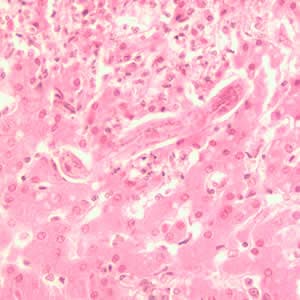
H&E stain: longitudinal section within hepatic parenchyma, surrounded by eosinophilic inflammatory infiltrate and early granuloma formation. Image courtesy of the CDC (public domain).
Question 1
What is the most likely diagnosis?
Select one answer to view the rationale and peer response data.
Question 2
What is the treatment of choice?
Select one answer to view the rationale and peer response data.
Question 3
Which best explains why this patient has visceral larva migrans rather than an intestinal worm infection, and why stool O&P is negative?
Select one answer to view the rationale and peer response data.
Rationale locked
Answer the question above to reveal the rationale.
Rationale locked
Answer the question above to reveal the rationale.
References
Despommier D. Toxocariasis: clinical aspects, epidemiology, medical ecology, and molecular aspects. Clinical Microbiology Reviews. 2003;16(2):265-272.
Despommier: Toxocariasis — Clinical Aspects and Epidemiology
Rubinsky-Elefant G, Hirata CE, Yamamoto JH, Ferreira MU. Human toxocariasis: diagnosis, worldwide seroprevalences and clinical expression of the systemic and ocular forms. Annals of Tropical Medicine and Parasitology. 2010;104(1):3-23.
Rubinsky-Elefant et al.: Human Toxocariasis — Diagnosis and Clinical Expression
Centers for Disease Control and Prevention. Toxocariasis: Resources for Health Professionals.
Marcos LA, Terashima A, Gotuzzo E. Update on hepatobiliary flukes: fascioliasis, opisthorchiasis and clonorchiasis. Current Opinion in Infectious Diseases. 2008;21(5):523-530.