Phase I vs Phase II
Clinical Vignette
A 58-year-old sheep farmer from rural Vermont presents with three months of low-grade fevers, drenching night sweats, a 15-pound weight loss, and progressive exertional dyspnea. He was diagnosed with a bicuspid aortic valve at age 40 after a heart murmur was detected on a routine insurance examination, but he has never required cardiac surgery. Over the past year he has also complained of intermittent bilateral knee and wrist pain that his primary care physician attributed to osteoarthritis.
Six months ago his barn cat delivered a litter of kittens in the hayloft. He handled the animals frequently during and after the birth, cleaning the bedding and feeding the queen by hand. He also drinks unpasteurized goat milk from a neighboring farm several times a week and has done so for years. He denies IV drug use, recent dental work, and international travel. He has no history of rheumatic fever, congenital heart disease beyond the bicuspid valve, or prior endocarditis.
On examination he appears chronically ill. Temperature is 37.9°C, heart rate 92 bpm, blood pressure 134/68 mmHg. A grade 3/6 harsh systolic murmur is heard best at the right upper sternal border with an early diastolic component. Two splinter hemorrhages are present on the right thumbnail. The remainder of the examination is notable for tenderness and mild swelling of the wrists and knees without overt synovitis, and a palpable spleen tip.
White blood cell count is 8,400/μL with a normal differential, hemoglobin 10.1 g/dL (MCV 84), platelet count 198,000/μL, ESR 74 mm/hr, CRP 52 mg/L, and creatinine 1.0 mg/dL. Six sets of blood cultures drawn over 48 hours are all negative at five days. Transthoracic echocardiography reveals a bicuspid aortic valve with a 1.3 cm mobile echodensity on the right coronary cusp and moderate aortic regurgitation. The team sends additional serologic and molecular studies to pursue culture-negative endocarditis.
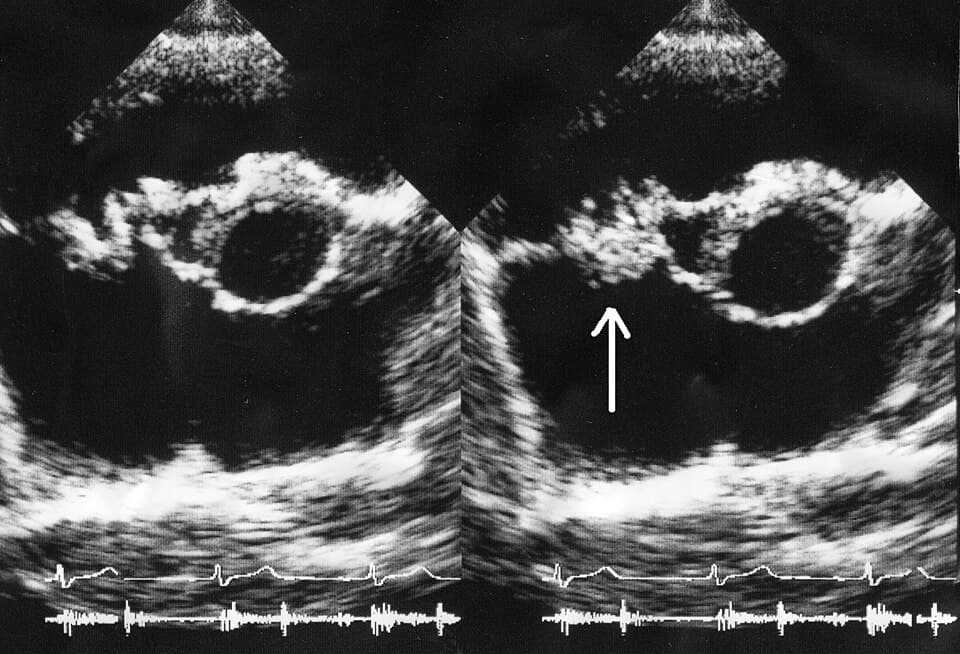
Echocardiogram demonstrating a valvular vegetation (arrow).
Question 1
What is the most likely diagnosis?
Select one option to submit your answer and view live poll results.
Question 2
Serology returns with Phase I IgG 1:2048 and Phase II IgG 1:512. Which statement about this serologic pattern is correct?
Select one option to submit your answer and view live poll results.
Question 3
What is the optimal antimicrobial regimen?
Select one option to submit your answer and view live poll results.
References
Million M, Thuny F, Richet H, Raoult D. Long-term outcome of Q fever endocarditis: a 26-year personal survey. Lancet Infectious Diseases. 2010;10(8):527-535.
Delahaye A, Eldin C, Bleibtreu A, Djossou F, Marrie TJ, Ghanem-Zoubi N, et al. Treatment of persistent focalized Q fever: time has come for an international randomized controlled trial. Journal of Antimicrobial Chemotherapy. 2024;79(8):1725-1747.
Armstrong MR, McCarthy KL, Horvath RL. A contemporary 16-year review of Coxiella burnetii infective endocarditis in a tertiary cardiac center in Queensland, Australia. Infectious Diseases. 2018;50(7):531-538.
Rodríguez-Fernández M, Espíndola Gómez R, Trigo-Rodríguez M, et al. High incidence of asymptomatic Phase I IgG seroconversion after an acute Q fever episode: implications for chronic Q fever diagnosis. Clinical Infectious Diseases. 2022;74(12):2122-2128.
Stahl JP, Varon E, Bru JP. Treatment of Coxiella burnetii endocarditis with hydroxychloroquine. Is it evidence-based? Clinical Microbiology and Infection. 2022;28(5):637-639.