The Joint Pain Before the Murmur
Clinical Vignette
A 54-year-old male carpenter is referred to the hospital by his primary care physician for evaluation of six weeks of progressive fatigue, low-grade fevers, drenching night sweats, and a 20-pound unintentional weight loss. He describes worsening exertional dyspnea over the past three weeks, now limiting him to one flight of stairs. For the past three months he has also noticed intermittent watery diarrhea occurring three to four times per week, which he attributed to dietary changes. He has no recent travel, sick contacts, dental procedures, animal exposures, or intravenous drug use.
His past medical history is notable for a five-year history of seronegative polyarthralgias affecting the knees, ankles, and wrists. Rheumatoid factor and anti-CCP antibodies have been repeatedly negative. He has been managed with ibuprofen and intermittent prednisone tapers, the most recent completed six months ago. He underwent colonoscopy two years ago for the diarrhea workup, which was unremarkable. His only other medication is omeprazole. He drinks alcohol occasionally and does not smoke.
On examination he is febrile to 38.3°C, heart rate 92 bpm, blood pressure 132/78 mmHg, respiratory rate 20 breaths per minute, and oxygen saturation 96% on room air. He appears chronically ill with temporal wasting. Cardiac auscultation reveals a new harsh diastolic murmur radiating to the right sternal border, best heard at the right second intercostal space. Conjunctival petechiae are present bilaterally. Splinter hemorrhages are noted on the left thumbnail and right index fingernail. The abdomen is soft and non-tender with no hepatosplenomegaly. There is no peripheral edema. Examination of the joints reveals mild bogginess and tenderness of both knees and the right wrist without overt synovitis. The remainder of the examination is unremarkable.
White blood cell count is 11,400/μL with 74% neutrophils. Hemoglobin is 10.8 g/dL with a mean corpuscular volume of 84 fL. Platelet count is 310,000/μL. ESR is 68 mm/hr and CRP is 54 mg/L. Basic metabolic panel and liver function tests are within normal limits. Six sets of blood cultures are drawn from separate peripheral sites over five days — all are negative at five days of incubation. Transthoracic echocardiography demonstrates a 1.4 cm mobile echodense mass on the aortic valve with moderate aortic regurgitation. Given the combination of culture-negative endocarditis, chronic diarrhea, and years of seronegative polyarthralgias, the team pursues additional diagnostic workup. Upper endoscopy with duodenal biopsies is performed. The duodenal mucosa appears mildly edematous with pale, yellow-white patches but no frank ulceration.
Histopathologic examination of the duodenal biopsies reveals numerous foamy macrophages filling the lamina propria and expanding the villi. Periodic acid-Schiff staining demonstrates abundant PAS-positive, diastase-resistant granular material within these macrophages. No acid-fast organisms are seen. Gram stain of the tissue is negative.
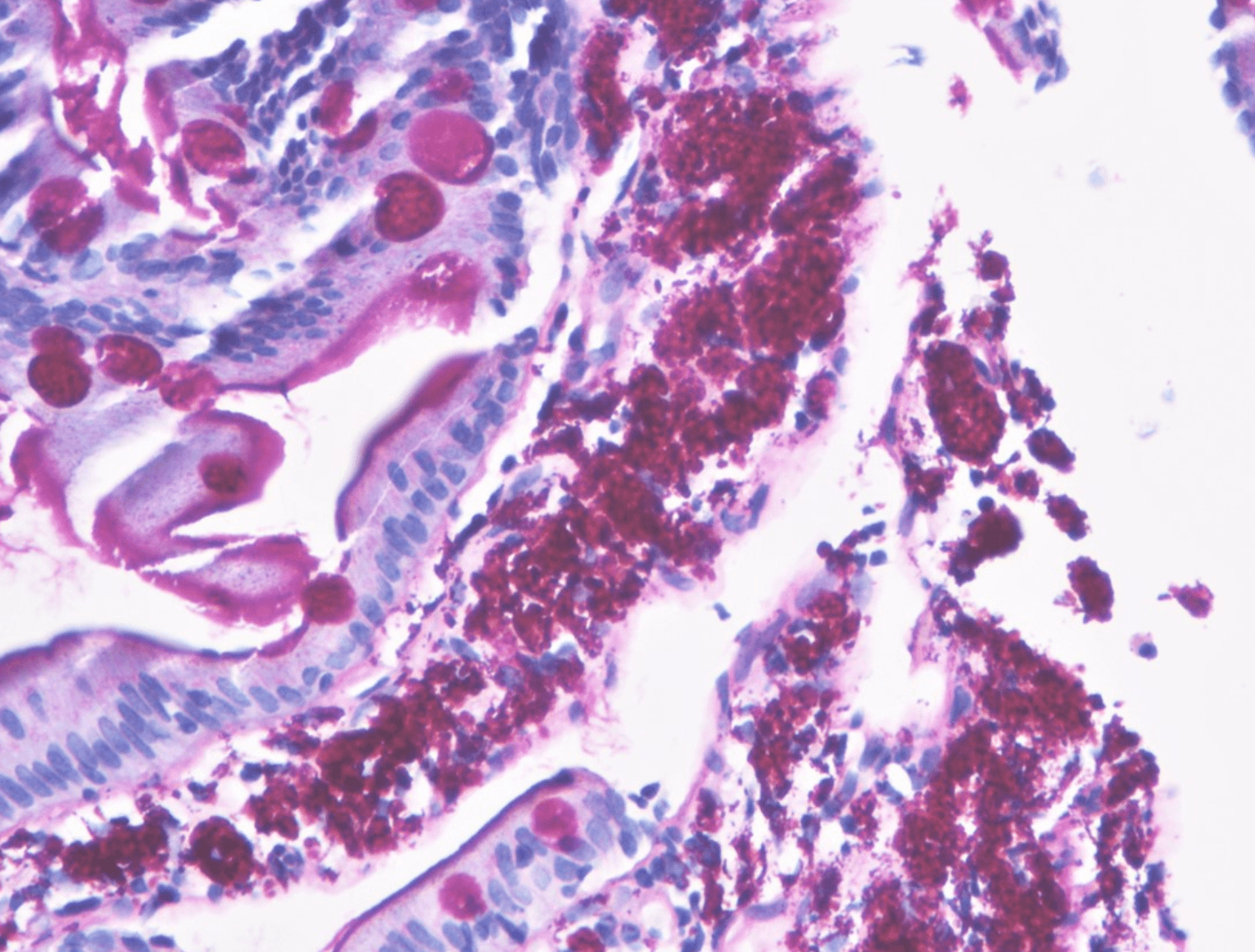
PAS stain of duodenal biopsy: foamy macrophages in the lamina propria distended with PAS-positive, diastase-resistant intracellular granular material.
Question 1
What is the most likely diagnosis?
Select one option to submit your answer and view live poll results.
Question 2
What is the best test to confirm the diagnosis?
Select one option to submit your answer and view live poll results.
Question 3
What is the best initial treatment?
Select one option to submit your answer and view live poll results.
Question 4
What is the best oral maintenance regimen?
Select one option to submit your answer and view live poll results.
References
Fenollar F, Célard M, Lagier JC, Lepidi H, Fournier PE, Raoult D. Tropheryma whipplei endocarditis. Emerging Infectious Diseases. 2013;19(11):1721-1730.
Dolmans RA, Boel CH, Lacle MM, Kusters JG. Clinical manifestations, treatment, and diagnosis of Tropheryma whipplei infections. Clinical Microbiology Reviews. 2017;30(2):529-555.
Boumaza A, Ben Azzouz E, Arrindell J, Lepidi H, Mezouar S, Desnues B. Whipple's disease and Tropheryma whipplei infections: from bench to bedside. Lancet Infectious Diseases. 2022;22(10):e280-e291.
Marth T, Moos V, Müller C, Biagi F, Schneider T. Tropheryma whipplei infection and Whipple's disease. Lancet Infectious Diseases. 2016;16(3):e13-e22.
McGee M, Brienesse S, Chong B, Levendel A, Lai K. Tropheryma whipplei endocarditis: case presentation and review of the literature. Open Forum Infectious Diseases. 2018;6(1):ofy330.