The Wolf in CoNS Clothing
Clinical Vignette
A 52-year-old man with hypertension and osteoarthritis presents to the emergency department with nine days of fever, night sweats, anorexia, and progressive dyspnea on exertion. One week before the fevers began he underwent incision and drainage of a spontaneous left inguinal abscess that was not cultured. He has no prosthetic valves, no indwelling hardware, no recent hospitalizations, and no injection drug use. He works as a maintenance technician at an apartment complex.
On examination his temperature is 38.9 C, heart rate 112/min, blood pressure 98/62 mmHg, and oxygen saturation 95% on room air. He appears ill and diaphoretic. Cardiac auscultation reveals a new grade 3/6 holosystolic murmur at the apex radiating to the axilla. There is faint conjunctival injection bilaterally but no splinter hemorrhages, Janeway lesions, Osler nodes, or Roth spots. Lungs are clear. There is a healing 2-cm scar in the left inguinal fold without surrounding erythema or fluctuance.
Laboratory studies show white blood cells 14.8 x 10^3/uL with 82% neutrophils, hemoglobin 10.4 g/dL, platelets 187 x 10^3/uL, erythrocyte sedimentation rate 92 mm/h, C-reactive protein 18.4 mg/dL, creatinine 1.3 mg/dL, and blood urea nitrogen 28 mg/dL. Urinalysis shows 2+ proteinuria and 10 to 25 red blood cells per high-power field without casts. Three sets of blood cultures drawn from peripheral venipuncture over the first 90 minutes all grow gram-positive cocci in clusters within 14 hours. The laboratory reports the isolate as coagulase-negative Staphylococcus species. Because the organism grew in all six bottles from three separate sets drawn from different sites, the team escalates concern beyond typical contamination.
Transthoracic echocardiography demonstrates a mobile echodensity on the anterior mitral valve leaflet with moderate-to-severe mitral regurgitation. Transesophageal echocardiography confirms a 1.6 x 0.5 cm mobile vegetation on the anterior leaflet with a small area of leaflet perforation and no perivalvular abscess.
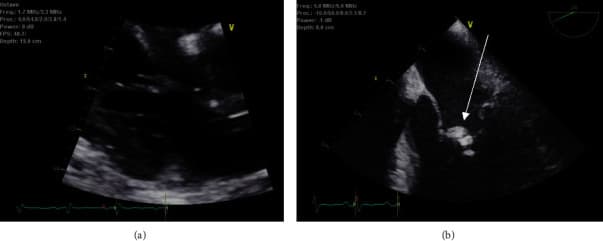
Transthoracic echocardiography and transesophageal echocardiography demonstrating a mobile vegetation on the mitral valve.
Question 1
Full species identification by MALDI-TOF MS is pending. Which organism should be specifically considered?
Select one option to submit your answer and view live poll results.
Question 2
MALDI-TOF MS confirms Staphylococcus lugdunensis. Which statement most accurately describes its coagulase testing profile and the mechanism behind it?
Select one option to submit your answer and view live poll results.
Question 3
The isolate is methicillin-susceptible. The patient remains febrile on vancomycin with a rising creatinine and worsening mitral regurgitation on repeat echocardiography. Cardiothoracic surgery is consulted. Which antibiotic regimen is most appropriate for definitive therapy?
Select one option to submit your answer and view live poll results.
References
Heilbronner S, Foster TJ. Staphylococcus lugdunensis: a skin commensal with invasive pathogenic potential. Clinical Microbiology Reviews. 2021;34(2):e00205-20.
Liu PY, Huang YF, Tang CW, et al. Staphylococcus lugdunensis infective endocarditis: a literature review and analysis of risk factors. Journal of Microbiology, Immunology, and Infection. 2010;43(6):478-484.
Argemi X, Hansmann Y, Riegel P, Prevost G. Is Staphylococcus lugdunensis significant in clinical samples? Journal of Clinical Microbiology. 2017;55(11):3167-3174.
Elamin WF, Ball D, Millar M. Unbiased species-level identification of clinical isolates of coagulase-negative staphylococci: does it change the perspective on Staphylococcus lugdunensis? Journal of Clinical Microbiology. 2015;53(1):292-294.
Baddour LM, Wilson WR, Bayer AS, et al. Infective endocarditis in adults: diagnosis, antimicrobial therapy, and management of complications. Circulation. 2015;132(15):1435-1486.
Linz MS, Finkel D, Goshorn ES. Staphylococcus lugdunensis endocarditis presenting with brain abscesses and temporal vision deficits. Case Reports in Infectious Diseases. 2024;2024:4728700.