The 5-Month Mystery
Clinical Vignette
A 62-year-old man with a history of severe aortic stenosis presents to the emergency department with 3 weeks of progressive illness. He initially developed low-grade fevers at home, which he attributed to "post-viral fatigue." Over the past week, he has noticed increasing fatigue, decreased exercise tolerance, and night sweats that soak through his pillow. He also reports decreased appetite and an unintentional 3-kg weight loss.
Five months prior, he underwent a successful surgical aortic valve replacement with a bioprosthetic valve for severe symptomatic aortic stenosis. His postoperative course was uncomplicated, and he has been in regular follow-up. He denies any recent dental procedures, surgery, invasive procedures, or catheterizations. His only medication is aspirin 81 mg daily.
On arrival, his temperature is 38.2°C, heart rate is 92/min, blood pressure 128/70 mmHg, respiratory rate 18/min, and oxygen saturation 98% on room air. Physical examination reveals a thin, somewhat diaphoretic man in mild distress. Cardiac auscultation demonstrates a new soft diastolic murmur at the right upper sternal border, different from his postoperative exam. He has no peripheral stigmata of endocarditis. No jugular venous distension or peripheral edema is noted.
Laboratory evaluation shows a white blood cell count of 11.2 x 10^9/L (neutrophils 78%, lymphocytes 12%, monocytes 8%), hemoglobin 10.8 g/dL, platelets 245 x 10^9/L, C-reactive protein 45 mg/dL, and erythrocyte sedimentation rate 68 mm/hour. Basic metabolic panel reveals creatinine 1.1 mg/dL, blood urea nitrogen 22 mg/dL, and normal electrolytes. Urinalysis shows trace protein but no hematuria or pyuria.
Three sets of blood cultures drawn more than 1 hour apart all grow gram-positive cocci in clusters after 48 hours of incubation. The laboratory performs a coagulase tube test, which shows the patient's isolate fails to clot plasma after 24 hours (negative), while a control staphylococcal isolate shows clot formation within 4 hours (positive). Gram stain confirms gram-positive cocci in clusters. Oxacillin susceptibility testing is pending, but the isolate is presumed methicillin-resistant pending full susceptibilities. Initial transthoracic echocardiography is limited by body habitus and prosthetic valve shadowing, with inconclusive findings for vegetation or abscess.
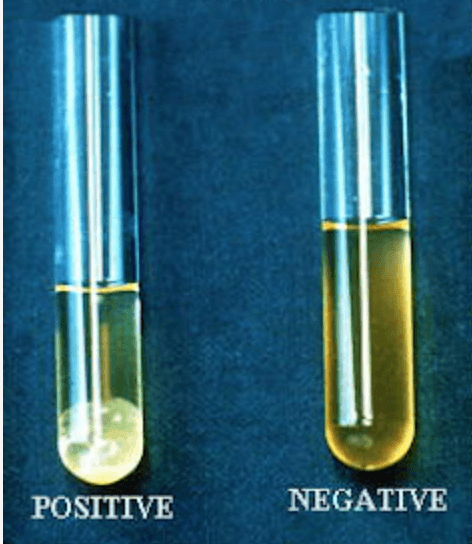
Coagulase tube test showing patient's isolate (negative) and control (positive)
Question
Based on gram-positive cocci in clusters with negative coagulase testing, what is the most likely organism?
Select one option to submit your answer and view live poll results.
Question 2
What is the most appropriate next imaging study?
Select one option to submit your answer and view live poll results.
Question 3
Which of the following findings would represent a Class I indication for surgery in prosthetic valve endocarditis?
Select one option to submit your answer and view live poll results.
Question 4
What is the initial antibiotic regimen of choice for coagulase-negative staphylococcal prosthetic valve endocarditis?
Select one option to submit your answer and view live poll results.
References
Baddour LM, Wilson WR, Bayer AS, et al. Infective Endocarditis in Adults: Diagnosis, Antimicrobial Therapy, and Management of Complications: A Scientific Statement for Healthcare Professionals From the American Heart Association. Circulation. 2015;132(15):1435-1486.
Habib G, Lancelotti P, Antunes MJ, et al. 2015 ESC Guidelines for the management of infective endocarditis: The Task Force for the Management of Infective Endocarditis of the European Society of Cardiology (ESC). Endorsed by: European Association for Cardio-Thoracic Surgery (EACTS), the European Association of Nuclear Medicine (EANM). Eur Heart J. 2015;36(44):3075-3128.
Nishimura RA, Otto CM, Bonow RO, et al. 2017 AHA/ACC Focused Update of the 2014 AHA/ACC Guideline for the Management of Patients With Valvular Heart Disease: A Report of the American College of Cardiology/American Heart Association Task Force on Clinical Practice Guidelines. J Am Coll Cardiol. 2017;70(2):252-289.