Legs from the Bush
Clinical Vignette
A 34-year-old previously healthy man presents in late summer with four days of fever, severe headache, myalgias, and profound fatigue that began two days after returning from a 10-day safari in South Africa. He spent most of the trip hiking through brush in Kruger and the surrounding game reserves while wearing shorts in the heat. He remembers repeated bites from mosquitoes and other insects during the trip, especially around his lower legs, but did not think much of them because he felt well at the time.
Two days before presentation he noticed three dark, tender spots on his lower legs at the sites of prior bites. Since then he has developed subjective fevers, drenching sweats, neck stiffness without photophobia, and aching in the shoulders and thighs. He denies cough, diarrhea, dysuria, or confusion. He took two doses of atovaquone-proguanil that he had left over from a prior trip because he worried this might be malaria or another mosquito-borne infection, but his symptoms continued to worsen.
On examination he is ill-appearing but alert. Temperature is 38.8°C, heart rate 104 bpm, blood pressure 118/72 mmHg, respiratory rate 18 breaths per minute, and oxygen saturation 98% on room air. Three 1 cm necrotic inoculation eschars with surrounding erythema are present over the right shin and left ankle. There is tender right inguinal lymphadenopathy and a faint scattered papular eruption over the trunk, sparing the palms and soles. No meningismus, conjunctivitis, or murmur is present.
White blood cell count is 5,100/μL, platelet count 132,000/μL, AST 68 U/L, ALT 61 U/L, and C-reactive protein 74 mg/L. Creatinine is normal. Thick and thin smears for malaria are negative, and a rapid malaria antigen test is also negative. Because the combination of safari exposure, fever, regional nodes, and multiple eschars strongly suggests a spotted fever group rickettsiosis, the team focuses on confirming the diagnosis without waiting for delayed serologic conversion.
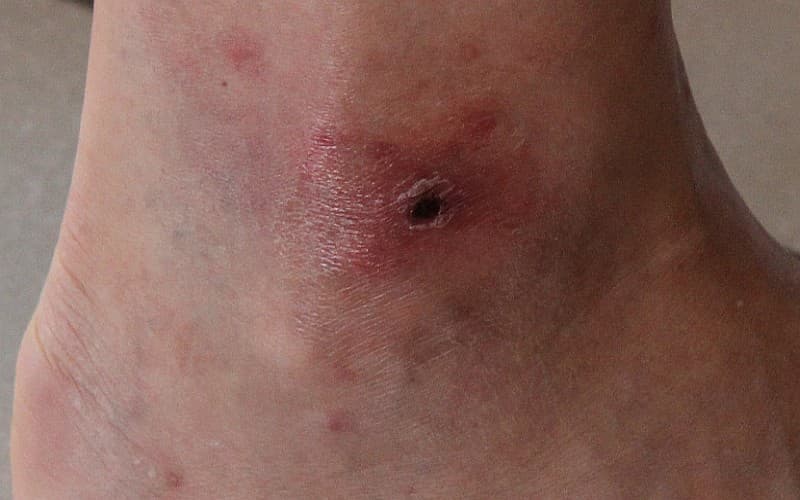
Typical inoculation eschar of African tick-bite fever on the lower extremity.
Question 1
What is the most likely diagnosis?
Select one option to submit your answer and view live poll results.
Question 2
Which test is most sensitive in the first week?
Select one option to submit your answer and view live poll results.
Question 3
What is the best treatment?
Select one option to submit your answer and view live poll results.
References
Jensenius M, Fournier PE, Kelly P, Myrvang B, Raoult D. African tick bite fever. Lancet Infectious Diseases. 2003;3(9):557-564.
Frean J, Grayson W. South African tick bite fever: an overview. Dermatopathology. 2019;6(2):70-76.
Silva-Ramos CR, Faccini-Martinez AA. Clinical, epidemiological, and laboratory features of Rickettsia africae infection, African tick-bite fever: a systematic review. Le Infezioni in Medicina. 2021;29(3):366-377.
Cherry CC, Denison AM, Kato CY, Thornton K, Paddock CD. Diagnosis of spotted fever group rickettsioses in U.S. travelers returning from Africa, 2007-2016. American Journal of Tropical Medicine and Hygiene. 2018;99(1):136-142.
Harrison N, Burgmann H, Forstner C, et al. Molecular diagnosis of African tick bite fever using eschar swabs in a traveller returning from Tanzania. Wiener Klinische Wochenschrift. 2016;128(15-16):602-605.