The Cytokine Storm Within
Clinical Vignette
A 38-year-old man with HIV infection diagnosed three years ago presents with six weeks of drenching night sweats, progressive fatigue, and a 20-pound weight loss. His antiretroviral therapy consists of bictegravir, emtricitabine, and tenofovir alafenamide, and his most recent HIV viral load was less than 20 copies/mL three months ago. His CD4 count at that time was 185 cells/μL. He denies cough, dysuria, diarrhea, or new skin lesions. He has no recent travel, sick contacts, or known tuberculosis exposure.
On examination he appears chronically ill and fatigued. Temperature is 38.2°C, heart rate 104 bpm, blood pressure 112/68 mmHg. Bilateral cervical, axillary, and inguinal lymph nodes are enlarged, firm, non-tender, and mobile, ranging from 1.5 to 3 cm. The spleen is palpable 4 cm below the left costal margin. No skin lesions, oral ulcers, or petechiae are present. The remainder of the examination is unremarkable.
Laboratory studies reveal hemoglobin 9.2 g/dL (MCV 86), white blood cell count 6,800/μL with a normal differential, platelet count 135,000/μL, albumin 2.4 g/dL, CRP 128 mg/L, and ESR 95 mm/hr. Creatinine, liver enzymes, and lactate dehydrogenase are within normal limits. Thick and thin blood smears are negative. Serum cryptococcal antigen is negative. Quantiferon-TB Gold is negative. Blood cultures show no growth at five days.
CT of the chest, abdomen, and pelvis demonstrates diffusely enlarged mediastinal, retroperitoneal, and mesenteric lymph nodes with a dominant 8.5 cm intensely enhancing retroperitoneal mass containing scattered calcifications. The spleen is enlarged at 16 cm. No pulmonary infiltrates or hepatic lesions are seen. An excisional biopsy of a right cervical lymph node is performed. Pathology reveals Castleman disease histology with expanded mantles, penetrating hyalinized vessels, and scattered plasmablasts in the interfollicular regions.
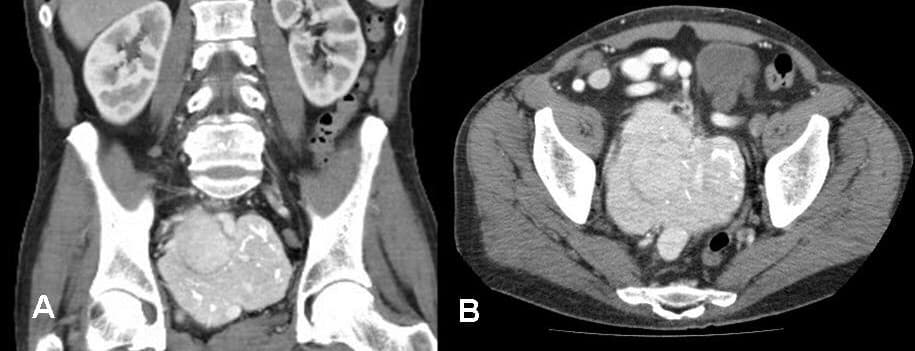
CT scan of the abdomen demonstrating a large, enhancing retroperitoneal mass with intratumoral calcifications.
Question 1
What is the most likely diagnosis?
Select one option to submit your answer and view live poll results.
Question 2
Which of the following best characterizes the most likely etiologic agent?
Select one option to submit your answer and view live poll results.
Question 3
What is the most appropriate treatment?
Select one option to submit your answer and view live poll results.
References
Bower M, Newsom-Davis T, Naresh K, et al. Clinical features and outcome in HIV-associated multicentric Castleman's disease. Journal of Clinical Oncology. 2011;29(18):2481-2486.
van Rhee F, Voorhees P, Dispenzieri A, et al. International, evidence-based consensus treatment guidelines for idiopathic multicentric Castleman disease. Blood. 2018;132(20):2115-2124.
Uldrick TS, Polizzotto MN, Aleman K, et al. Rituximab plus liposomal doxorubicin in HIV-infected patients with KSHV-associated multicentric Castleman disease. Blood. 2014;124(24):3544-3552.
Carbone A, De Paoli P, Gloghini A, Vaccher E. KSHV-associated multicentric Castleman disease: a tangle of different entities requiring multitarget treatment strategies. International Journal of Cancer. 2015;137(2):251-261.
Nasir MW, Gao Y. Advances in KSHV research: molecular pathogenesis, immune evasion, and evolving therapeutic horizon. Journal of Medical Virology. 2025;97(11):e70695.