The Long Sleep
Clinical Vignette
A 34-year-old woman presents to an urgent care clinic with five days of high fevers, shaking chills, severe frontal headache, profound myalgias, and fatigue. The fevers have been occurring every other day with striking regularity. When the clinician asks about recent travel, she mentions a three-month humanitarian aid mission to rural Papua New Guinea that ended six months ago. She adds that she does not think it could be related because she took her malaria prophylaxis every day while she was there and for a week after returning, and has felt completely well since. She has no significant medical history, takes no medications currently, and is not pregnant.
On examination, temperature is 38.9°C, heart rate 112/min, blood pressure 104/68 mmHg, respiratory rate 18/min, and oxygen saturation 98% on room air. She appears ill and fatigued. The spleen tip is palpable 2 cm below the left costal margin. No jaundice, no lymphadenopathy, and no skin rash are identified.
Laboratory studies show white blood cells 4.8 x 10^3/uL with a mild relative lymphocytosis, hemoglobin 10.8 g/dL (normocytic), platelets 98 x 10^3/uL, total bilirubin 1.8 mg/dL, LDH 312 U/L, creatinine 0.9 mg/dL, and ALT 44 U/L. Thick and thin Giemsa-stained blood smears are positive for malaria; the infected erythrocytes are enlarged and contain ameboid trophozoites with fine eosinophilic stippling of the red cell membrane. A rapid diagnostic test is positive for pan-Plasmodium lactate dehydrogenase (pLDH). The prophylaxis she took in Papua New Guinea was atovaquone-proguanil.
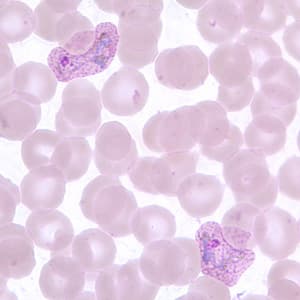
Giemsa-stained thin blood smear: enlarged erythrocytes containing ameboid trophozoites with fine eosinophilic stippling of the red cell membrane. Image courtesy of the CDC/DPDx (public domain).
Question 1
Which Plasmodium species best explains this presentation six months after travel despite compliant prophylaxis?
Select one answer to view the rationale and peer response data.
Question 2
What is the correct treatment?
Select one answer to view the rationale and peer response data.
Question 3
A colleague is about to leave for a similar mission to Papua New Guinea and asks which prophylaxis regimen also protects against hypnozoite establishment. What do you recommend?
Select one answer to view the rationale and peer response data.
Rationale locked
Answer the question above to reveal the rationale.
Rationale locked
Answer the question above to reveal the rationale.
References
Centers for Disease Control and Prevention. Malaria: Treatment (United States).
Centers for Disease Control and Prevention. Malaria: Choosing a Drug to Prevent Malaria.
Baird JK. Resistance to therapies for infection by Plasmodium vivax. Clinical Microbiology Reviews. 2009;22(3):508-534.
Lacerda MVG, Llanos-Cuentas A, Krudsood S, et al. Single-dose tafenoquine to prevent relapse of Plasmodium vivax malaria. New England Journal of Medicine. 2019;380(3):215-228.
Lacerda et al.: Single-Dose Tafenoquine for P. vivax Relapse Prevention (NEJM 2019)