The Fig Tree Fever
Clinical Vignette
A 38-year-old woman who works as a school librarian in Highland Park, Los Angeles presents to an urgent care clinic with 9 days of high-grade fever, severe bifrontal headache, profound fatigue, and diffuse myalgias. She initially attributed her symptoms to a summer viral illness and managed them with ibuprofen, which offered only partial headache relief. She has no significant past medical history, takes no chronic medications, and is up to date on routine vaccinations.
Around day 6 of her illness, her husband noticed faint pinkish spots on her abdomen and chest. She dismissed them as a heat rash and did not seek care at that time. She denies cough, dyspnea, nausea, vomiting, diarrhea, dysuria, or neck stiffness. She has no international travel, no wilderness camping, and no tick bites that she is aware of. She lives in a hillside home in Highland Park with a backyard containing a fig tree and an avocado tree. She has two indoor-outdoor cats that use a cat door freely. She mentions that opossums regularly visit the yard at night, eating fallen fruit under the trees.
On examination, temperature is 38.9°C, heart rate 104/min, blood pressure 108/70 mmHg, respiratory rate 16/min, and oxygen saturation 99% on room air. She appears fatigued but is alert and conversant. A maculopapular rash composed of discrete 2 to 4 mm erythematous macules and papules is distributed across the anterior chest, abdomen, and upper back. The palms, soles, and face are spared. No petechiae or vesicles are present. There is no eschar on the scalp, neck, axillae, groin, or anywhere else on the skin surface. The liver edge is palpable 2 cm below the costal margin and mildly tender to deep palpation. The spleen tip is palpable. No lymphadenopathy is appreciated. Lung and cardiac examinations are unremarkable.
Laboratory studies show white blood cells 5.8 x 10^3/uL with 72% neutrophils and 8% bands, hemoglobin 12.4 g/dL, platelets 88 x 10^3/uL, creatinine 1.2 mg/dL, sodium 131 mEq/L, AST 92 U/L, ALT 71 U/L, LDH 328 U/L, and C-reactive protein 112 mg/L. A malaria smear and rapid antigen test are negative. Dengue NS1 antigen and IgM ELISA are negative. Blood cultures are obtained. A chest radiograph is unremarkable.
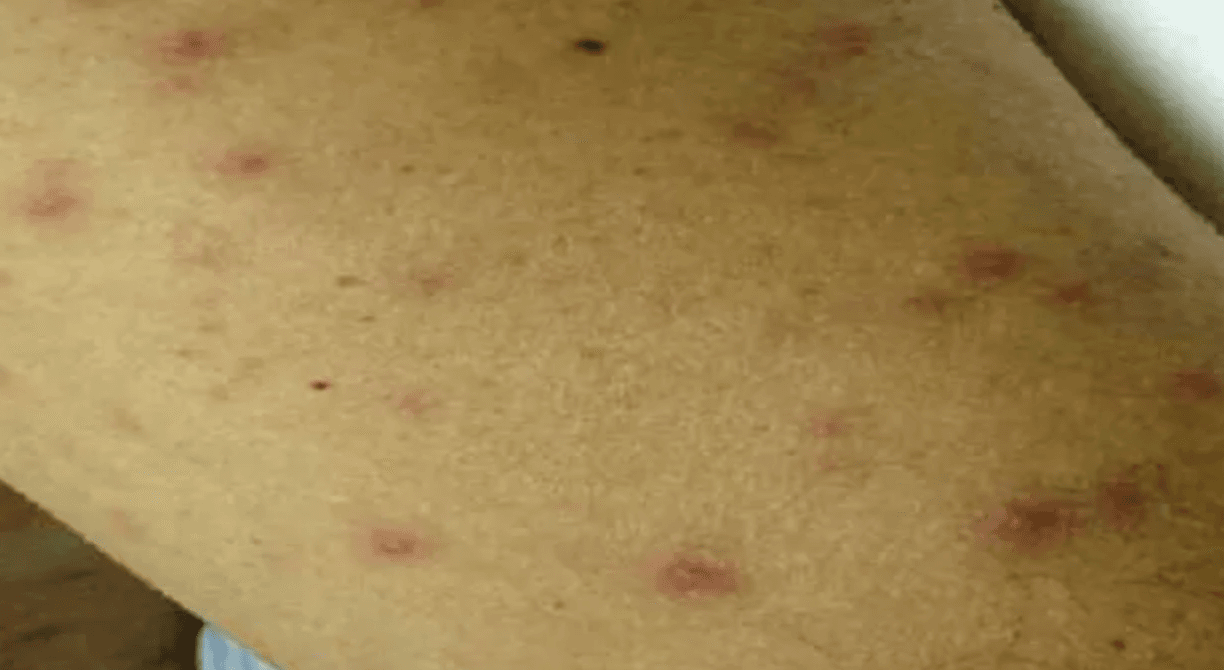
Maculopapular rash on the trunk. The palms, soles, and face are spared.
Question 1
What is the most likely diagnosis?
Select one option to submit your answer and view live poll results.
Question 2
What is the treatment of choice?
Select one option to submit your answer and view live poll results.
Question 3
How does R. typhi typically enter the human host?
Select one option to submit your answer and view live poll results.
References
Centers for Disease Control and Prevention. Murine Typhus: Clinical Information.
California Department of Public Health. Murine Typhus.
Adjemian J, Parks S, McElroy K, et al. Murine typhus in Austin, Texas, USA, 2008. Emerging Infectious Diseases. 2010;16(3):412-417.
Blanton LS. The Rickettsioses: A Practical Update. Infectious Disease Clinics of North America. 2019;33(1):213-229.