The Absent Shield
Clinical Vignette
A 54-year-old woman born in Vietnam who immigrated to the United States 20 years ago presents with four months of daily fevers, drenching night sweats, a 9 kg weight loss, and progressive enlargement of lymph nodes in the neck and groin. She has no known medical history, takes no medications, and has no family history of immunodeficiency or malignancy. She has no recent travel outside the continental United States, no animal exposures, and no sick contacts. She was referred from an outside facility where she had been evaluated for possible lymphoma.
On examination, temperature is 38.7°C, heart rate 102/min, blood pressure 110/70 mmHg, respiratory rate 18/min, and oxygen saturation 96% on room air. She appears cachectic and chronically ill. Bilateral cervical, axillary, and inguinal lymphadenopathy is present; nodes measure 2 to 4 cm, are firm and non-tender. The liver edge is palpable 3 cm below the right costal margin. The spleen tip is palpable 4 cm below the left costal margin. No mucocutaneous lesions or skin findings are identified.
Laboratory studies show white blood cells 8.2 x 10^3/uL with a normal differential, hemoglobin 9.4 g/dL (normocytic), platelets 142 x 10^3/uL, LDH 584 U/L, ferritin 2,840 ng/mL, ESR 98 mm/hr, CRP 88 mg/L, and albumin 2.6 g/dL. HIV-1/2 antigen-antibody combination assay is negative. CD4 count is 420 cells/uL. QuantiFERON-TB Gold Plus is indeterminate on two separate occasions. CT chest, abdomen, and pelvis shows mediastinal and bilateral hilar lymphadenopathy, hepatosplenomegaly, retroperitoneal lymphadenopathy, and diffuse pulmonary nodules with right upper lobe consolidation. PET-CT shows hypermetabolic lymphadenopathy in mediastinal, hilar, and retroperitoneal stations with SUV max of 14.2, along with hypermetabolic hepatosplenomegaly and bilateral pulmonary disease.
Excisional cervical lymph node biopsy shows non-caseating granulomas with abundant acid-fast bacilli on Ziehl-Neelsen stain; flow cytometry shows no evidence of lymphoma. Bone marrow biopsy reveals hypercellular marrow with granulomas and AFB. Blood cultures using the BACTEC MGIT 960 liquid system turn positive at day 11; speciation by hsp65 sequencing identifies Mycobacterium avium complex. No susceptibility testing suggests macrolide resistance.
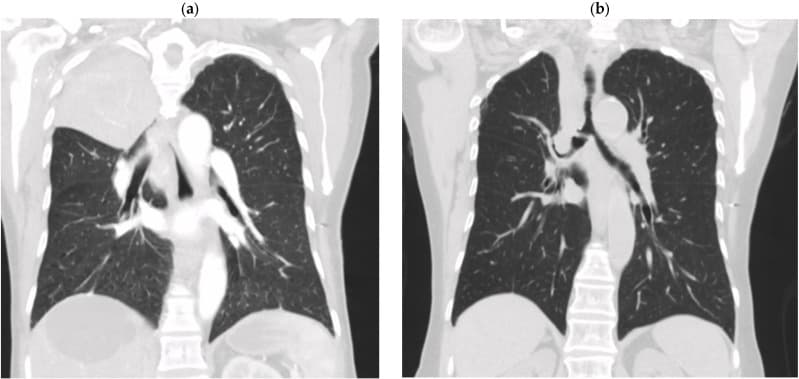
Coronal chest CT at presentation (left) showing dense right-sided consolidation and bulky mediastinal lymphadenopathy, with marked radiographic improvement after treatment (right). Image adapted from Nguyen et al., Tropical Medicine and Infectious Disease (2025), CC BY 4.0.
Question 1
What is the most likely underlying immunological mechanism explaining disseminated MAC in this HIV-negative adult?
Select one answer to view the rationale and peer response data.
Question 2
Which single test best confirms the suspected immune defect?
Select one answer to view the rationale and peer response data.
Question 3
Beyond MAC-directed antimicrobials, which intervention best addresses the underlying immune defect?
Select one answer to view the rationale and peer response data.
Rationale locked
Answer the question above to reveal the rationale.
Rationale locked
Answer the question above to reveal the rationale.
References
Browne SK, Burbelo PD, Chetchotisakd P, et al. Adult-onset immunodeficiency in Thailand and Taiwan. New England Journal of Medicine. 2012;367(8):725-734.
Browne et al.: Adult-Onset Immunodeficiency in Thailand and Taiwan (NEJM 2012)
Nguyen VT, Pham TK, Nguyen TTH, et al. Anti-IFN-γ autoantibody syndrome presenting with disseminated nontuberculous mycobacteria infections: a case series of therapeutic implications and review of literature. Tropical Medicine and Infectious Disease. 2025;10(7):202.
Nguyen et al.: Anti-IFN-γ Syndrome — Case Series and Therapeutic Implications (2025)
Sharma SK, Soneja M, Sreenivas V, et al. Treatment dilemmas in disseminated nontuberculous mycobacterial infections with interferon-gamma autoantibodies. Open Forum Infectious Diseases. 2021;8(8):ofab253.
Sharma et al.: Treatment Dilemmas in Disseminated NTM with IFN-γ Autoantibodies
Chi CY, Chu CC, Liu JP, et al. Anti-IFN-γ autoantibodies in adults with disseminated nontuberculous mycobacterial infections are associated with HLA-DRB116:02 and HLA-DQB105:02 and the reactivation of latent varicella-zoster virus infection. Blood. 2013;121(8):1357-1366.
Chi et al.: HLA Associations and Anti-IFN-γ Autoantibodies in NTM Infections