Fever in the Ozarks
Clinical Vignette
A 58-year-old man from rural Missouri presents to an urgent care clinic with four days of abrupt high-grade fever, shaking chills, a severe bifrontal headache, diffuse myalgias, nausea, and anorexia. He returned from a three-day deer hunting trip in the Ozarks ten days ago and recalls pulling two small ticks from his lower extremities on the last day of the trip. He has no significant medical history, takes no medications, and denies any rash, neck stiffness, joint pain, cough, or dyspnea.
On examination, temperature is 39.8°C, heart rate 108/min, blood pressure 108/70 mmHg, respiratory rate 18/min, and oxygen saturation 97% on room air. He appears acutely ill and fatigued. No rash is identified on full skin survey including the palms and soles. The liver edge is palpable 2 cm below the right costal margin. No lymphadenopathy and no splenomegaly are detected.
Laboratory studies show white blood cells 2.4 x 10^3/uL with 62% neutrophils, 22% lymphocytes, and 10% monocytes, hemoglobin 13.8 g/dL, and platelets 68 x 10^3/uL. AST is 182 U/L, ALT is 148 U/L, LDH is 512 U/L, creatinine is 1.5 mg/dL, and sodium is 126 mEq/L. A peripheral blood smear is examined (see image). Blood cultures are obtained and pending. A chest radiograph is unremarkable.
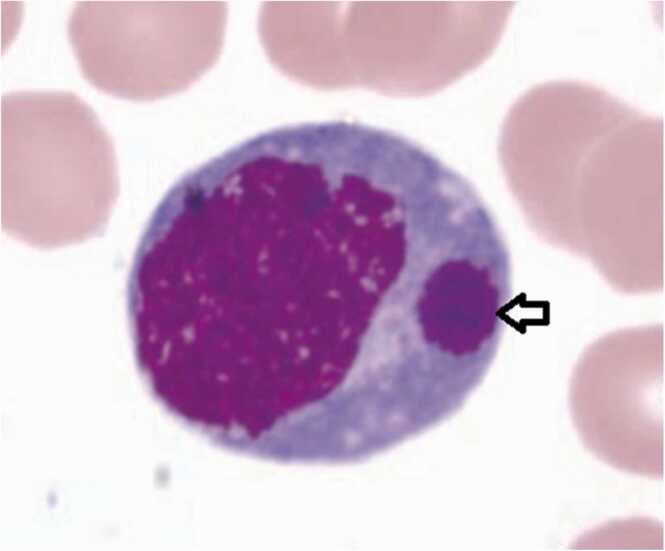
Wright stain of peripheral blood smear: a monocyte containing an intracytoplasmic basophilic inclusion (arrow). Image adapted from Adesanya et al., American Journal of Emergency Medicine (2022), CC BY-NC-ND.
Question 1
What is the most likely diagnosis?
Select one answer to view the rationale and peer response data.
Question 2
Which test best confirms the diagnosis early in the illness?
Select one answer to view the rationale and peer response data.
Question 3
What is the treatment of choice?
Select one answer to view the rationale and peer response data.
Rationale locked
Answer the question above to reveal the rationale.
Rationale locked
Answer the question above to reveal the rationale.
References
Centers for Disease Control and Prevention. Ehrlichiosis: Clinical Overview for Healthcare Providers.
Paddock CD, Childs JE. Ehrlichia chaffeensis: a prototypical emerging pathogen. Clinical Microbiology Reviews. 2003;16(1):37-64.
Paddock & Childs: E. chaffeensis — A Prototypical Emerging Pathogen
Adesanya O, Adekunle I, Motunrayo Oyelaran M, et al. Ehrlichiosis mimicking acute leukemia. American Journal of Emergency Medicine. 2022;57:231.e1-231.e3.
Adesanya et al.: Ehrlichiosis Mimicking Acute Leukemia (image source, CC BY-NC-ND)
McMullan LK, Folk SM, Kelly AJ, et al. A new phlebovirus associated with severe febrile illness in Missouri. New England Journal of Medicine. 2012;367(9):834-841.
McMullan et al.: Heartland Virus — A New Phlebovirus in Missouri (NEJM 2012)