The PCR That Climbed
Clinical Vignette
A 58-year-old man with idiopathic pulmonary fibrosis underwent bilateral lung transplantation fourteen months ago. Pre-transplant CMV serology demonstrated a seropositive donor and seronegative recipient (D+/R−). He completed twelve months of valganciclovir prophylaxis, which was discontinued two months ago. His current immunosuppressive regimen includes tacrolimus (trough 7.4 ng/mL), mycophenolate mofetil 1000 mg twice daily, and prednisone 5 mg daily. He has had no episodes of acute rejection.
He presents to the transplant clinic with two weeks of persistent fever (maximum temperature 38.3 °C), progressive fatigue, myalgias, and anorexia. He reports no cough, dyspnea, diarrhea, or abdominal pain. On examination, temperature is 38.1 °C, heart rate 96/min, blood pressure 128/76 mmHg, oxygen saturation 97% on room air. The chest is clear to auscultation, and the surgical incision is well healed. There is no hepatosplenomegaly, no oral lesions, and no focal neurological findings. Laboratory studies reveal a white blood cell count of 2.8 k/mcL with an absolute neutrophil count of 1.2 k/mcL and absolute lymphocyte count of 0.4 k/mcL, hemoglobin 10.8 g/dL, platelets 112 k/mcL, and serum creatinine 1.1 mg/dL (baseline). Serum CMV quantitative PCR returns at 48,000 IU/mL. Chest CT shows no new infiltrates or nodules. Stool studies are negative. CMV syndrome is diagnosed, and the patient is admitted for intravenous ganciclovir 5 mg/kg every 12 hours, dosed appropriately for his renal function.
During the admission the pharmacy team confirms that the ganciclovir dose is weight-based and appropriately renal-adjusted, with no missed doses. The tacrolimus trough and mycophenolate dose are unchanged. Weekly serum CMV PCR monitoring is initiated. The viral load trajectory is shown below.
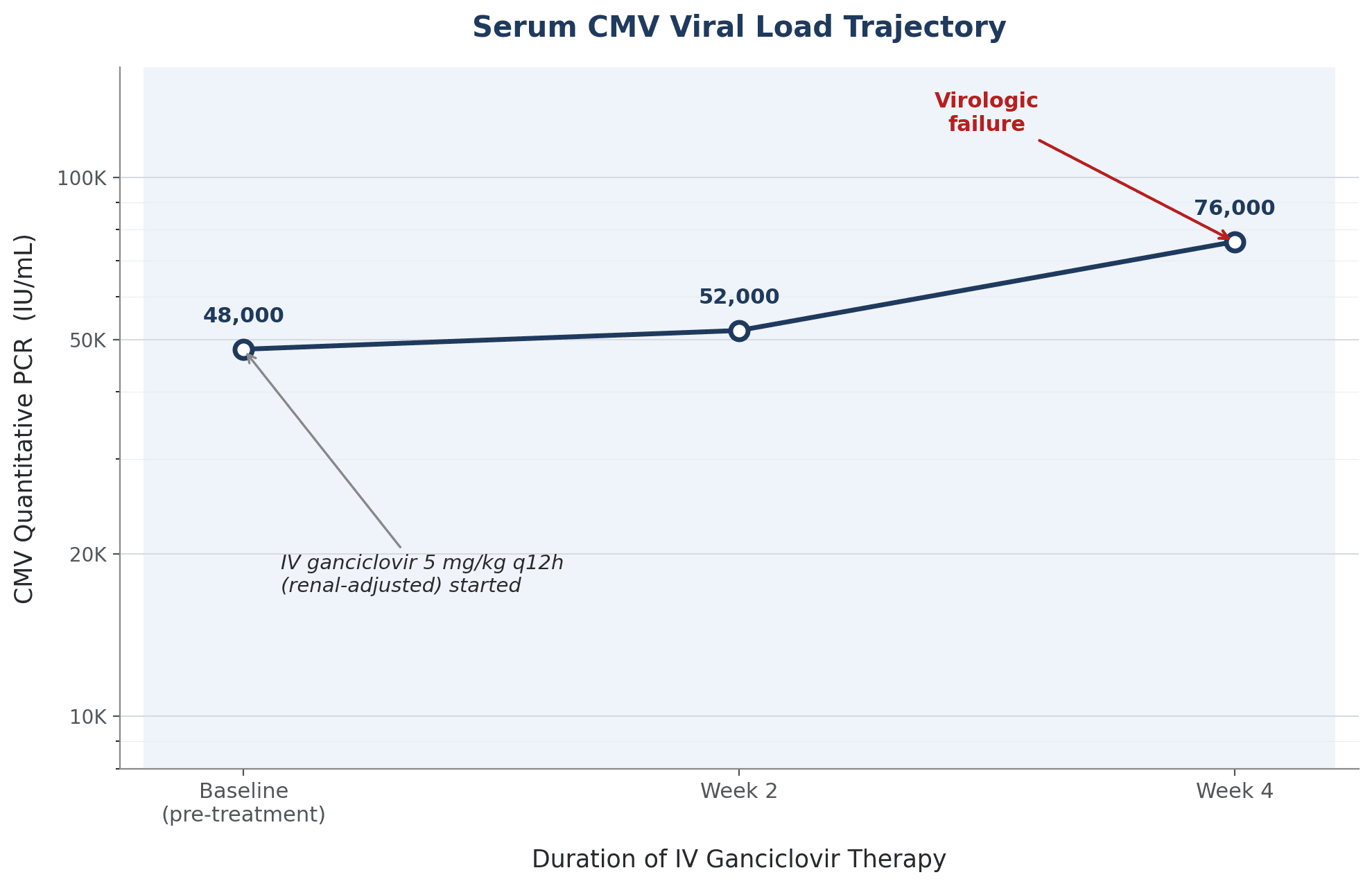
Serum CMV quantitative PCR trajectory: viral load rises despite four weeks of weight-based, renal-adjusted IV ganciclovir.
Question 1
After four weeks of weight-based, renal-adjusted IV ganciclovir with confirmed adherence and no missed doses, the CMV PCR has risen from 48,000 to 76,000 IU/mL. What is the most appropriate next step?
Select one option to submit your answer and view live poll results.
Question 2
Genotypic resistance testing returns two weeks later and reveals a UL97 A594V mutation. No UL54 mutation is detected. The CMV PCR is now 94,000 IU/mL. Based on this result, which statement best describes the antiviral susceptibility profile of this CMV isolate?
Select one option to submit your answer and view live poll results.
Question 3
The patient is switched to foscarnet 90 mg/kg every 12 hours with pre-hydration and electrolyte monitoring. After two weeks, the CMV PCR declines to 18,000 IU/mL. However, his creatinine rises from 1.1 to 2.8 mg/dL. He develops severe hypokalemia (2.8 mEq/L), hypocalcemia, and hypomagnesemia despite aggressive repletion. What is the most appropriate next step?
Select one option to submit your answer and view live poll results.
References
Kotton CN, Kumar D, Caliendo AM, et al. The Third International Consensus Guidelines on the Management of Cytomegalovirus in Solid-Organ Transplantation. Transplantation. 2018;102(6):900-931.
Avery RK, Alain S, Alexander BD, et al. Maribavir for Refractory Cytomegalovirus Infections with or without Resistance Post-Transplant: Results from the Phase 3 Randomized SOLSTICE Trial. Clinical Infectious Diseases. 2022;75(4):690-701.
Lurain NS, Chou S. Antiviral drug resistance of human cytomegalovirus. Clinical Microbiology Reviews. 2010;23(4):689-712.
Chou S. Approach to drug-resistant cytomegalovirus in transplant recipients. Current Opinion in Infectious Diseases. 2015;28(4):293-299.