The Normal Lung Exam
Clinical Vignette
A 29-year-old man presents to urgent care with 3 weeks of progressive shortness of breath, dry cough, fatigue, and intermittent low-grade fevers. He first noticed dyspnea while climbing stairs, but now becomes winded walking from his apartment to the parking lot. He has no known medical conditions, takes no daily medications, and has not seen a physician in several years. He does not smoke or vape. He works from home, has no recent travel, no animal exposures, and no known sick contacts.
He was given azithromycin at a retail clinic 6 days ago for presumed atypical pneumonia, but his symptoms continued to worsen. He reports poor appetite and says his clothes feel looser than usual, though he has not weighed himself. He denies hemoptysis, pleuritic chest pain, wheezing, leg swelling, night sweats, diarrhea, rash, joint pain, or new occupational exposures.
On examination, temperature is 37.9 C, heart rate 108/min, blood pressure 116/74 mmHg, respiratory rate 24/min, and oxygen saturation 92% on room air at rest. After a short hallway walk, oxygen saturation falls to 83% and he must stop to catch his breath. He appears uncomfortable but speaks in full sentences. Lung examination is surprisingly quiet, with no focal crackles, wheezing, or egophony. There is no cervical lymphadenopathy, oral lesion, rash, clubbing, edema, or murmur.
Laboratory studies show white blood cells 3.2 x 10^3/uL with absolute lymphocyte count 0.5 x 10^3/uL, hemoglobin 12.7 g/dL, platelets 172 x 10^3/uL, creatinine 0.9 mg/dL, AST 42 U/L, ALT 38 U/L, lactate dehydrogenase 468 U/L, C-reactive protein 76 mg/L, and procalcitonin 0.06 ng/mL. Respiratory viral PCR testing, including SARS-CoV-2 and influenza, is negative. Chest radiograph shows only faint bilateral interstitial haziness. CT pulmonary angiography shows no pulmonary embolism but demonstrates diffuse bilateral ground-glass opacities without pleural effusion, cavitation, or focal lobar consolidation.
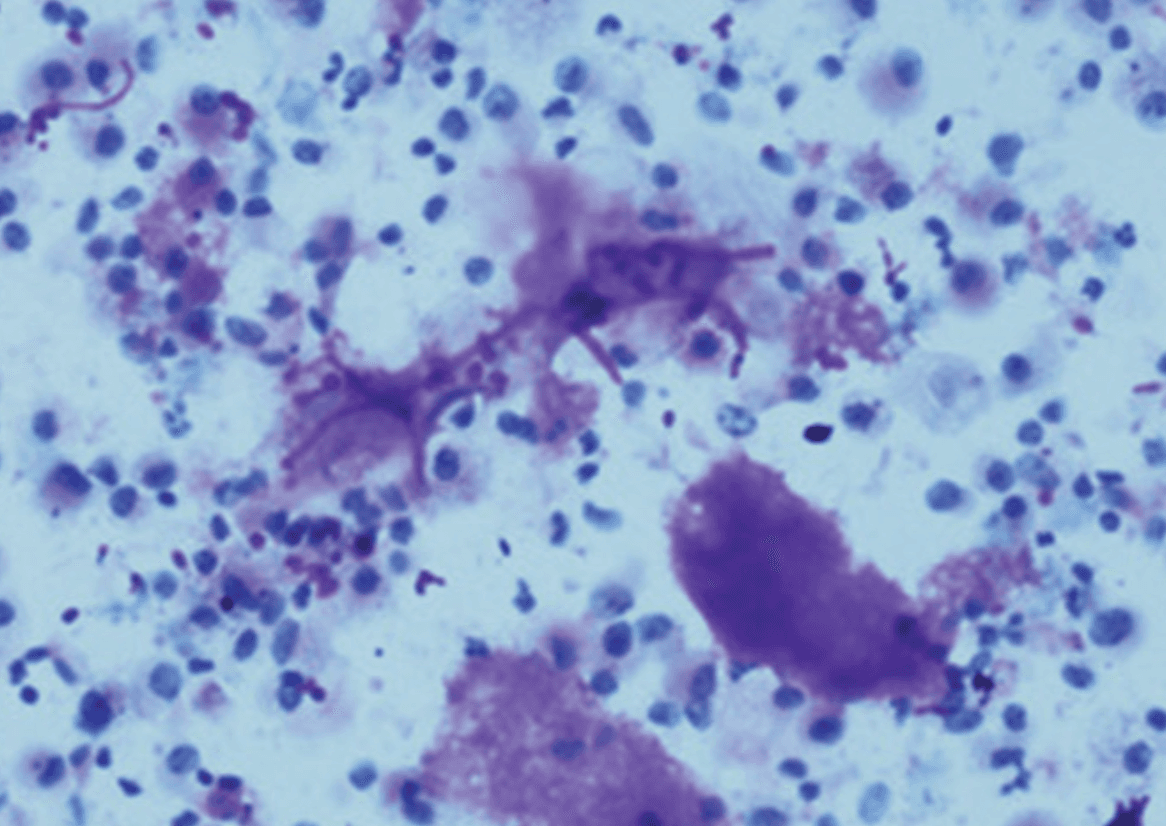
PAS-stained bronchoalveolar lavage specimen from this patient.
Question 1
What is the most likely diagnosis?
Select one option to submit your answer and view live poll results.
Question 2
What diagnostic step is most appropriate now?
Select one option to submit your answer and view live poll results.
Question 3
What is the best treatment?
Select one option to submit your answer and view live poll results.
References
National Institutes of Health. Guidelines for the Prevention and Treatment of Opportunistic Infections in Adults and Adolescents With HIV: Pneumocystis Pneumonia.
Centers for Disease Control and Prevention. Guidelines for Preventing Opportunistic Infections Among HIV-Infected Persons.
Thomas CF Jr, Limper AH. Pneumocystis pneumonia. New England Journal of Medicine. 2004;350:2487-2498.