The Unyielding Ring
Clinical Vignette
A 38-year-old man from rural Cochabamba department, Bolivia presents to the emergency department with two weeks of progressive headache, confusion, and right arm weakness. He grew up in a mud-walled adobe house where triatomine insects were commonly observed during childhood. He immigrated to California six years ago. HIV was diagnosed incidentally three months ago; he has not yet started antiretroviral therapy. His CD4 count is 78 cells/μL and HIV viral load is 482,000 copies/mL.
On examination, temperature is 38.2°C, heart rate 98/min, blood pressure 124/78 mmHg. He is oriented to person only. There is a right arm drift and dysmetria on finger-nose testing; no meningismus is present. MRI brain with gadolinium reveals two ring-enhancing cortical and subcortical lesions in the left frontal and parietal regions with surrounding vasogenic edema. Toxoplasma gondii IgG is negative; serum cryptococcal antigen is negative; CMV PCR and EBV PCR are both undetectable.
Given the imaging findings and degree of immunosuppression, empiric therapy with pyrimethamine (200 mg loading dose, then 75 mg/day), sulfadiazine (4 g/day in divided doses), and leucovorin (10 mg/day) is initiated alongside dexamethasone. After 14 days, he shows no clinical improvement and repeat MRI demonstrates stable-to-mildly progressive lesion enhancement.
Lumbar puncture is performed. Opening pressure is 18 cm H₂O. CSF analysis shows 14 nucleated cells (predominantly lymphocytes), protein 82 mg/dL, and glucose 54 mg/dL (serum glucose 98 mg/dL). On wet mount examination of the CSF, the finding shown below is identified.
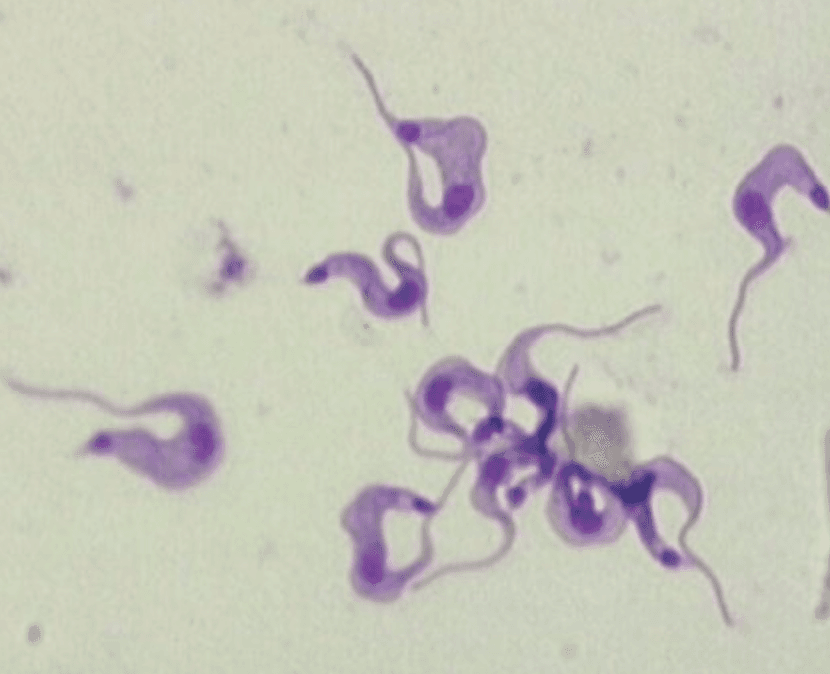
CSF wet mount preparation
Question 1
Which of the following best explains this patient's CNS lesions?
Select one answer to view the rationale and peer response data.
Question 2
T. cruzi IgG serology returns strongly positive, confirming the diagnosis. Which treatment is most appropriate?
Select one answer to view the rationale and peer response data.
Rationale locked
Answer the question above to reveal the rationale.
Rationale locked
Answer the question above to reveal the rationale.
References
Bern C. Chagas disease. New England Journal of Medicine. 2015;373(5):456–466.
Cordova E, Boschi A, Ambrosioni J, Cudos C, Corti M. Reactivation of Chagas disease with central nervous system involvement in HIV-infected patients in Argentina, 1992–2007. International Journal of Infectious Diseases. 2008;12(6):587–592.
Panel on Opportunistic Infections in Adults and Adolescents with HIV. Guidelines for the Prevention and Treatment of Opportunistic Infections in Adults and Adolescents with HIV: Recommendations from the Centers for Disease Control and Prevention, the National Institutes of Health, and the HIV Medicine Association of the Infectious Diseases Society of America. Section: American Trypanosomiasis (Chagas Disease). Updated 2024.
Bern C, Montgomery SP, Herwaldt BL, et al. Evaluation and treatment of Chagas disease in the United States: a systematic review. JAMA. 2007;298(18):2171–2181.
Bern et al.: Evaluation and Treatment of Chagas Disease in the United States (JAMA 2007)