The Eosinophils Knew
Clinical Vignette
A 28-year-old woman presents to the emergency department with two days of periumbilical pain that has migrated to the right lower quadrant. She reports nausea, one episode of non-bloody vomiting, and low-grade fever. She has no significant past medical history. She works as a preschool teacher and lives with her husband and their 5-year-old daughter. She mentions in passing that her daughter has been scratching her bottom at night for the past few weeks, which they attributed to dry skin.
On examination her temperature is 38.2 C, heart rate 92/min, blood pressure 114/72 mmHg, and respiratory rate 16/min. She is tender at McBurney's point with localized guarding and positive Rovsing sign. There is no rebound tenderness.
Laboratory studies show white blood cells 13.2 x 10^3/uL with 68% neutrophils, 8% eosinophils, 18% lymphocytes, and 6% monocytes. Hemoglobin is 12.8 g/dL and platelets are 310 x 10^3/uL. The absolute eosinophil count is approximately 1,050 cells per microliter. A basic metabolic panel and hepatic function panel are within normal limits. Urinalysis is unremarkable.
CT of the abdomen and pelvis with intravenous contrast demonstrates a dilated appendix measuring 12 mm in diameter with surrounding fat stranding and mild wall enhancement, consistent with acute appendicitis. There is no appendicolith, abscess, or free air. The remainder of the abdomen and pelvis is unremarkable.
The patient undergoes laparoscopic appendectomy without complication. Gross inspection reveals an inflamed, erythematous appendix without perforation. Histopathologic examination of the appendix shows acute suppurative appendicitis with a marked eosinophilic infiltrate involving the mucosa, submucosa, and muscularis propria. Within the appendiceal lumen, multiple cross-sections of a nematode are identified. The organism demonstrates a thin eosinophilic cuticle, two prominent lateral alae, and a body cavity containing a uterus filled with numerous eggs. The eggs are elongated-oval and flattened on one side, measuring approximately 50 to 60 by 20 to 30 micrometers.
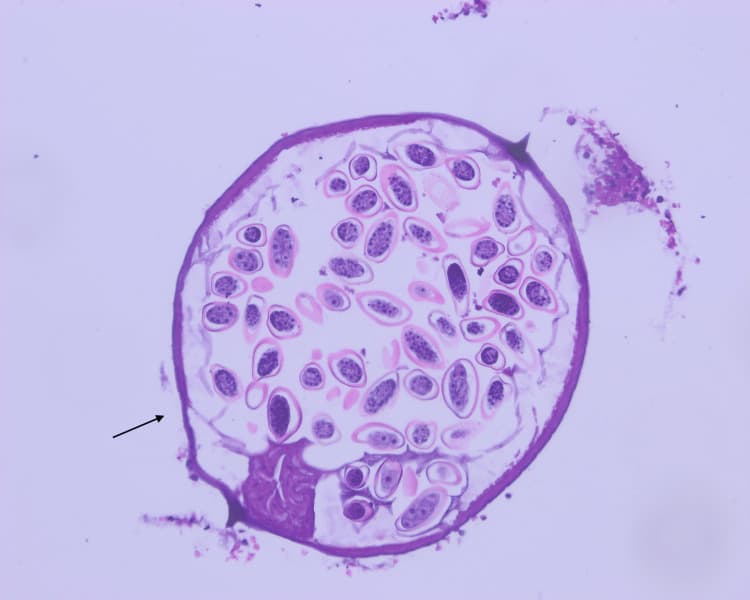
H&E stain of appendiceal lumen contents at x200 magnification. Image from Al-Mufargi et al., Cureus, 2025, CC BY 4.0.
Question 1
What is the most likely causative organism?
Select one option to submit your answer and view live poll results.
Question 2
Which immune mechanism best explains the marked eosinophilic infiltrate in the appendiceal wall?
Select one option to submit your answer and view live poll results.
Question 3
The patient's 5-year-old daughter has been scratching her bottom at night. Which diagnostic test is most appropriate to confirm the suspected infection in the daughter?
Select one option to submit your answer and view live poll results.
Question 4
Which approach to treatment is most appropriate?
Select one option to submit your answer and view live poll results.
References
Burkhart CN, Burkhart CG. Assessment of frequency, transmission, and genitourinary complications of enterobiasis (pinworms). International Journal of Dermatology. 2005;44(10):837-840.
Rohe DL, Vugia DJ, microparasitology review. Enterobiasis and the appendiceal connection: a systematic review. Clinical Infectious Diseases. 2020;71(4):e269-e276.
Gazzinelli-Guimaraes PH, Nutman TB. Helminth parasites and immune regulation. Seminars in Immunopathology. 2023;45(3):321-338.
Al-Mufargi Y, Al Musalhi K, Khalil M, Hamad M, Al-Atar A. Enterobius vermicularis as an intraoperative surprise in a child with suspected appendicitis and normal laboratory findings. Cureus. 2025;17(1):e94036.
Pogorelic Z, Babic V, Baskovic M, Ercegovic V, Mrklic I. Management and incidence of Enterobius vermicularis infestation in appendectomy specimens: a cross-sectional study of 6,359 appendectomies. Journal of Clinical Medicine. 2024;13(11):3198.