The Ulcers That Would Not Heal
Clinical Vignette
A 44-year-old woman with acute myeloid leukemia presents on day 64 after matched unrelated donor allogeneic hematopoietic stem cell transplantation with worsening oral pain and new perianal ulceration. Her post-transplant course has been complicated by grade II gastrointestinal graft-versus-host disease requiring prednisone 40 mg daily in addition to tacrolimus. She has been taking acyclovir prophylaxis since engraftment.
Ten days before presentation, she developed several painful vesicles on the lower lip and shallow erosions along the hard palate. A swab from the lip was positive for herpes simplex virus type 1 by polymerase chain reaction. Oral valacyclovir was changed to intravenous acyclovir, dosed appropriately for renal function. Despite 8 days of therapy, the oral lesions enlarged into punched-out ulcers, and she developed severe perianal pain with a deep ulcer at the anal verge. She reports no odynophagia, visual symptoms, headache, cough, or dysuria.
Temperature is 37.8 C, heart rate 96/min, blood pressure 118/70 mmHg, and oxygen saturation 98% on room air. Examination shows a 1.5-cm ulcer with a scalloped border on the lower lip, several shallow palatal ulcers with fibrinous bases, and a tender perianal ulcer without fluctuance. There is no diffuse vesicular rash. The central venous catheter site is clean. Absolute neutrophil count is 1.9 x 10^3/uL, absolute lymphocyte count is 0.3 x 10^3/uL, creatinine is 0.9 mg/dL, and liver enzymes are normal.
Repeat lesion testing remains positive for herpes simplex virus type 1 by polymerase chain reaction with a low cycle threshold. Bacterial culture from the perianal lesion grows only mixed skin flora, fungal culture is negative to date, and plasma cytomegalovirus polymerase chain reaction is not detected. Biopsy of the ulcer edge shows viral cytopathic change, and electron microscopy is reviewed by pathology, who note enveloped particles with icosahedral nucleocapsids within infected epithelial cells. The transplant team confirms that acyclovir was given at standard treatment dosing and that no doses were missed. The lesions continue to progress while she remains on intravenous acyclovir.
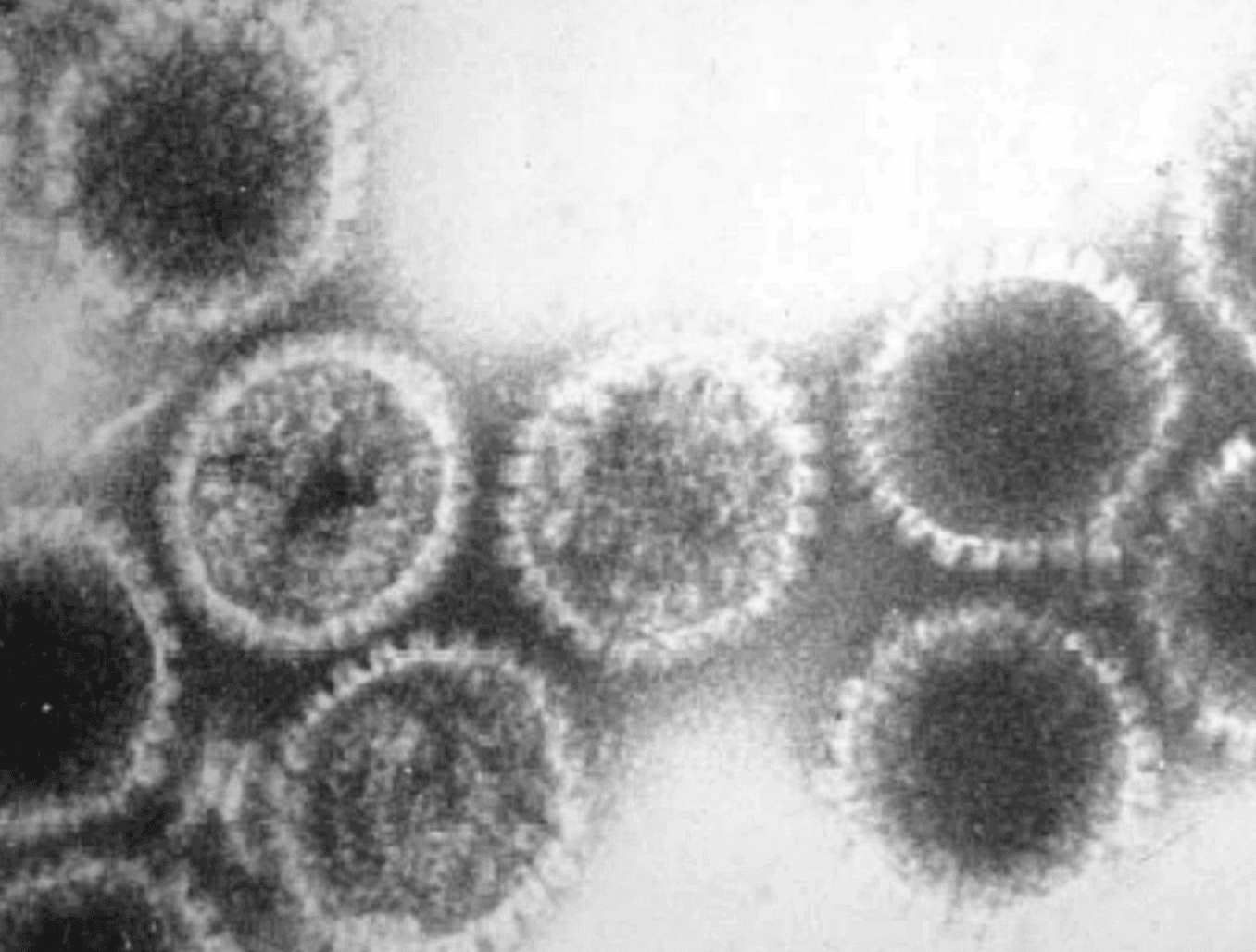
Electron microscopy demonstrating enveloped viral particles with icosahedral nucleocapsids.
Question 1
What is the most likely diagnosis?
Select one option to submit your answer and view live poll results.
Question 2
What test should be ordered next?
Select one option to submit your answer and view live poll results.
Question 3
What is the most common mechanism of resistance?
Select one option to submit your answer and view live poll results.
References
Erard V, Wald A, Corey L, Leisenring WM, Boeckh M. Use of long-term suppressive acyclovir after hematopoietic stem-cell transplantation: impact on herpes simplex virus disease and drug-resistant herpes simplex virus disease. J Infect Dis. 2007;196(2):266-270.
Schiffer JT, Corey L. New concepts in understanding genital herpes. Curr Infect Dis Rep. 2009;11(6):457-464.
Piret J, Boivin G. Resistance of herpes simplex viruses to nucleoside analogues: mechanisms, prevalence, and management. Antimicrob Agents Chemother. 2011;55(2):459-472.
Tomblyn M, Chiller T, Einsele H, et al. Guidelines for preventing infectious complications among hematopoietic cell transplantation recipients: a global perspective. Biol Blood Marrow Transplant. 2009;15(10):1143-1238.