The Eye of the Rabbit
Clinical Vignette
A 44-year-old previously healthy man from rural Arkansas presents to an urgent care clinic with 7 days of worsening left eye pain, redness, and discharge. Ten days prior, he was field-dressing a wild cottontail rabbit he had shot during a hunting trip. He was not wearing gloves and recalls rubbing his left eye with the back of his hand while processing the carcass. Three days after the exposure, he developed a foreign body sensation and mucopurulent discharge in the left eye, which he attributed to pink eye. Over the following days, the symptoms worsened to severe photophobia, a significant decrease in vision, and intense periorbital pain. He also noticed a large, painful lump in front of his left ear.
On examination, temperature is 38.5°C, heart rate 98, blood pressure 128/76 mmHg. The left eye has marked conjunctival injection, profuse mucopurulent discharge, and severe photophobia. Slit-lamp biomicroscopy reveals follicular conjunctivitis of the upper and lower tarsal conjunctiva and the finding shown in the image below. A left preauricular lymph node measuring 3 cm is palpable, tender, and fluctuant. There is additional tender left anterior cervical lymphadenopathy. The right eye is entirely normal.
Laboratory studies: WBC 12.4 k/mcL with 78% neutrophils, CRP 84 mg/L, ESR 62 mm/hr. LFTs mildly elevated. Corneal scraping and conjunctival swabs are sent to the laboratory. Gram stain of the conjunctival swab shows no organisms. Standard bacterial cultures are pending. The microbiology technician is alerted to the clinical history before processing.
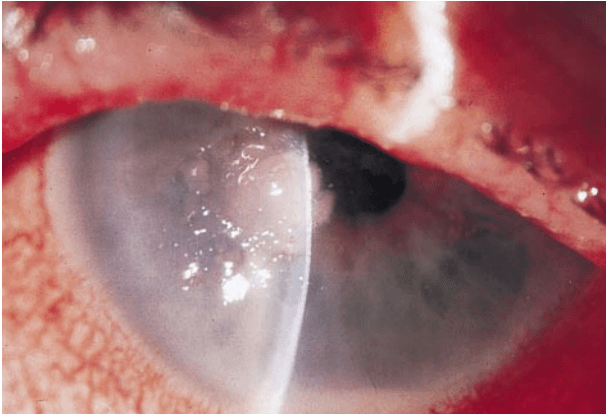
Slit-lamp examination of the left eye: a central corneal ulcer with dense stromal infiltrate and an inferior hypopyon occupying approximately 5% of the anterior chamber.
Question 1
What is the most likely diagnosis?
Select one option to submit your answer and view live poll results.
Question 2
What is the treatment of choice?
Select one option to submit your answer and view live poll results.
Question 3
Unilateral follicular conjunctivitis with ipsilateral preauricular lymphadenopathy defines Parinaud's oculoglandular syndrome. Which of the following is NOT a recognized cause?
Select one option to submit your answer and view live poll results.
References
Dennis DT, Inglesby TV, Henderson DA, et al. Tularemia as a biological weapon: medical and public health management. JAMA. 2001;285(21):2763-2773.
Maurin M, Gyuranecz M. Tularaemia: clinical aspects in Europe. The Lancet Infectious Diseases. 2016;16(1):113-124.
Tärnvik A, Chu MC. New approaches to diagnosis and therapy of tularemia. Annals of the New York Academy of Sciences. 2007;1105:378-404.