The Blinding Cycle
Clinical Vignette
A 28-year-old woman presents to a district health clinic in the Amhara region of Ethiopia with a three-month history of bilateral eye irritation, mucopurulent discharge, and photophobia. She works as a community health worker in a rural village where access to clean water requires a two-hour daily walk. She lives in a compound household with her parents, two siblings, and four young children. Several of the children have had similar eye symptoms for the past year. She reports no prior eye surgery or trauma and no systemic symptoms.
On examination, visual acuity is 20/25 bilaterally with no correction. There is mild conjunctival injection and a scant mucopurulent discharge in both eyes. Slit-lamp biomicroscopy of the everted upper eyelids reveals the finding shown in the image below. The lower tarsal conjunctiva and cornea are clear. There is no eyelid scarring, no in-turned eyelashes, and no corneal opacity on this examination. Regional lymphadenopathy and systemic examination are unremarkable.
A survey conducted in this community three months ago found that 38% of children aged 1 to 9 years had the same finding on upper tarsal conjunctival examination. The district health officer is asking for guidance on both individual management and community-level response.
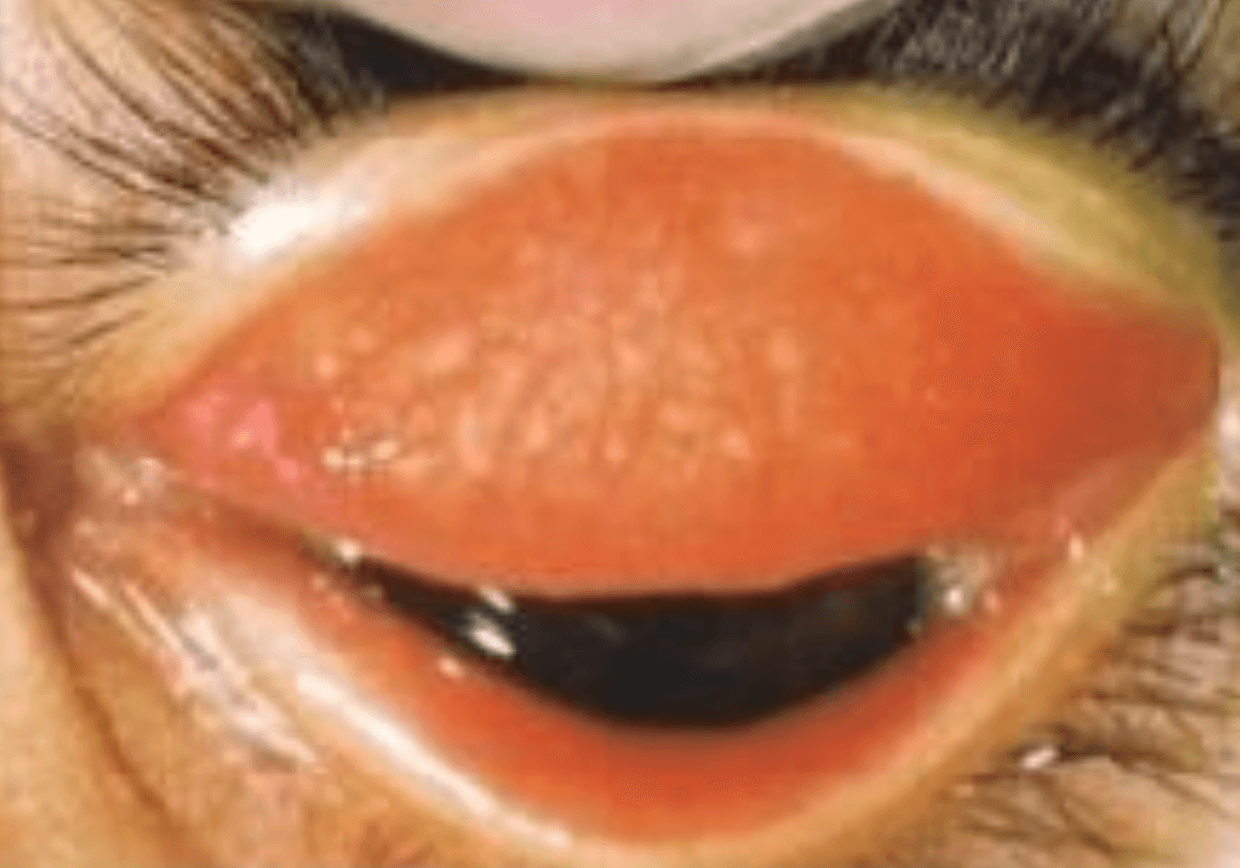
Slit-lamp biomicroscopy of the everted upper eyelid: multiple pale, round elevations are visible on the tarsal conjunctiva.
Question 1
Which organism is responsible for this condition?
Select one option to submit your answer and view live poll results.
Question 2
Given a community TF prevalence of 38% in children aged 1-9, what is the most appropriate response?
Select one option to submit your answer and view live poll results.
Question 3
If left untreated through repeated infections, what sequence of events leads to blindness?
Select one option to submit your answer and view live poll results.
References
Burton MJ, Rajak SN, Bauer J, et al. Conjunctival transcriptome in scarring trachoma. Infection and Immunity. 2011;79(1):499-511.
World Health Organization. Trachoma: WHO simplified grading system. Geneva: WHO; 1987. Reprinted 1993.
Keenan JD, Bailey RL, West SK, et al. Azithromycin to reduce childhood mortality in sub-Saharan Africa. New England Journal of Medicine. 2018;378(17):1583-1592.