Before Day Forty-Two
Clinical Vignette
A 48-year-old woman with acute myeloid leukemia in first complete remission was admitted for myeloablative allogeneic hematopoietic stem cell transplantation from a matched sibling donor. Her pretransplant infectious disease evaluation included CMV, EBV, HSV, VZV, HIV, hepatitis B, and hepatitis C serologies. Toxoplasma IgG was not ordered. Conditioning was completed with busulfan and cyclophosphamide. She received tacrolimus and methotrexate for graft-versus-host disease prophylaxis, fluconazole, acyclovir, and a fluoroquinolone. TMP-SMX was scheduled to begin at day 42 after confirmed engraftment.
On day 13 post-transplant, her nursing team noted that she seemed confused during morning rounds. Over the prior three days she had reported worsening bifrontal headache and had become increasingly forgetful. She had not mentioned these symptoms, attributing them to fatigue and tacrolimus side effects. She denied nausea, vomiting, visual changes, or seizure activity. She had not left the hospital since the start of conditioning. No weekly Toxoplasma PCR monitoring had been ordered during the post-engraftment surveillance period.
On examination, temperature is 38.3°C, heart rate 106/min, blood pressure 118/74 mmHg, respiratory rate 16/min, and oxygen saturation 97% on room air. She is oriented to person and place but not time, and cannot follow complex commands. Right arm pronator drift is present. Deep tendon reflexes are brisk on the right. No papilledema is seen on fundoscopy. No skin rash or eschar. No meningismus.
Laboratory studies show ANC 0.3 x 10^3/uL, hemoglobin 8.1 g/dL, platelets 22 x 10^3/uL, creatinine 1.1 mg/dL, AST 48 U/L, ALT 41 U/L, sodium 132 mEq/L, and LDH 412 U/L. CMV PCR is undetectable. EBV PCR is undetectable. Serum beta-D-glucan and galactomannan are both negative. Blood cultures are pending. A platelet transfusion is administered and lumbar puncture is performed: opening pressure 24 cm H2O, 18 nucleated cells (82% lymphocytes), protein 66 mg/dL, glucose 46 mg/dL; CSF bacterial and fungal cultures are sent and additional studies are pending. MRI brain with gadolinium contrast is hown below.
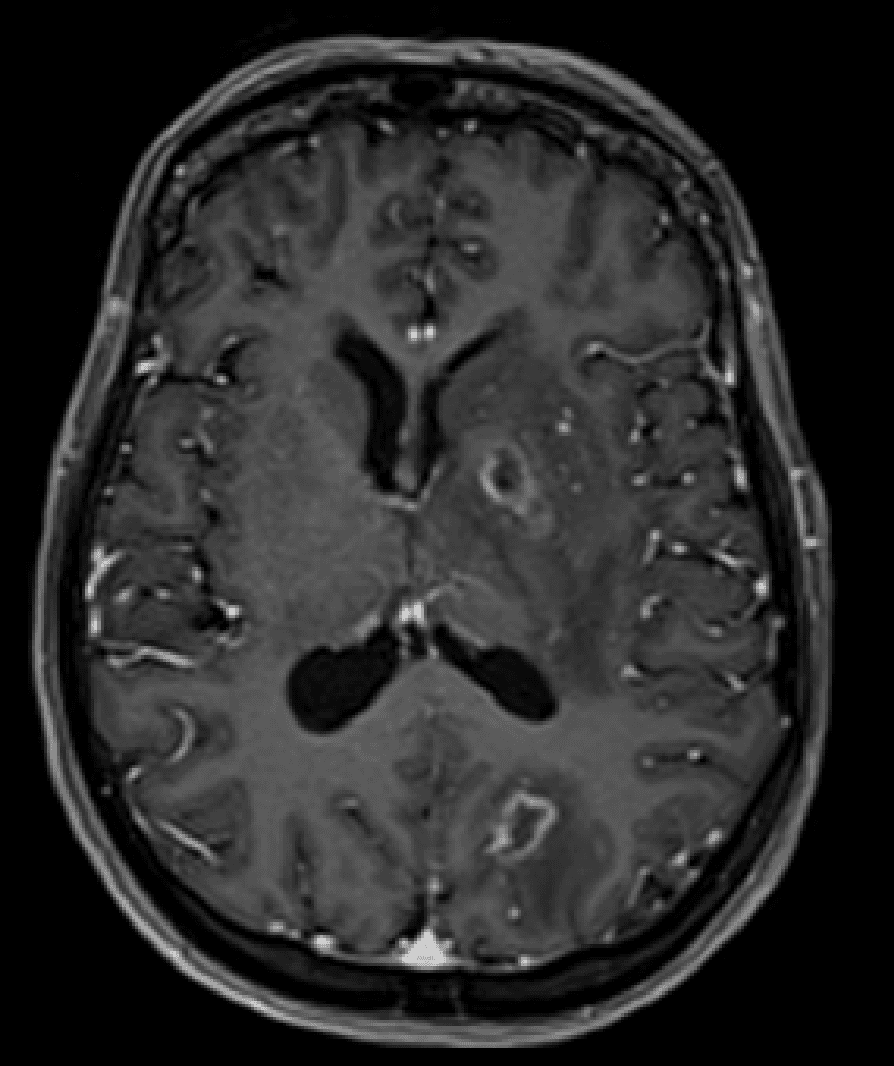
Post-contrast axial T1-weighted MRI revealing ring-enhancing lesions predominantly in the basal ganglia.
Question 1
What is the most likely diagnosis?
Select one option to submit your answer and view live poll results.
Question 2
What is the treatment of choice?
Select one option to submit your answer and view live poll results.
Question 3
Which best explains why this patient developed CNS toxoplasmosis despite having been hospitalized since the start of conditioning?
Select one option to submit your answer and view live poll results.
References
Centers for Disease Control and Prevention. Toxoplasmosis: Resources for Health Professionals.
Martino R, Bretagne S, Einsele H, et al. Early detection of Toxoplasma infection by molecular monitoring of Toxoplasma gondii in peripheral blood samples after allogeneic stem cell transplantation. Clinical Infectious Diseases. 2005;40(1):67-78.
Derouin F, Pelloux H; ESCMID Study Group on Clinical Parasitology. Prevention of toxoplasmosis in transplant patients. Clinical Microbiology and Infection. 2008;14(12):1089-1101.
Derouin & Pelloux: Prevention of Toxoplasmosis in Transplant Patients
Panel on Opportunistic Infections in Adults and Adolescents with HIV. Guidelines for the Prevention and Treatment of Opportunistic Infections in Adults and Adolescents with HIV. National Institutes of Health.