The Negative Test and the Worsening Lungs
Clinical Vignette
A 68-year-old man is admitted with 6 days of fever, progressive dyspnea, dry cough, watery diarrhea, and new confusion. He has rheumatoid arthritis treated with prednisone 15 mg daily and adalimumab. Ten days before presentation, his apartment building had several days of plumbing repairs after hot-water outages; he remembers running the shower for several minutes each morning because the water was rusty and sputtered when it returned.
On arrival, temperature is 39.2 C, heart rate 112/min, blood pressure 104/64 mmHg, respiratory rate 28/min, and oxygen saturation 87% on room air, improving to 94% with 5 L/min nasal cannula. He appears ill and mildly disoriented. Lung examination reveals crackles over the right upper and left lower lung fields. There is no neck stiffness, rash, abdominal tenderness, or peripheral edema.
Laboratory studies show white blood cell count 13.8 x 10^3/uL, sodium 125 mEq/L, creatinine 1.7 mg/dL from a baseline of 1.0 mg/dL, AST 96 U/L, ALT 82 U/L, and C-reactive protein 218 mg/L. Chest radiograph shows multifocal airspace opacities involving more than one lobe. Respiratory viral polymerase chain reaction testing is negative, blood cultures are pending, and sputum Gram stain shows few neutrophils with mixed upper respiratory flora.
He is started on ceftriaxone and vancomycin. After 48 hours, he remains febrile, his oxygen requirement rises to high-flow nasal cannula, and repeat imaging shows progression of multilobar pneumonia. A urine antigen test for Legionella is reported as negative.
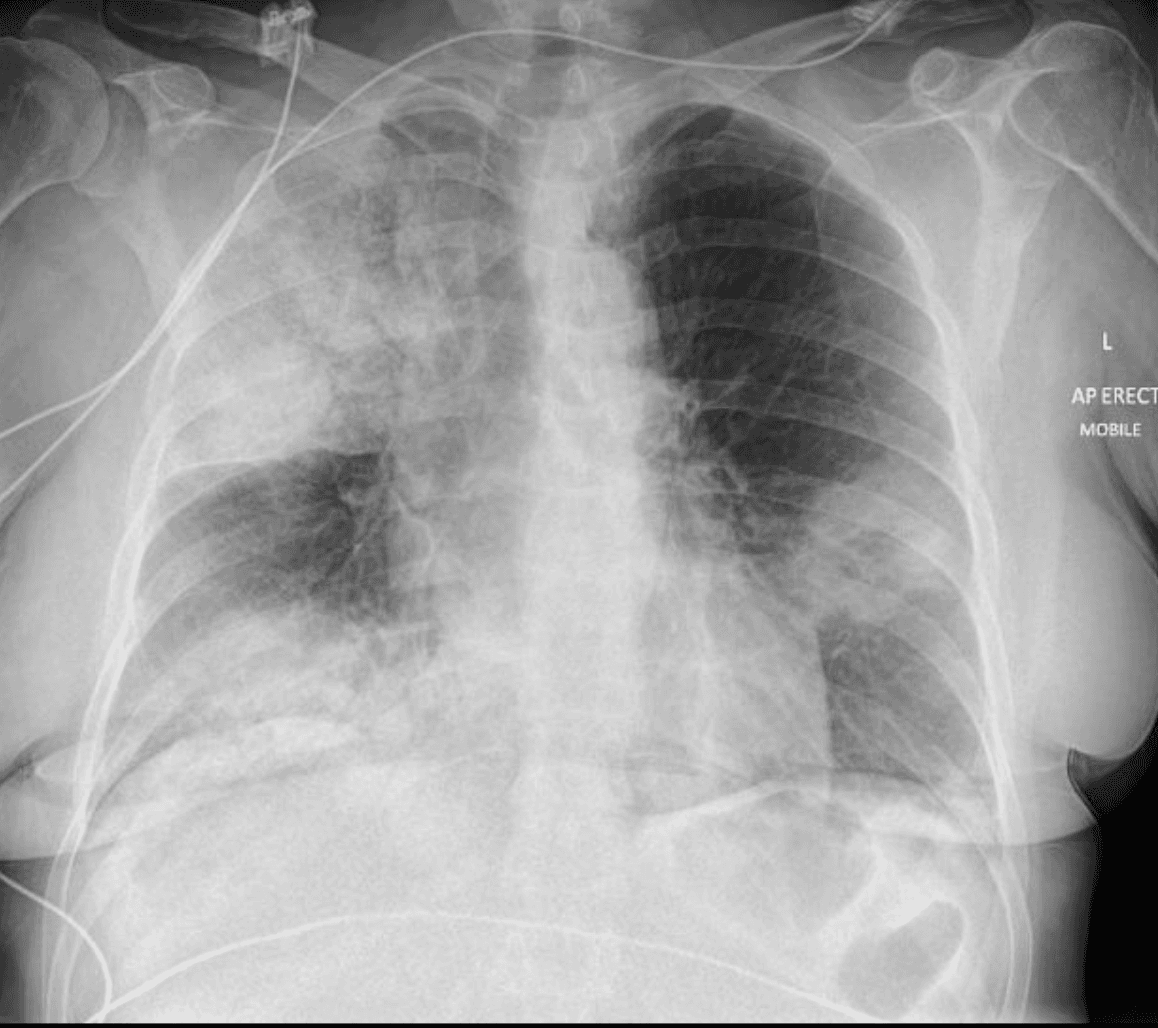
Chest radiograph demonstrating multifocal multilobar airspace opacities.
Question 1
What is the most likely diagnosis?
Select one option to submit your answer and view live poll results.
Question 2
Why does the negative urine antigen test not exclude this diagnosis?
Select one option to submit your answer and view live poll results.
Question 3
What is the best next diagnostic and treatment step?
Select one option to submit your answer and view live poll results.
References
Metlay JP, Waterer GW, Long AC, et al. Diagnosis and treatment of adults with community-acquired pneumonia. An official clinical practice guideline of the American Thoracic Society and Infectious Diseases Society of America. Am J Respir Crit Care Med. 2019;200(7):e45-e67.
Mercante JW, Winchell JM. Current and emerging Legionella diagnostics for laboratory and outbreak investigations. Clin Microbiol Rev. 2015;28(1):95-133.
Cunha BA, Burillo A, Bouza E. Legionnaires' disease. Lancet. 2016;387(10016):376-385.