The Climbing Lesion
Clinical Vignette
A 25-year-old woman presents with painful erythematous edema of the right knee. Over the last several days she has developed worsening redness, superficial erosions, shallow ulcers, and several small satellite pustules.
Most recently, she returned from a trip to Brazil. She spent time in a tropical rainforest area and recalls a minor traumatic injury to her leg, though she is unsure exactly what caused it. Since returning home, she has continued frequent gardening but does not remember a specific puncture wound or new traumatic injury. She also notes regular contact with feral cats near her neighborhood. She has a fishtank at home but is not in charge of cleaning it.
She is otherwise healthy and takes no medications. Examination shows tender knee edema with maceration and ulceration, multiple erythematous nodules in a sporotrichoid (lymphangitic) distribution extending up the right thigh, and right inguinal lymphadenopathy.
She was initially seen at urgent care and prescribed cephalexin for concern for a skin and soft tissue infection. Unfortunately, she did not improve and re-presented with progression of the lesions, at which point you were consulted.
Laboratory studies show white blood cells 14,900/mm3 (85.8% neutrophils), hemoglobin 14.0 g/dL, platelets 23.2 × 10^4/mm3, creatinine 0.6 mg/dL, CRP 0.7 mg/dL, and ESR 17 mm/h. Skin biopsy demonstrates nonspecific granulomatous inflammation with abscess formation. Grocott stain reveals fine filamentous branching bacilli in the dermis.
Cultures including routine bacterial, fungal, and AFB are pending.
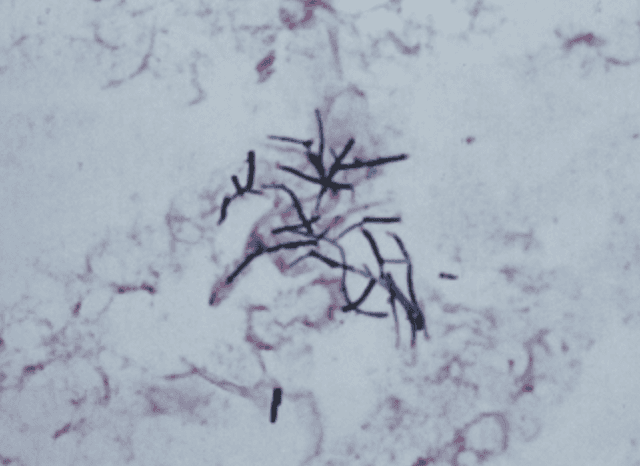
Obtained from Fukuda H et al., The Journal of Dermatology (2008). DOI:
10.1111/j.1346-8138.2008.00482.x
Question 1
What is the most likely diagnosis?
Select one answer to view the rationale and peer response data.
Question 2
What is the best next step?
Select one answer to view the rationale and peer response data.
Rationale locked
Answer the question above to reveal the rationale.
Rationale locked
Answer the question above to reveal the rationale.
References
Fukuda H, Saotome A, Usami N, Urushibata O, Mukai H. Lymphocutaneous type of nocardiosis caused by Nocardia brasiliensis: A case report and review of primary cutaneous nocardiosis caused by N. brasiliensis reported in Japan. The Journal of Dermatology. 2008;35(6):346-353.