What Grew in the Scar
Clinical Vignette
A 58-year-old man presents with six months of productive cough, an 8 kg weight loss, night sweats, and progressive exertional dyspnea. He worked as a hard-rock gold miner in Nevada for 25 years before retiring. He has never smoked and drinks alcohol only occasionally. He was diagnosed with silicosis eight years ago based on chest imaging showing bilateral upper lobe fibronodular changes with progressive massive fibrosis; his pulmonologist has followed him every six months. He takes no inhalers or medications. He has no travel history outside the southwestern United States.
On examination, temperature is 37.8°C, heart rate 96/min, blood pressure 122/74 mmHg, respiratory rate 20/min, and oxygen saturation 91% on room air. He appears thin and fatigued. Coarse crackles and occasional rhonchi are present in both upper lung zones, more prominent on the right. No lymphadenopathy and no clubbing.
Laboratory studies show white blood cells 9.4 x 10^3/uL, hemoglobin 11.2 g/dL, ESR 88 mm/hr, and CRP 76 mg/L. Renal function and liver enzymes are normal. HIV antigen-antibody assay is negative. QuantiFERON-TB Gold Plus is negative on two separate occasions. CT chest shows stable bilateral upper lobe fibronodular disease and progressive massive fibrosis consistent with known silicosis, plus a new right upper lobe cavitary lesion measuring 4.2 cm with surrounding satellite nodules. Sputum AFB smear is positive on two specimens collected on separate days. Mycobacterial cultures are sent. Speciation by hsp65 gene sequencing returns Mycobacterium kansasii from both specimens. Drug susceptibility testing is pending.
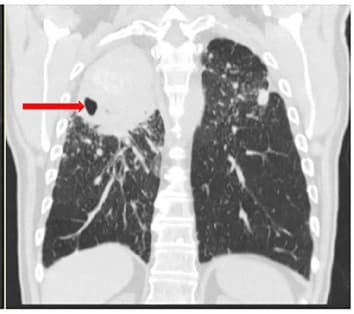
Coronal chest CT: right upper lobe cavitary lesion (arrow) against a background of bilateral nodular silicotic changes. Image adapted from Patel et al., Journal of Investigative Medicine High Impact Case Reports (2025), CC BY-NC 4.0.
Question 1
Which combination of findings establishes the diagnosis of M. kansasii pulmonary disease in this patient?
Select one answer to view the rationale and peer response data.
Question 2
What is the preferred first-line treatment regimen?
Select one answer to view the rationale and peer response data.
Question 3
Which property of M. kansasii most distinguishes its treatment regimen and prognosis from MAC pulmonary disease?
Select one answer to view the rationale and peer response data.
Question 4
At month 8 of rifampin + ethambutol + azithromycin, sputum cultures converted to negative at month 3. Repeat CT shows the right upper lobe cavity is unchanged in size. What is the most appropriate next step?
Select one answer to view the rationale and peer response data.
Rationale locked
Answer the question above to reveal the rationale.
Rationale locked
Answer the question above to reveal the rationale.
References
Daley CL, Iaccarino JM, Lange C, et al. Treatment of nontuberculous mycobacterial pulmonary disease: an official ATS/ERS/ESCMID/IDSA clinical practice guideline. European Respiratory Journal. 2020;56(1):2000535.
Daley et al.: ATS/ERS/ESCMID/IDSA NTM Treatment Guidelines 2020
Griffith DE, Daley CL. Treatment of Mycobacterium abscessus pulmonary disease. Chest. 2012;141(4):1059-1068.
Patel K, Habeeb S, Deshpande D. Dust to disease: cavitary lung lesion with Mycobacterium kansasii in a black lung patient. Journal of Investigative Medicine High Impact Case Reports. 2025;13:23247096251348906.
Patel et al.: M. kansasii in Coal Workers' Pneumoconiosis (image source, CC BY-NC 4.0)
Haworth CS, Banks J, Capstick T, et al. British Thoracic Society guidelines for the management of non-tuberculous mycobacterial pulmonary disease (NTM-PD). Thorax. 2017;72(Suppl 2):ii1-ii64.