The Rough Colony
Clinical Vignette
A 32-year-old man with cystic fibrosis (F508del homozygous) underwent bilateral lung transplantation five months ago for end-stage CF lung disease. His pretransplant infectious disease evaluation documented two consecutive sputum cultures growing Mycobacterium abscessus complex, which was noted in the ID pretransplant consultation but did not prevent transplantation. Post-transplant immunosuppression consists of tacrolimus, mycophenolate mofetil, and prednisone 10 mg daily. Prophylaxis includes TMP-SMX (PJP), valganciclovir (CMV), and itraconazole (mold). His post-transplant course was complicated by a single episode of acute cellular rejection (grade A2) at day 34, treated with pulse methylprednisolone.
Six weeks before the current visit he developed progressive cough with purulent sputum, low-grade fevers, night sweats, and a 4 kg weight loss. The primary team empirically started azithromycin for presumed bacterial bronchitis; there was no improvement. Three weeks later he noticed a firm, tender erythematous nodule on his right forearm. Two additional smaller nodules appeared over the following two weeks. He denies hemoptysis, dyspnea at rest, or joint pain.
On examination, temperature is 38.2°C, heart rate 102/min, blood pressure 116/74 mmHg, respiratory rate 18/min, and oxygen saturation 94% on room air. Three indurated, erythematous subcutaneous nodules measuring 1.2 to 2.4 cm are present on the right forearm; the largest has overlying fluctuance. Coarse crackles are heard in the right lower zone. No lymphadenopathy is palpated. The remainder of the examination is unremarkable.
Laboratory studies show white blood cells 9.2 x 10^3/uL with 84% neutrophils and 6% bands, CRP 96 mg/L, procalcitonin 0.6 ng/mL, creatinine 1.4 mg/dL, and tacrolimus level 7.8 ng/mL. CT chest shows a 2.6 cm cavitary nodule in the right lower lobe with adjacent consolidation and multiple 5 to 8 mm satellite nodules; no pleural effusion. Flexible bronchoscopy is performed: bronchoalveolar lavage AFB smear is positive by auramine-rhodamine fluorescence. Standard bacterial cultures from the BAL are negative; aspergillus galactomannan on BAL is negative. Mycobacterial blood cultures using the BACTEC MGIT 960 liquid system are flagged positive at day 8; auramine stain of the broth confirms acid-fast bacilli. Colonies grow within 7 days at 30°C on solid media, consistent with a rapidly growing mycobacterium. Molecular speciation by hsp65 gene sequencing identifies M. abscessus complex, subspecies abscessus. Azithromycin susceptibility at day 3 reads as susceptible (MIC 4 mcg/mL); the laboratory comments that extended 14-day incubation testing is in progress given the presence of a functional erm(41) gene in this subspecies.
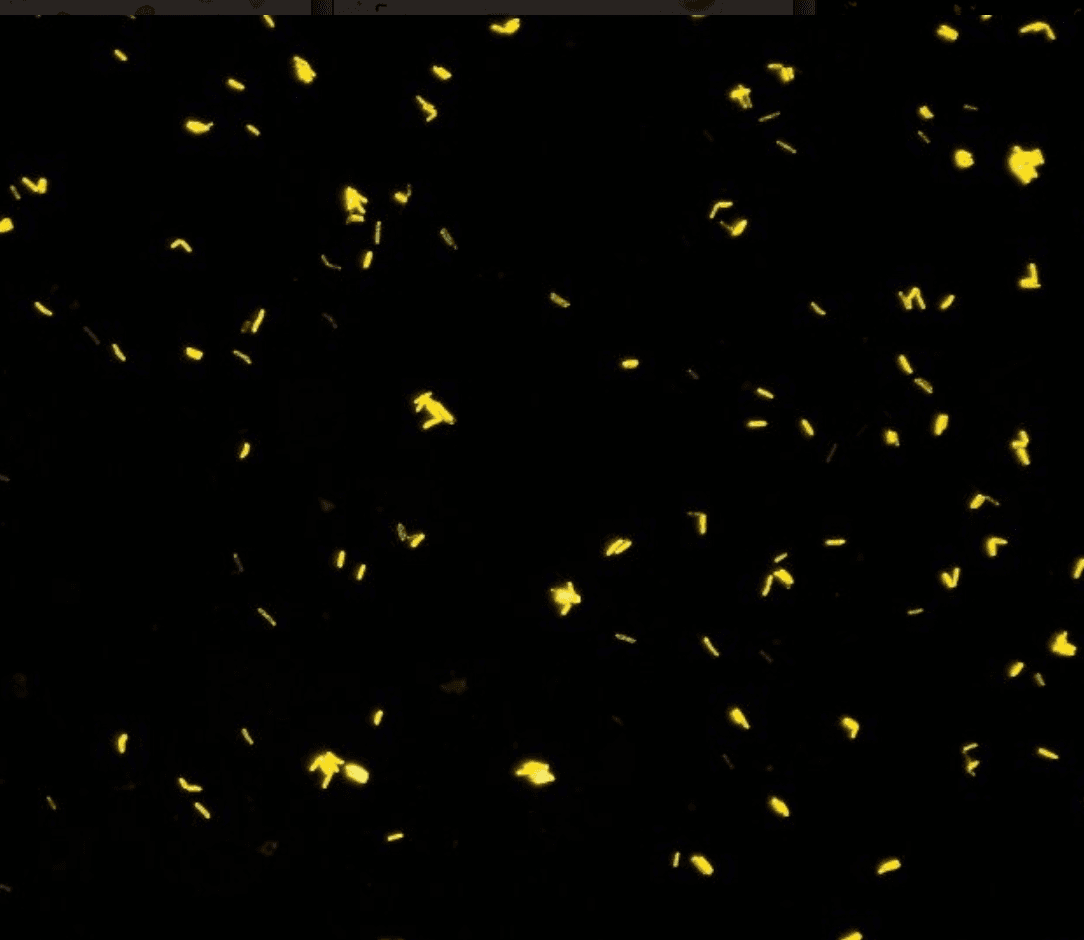
Auramine fluorescence stain of BACTEC blood culture broth: bright fluorescent acid-fast bacilli consistent with a rapidly growing mycobacterium.
Question 1
What is the most appropriate initial treatment approach?
Select one answer to view the rationale and peer response data.
Question 2
Which mechanism explains why azithromycin cannot be relied upon as an active agent in M. abscessus subsp. abscessus despite day-3 susceptibility testing showing susceptibility?
Select one answer to view the rationale and peer response data.
Question 3
With macrolide resistance confirmed, what is the best continuation regimen?
Select one answer to view the rationale and peer response data.
Rationale locked
Answer the question above to reveal the rationale.
Rationale locked
Answer the question above to reveal the rationale.
References
Daley CL, Iaccarino JM, Lange C, et al. Treatment of nontuberculous mycobacterial pulmonary disease: an official ATS/ERS/ESCMID/IDSA clinical practice guideline. European Respiratory Journal. 2020;56(1):2000535.
Daley et al.: ATS/ERS/ESCMID/IDSA NTM Treatment Guidelines 2020
Drusano GL, Sgambati N, Eichas A, et al. The combination of rifampin plus moxifloxacin is not more active than moxifloxacin alone against Mycobacterium abscessus in a mouse infection model. Antimicrobial Agents and Chemotherapy. 2018;62(8):e00635-18.
Drusano et al.: Fluoroquinolone Activity Against M. abscessus
Nessar R, Cambau E, Reyrat JM, Murray A, Gicquel B. Mycobacterium abscessus: a new antibiotic nightmare. Journal of Antimicrobial Chemotherapy. 2012;67(4):810-818.
Haworth CS, Banks J, Capstick T, et al. British Thoracic Society guidelines for the management of non-tuberculous mycobacterial pulmonary disease (NTM-PD). Thorax. 2017;72(Suppl 2):ii1-ii64.