The Brainstem Under Siege
Clinical Vignette
A 28-year-old man presents to the emergency department of a hospital in Ho Chi Minh City with three days of fever, sore throat, and painful oral ulcers. His five-year-old nephew recovered from hand-foot-and-mouth disease two weeks ago, and the patient recalls similar small vesicles on his palms that have since faded. He was diagnosed with granulomatosis with polyangiitis eight months ago, currently in remission on rituximab maintenance therapy (last infusion six weeks ago, CD19-positive B cells undetectable) and prednisone 5 mg daily. He has no other medical history.
This morning he developed intermittent jerking of his arms and legs that woke him from sleep. His wife noticed his eyes were "not moving properly" and that he was stumbling when walking. Over the next several hours he became progressively dysarthric and began drooling, unable to swallow his saliva. On arrival to the emergency department he is tachycardic to 142 bpm, blood pressure 178/104 mmHg, respiratory rate 32, temperature 38.6°C. He is alert but dysarthric, with bilateral sixth nerve palsies, left facial weakness, and absent gag reflex. He has frequent myoclonic jerks involving all four extremities and is ataxic when attempting to sit. Plantar responses are flexor. There is no meningismus. His palms show faint resolving macular lesions; no active vesicles are present.
Laboratory studies reveal a white blood cell count of 11,200/μL (neutrophils 82%, lymphocytes 11%), hemoglobin 12.8 g/dL, and platelet count 198,000/μL. Serum sodium is 139 mEq/L, creatinine 0.9 mg/dL. CRP is 4.2 mg/dL. A lumbar puncture reveals an opening pressure of 240 mmH2O, CSF white blood cell count 52/μL (78% lymphocytes), protein 71 mg/dL, and glucose 62 mg/dL (serum glucose 108 mg/dL). CSF Gram stain shows no organisms.
MRI of the brain with and without gadolinium is performed.
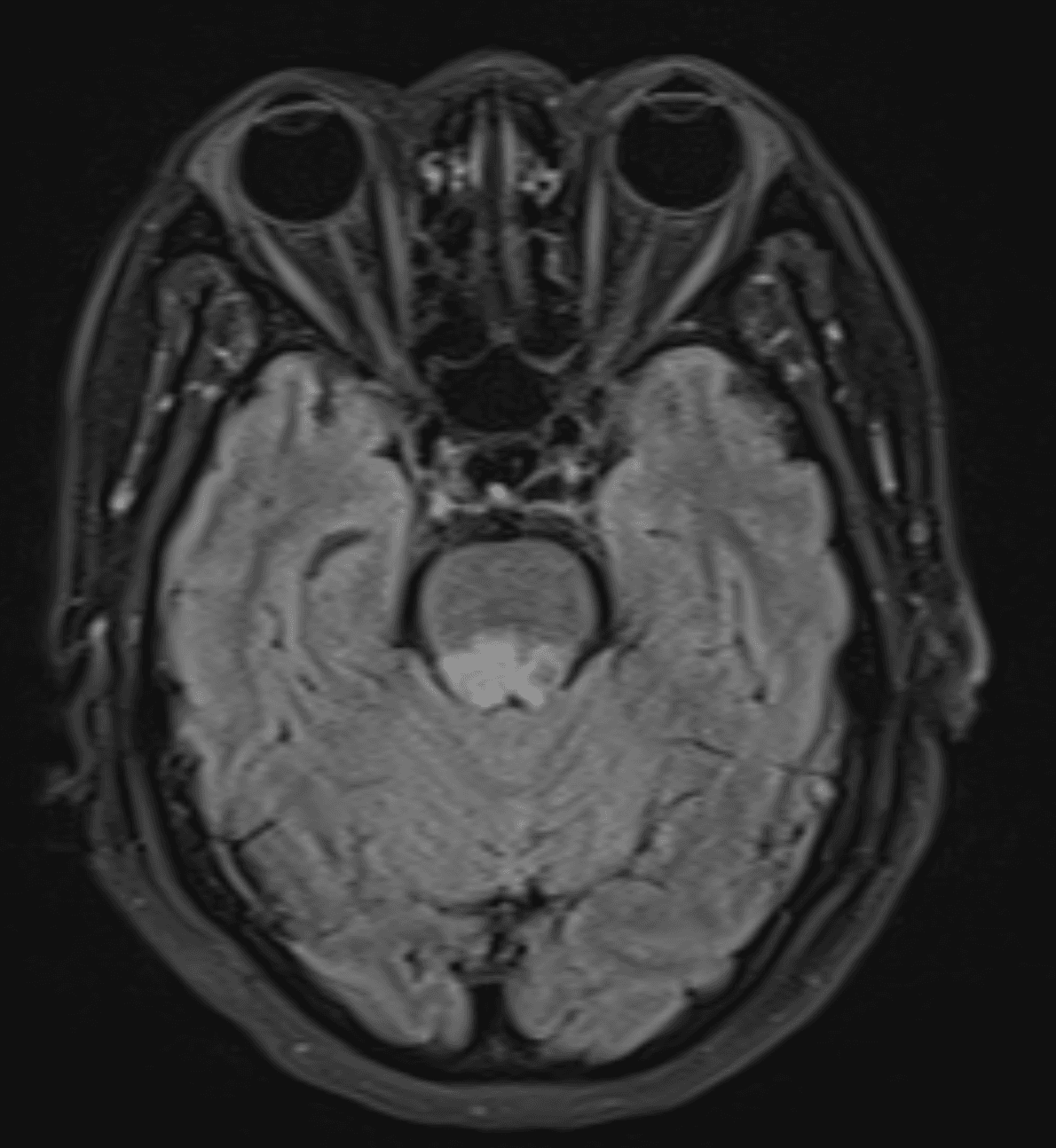
MRI brain: hyperintensity involving the dorsal medulla oblongata, posterior pontine tegmentum, and bilateral dentate nuclei, without significant gadolinium enhancement. Pattern consistent with rhombencephalitis.
Question 1
Which of the following is the most likely cause of this patient's brainstem encephalitis?
Select one answer to view the rationale and peer response data.
Question 2
What is the most appropriate diagnostic approach to confirm the etiology of this patient's rhombencephalitis?
Select one answer to view the rationale and peer response data.
Question 3
RT-PCR confirms EV-A71 from throat and rectal swabs; CSF is weakly positive. HSV and VZV PCRs are negative. The patient is now tachypneic with an SpO2 of 88% on room air, and chest X-ray shows new bilateral infiltrates consistent with early neurogenic pulmonary edema. What is the most appropriate management?
Select one answer to view the rationale and peer response data.
Rationale locked
Answer the question above to reveal the rationale.
Rationale locked
Answer the question above to reveal the rationale.
References
Huang CC, Liu CC, Chang YC, Chen CY, Wang ST, Yeh TF. Neurologic complications in children with enterovirus 71 infection. New England Journal of Medicine. 1999;341(13):936-942.
Kapadia RK, Wackym PA, Shatzkes DR, Bly RA, Lalwani AK. Enterovirus A71 causing meningoencephalitis and acute flaccid myelitis in a patient receiving rituximab. Journal of Neuroimmunology. 2021;358:577639.
Pham KNO, Nguyen HT, Le VT, Tran TM, Vu TH, Nguyen TT. Hand, foot and mouth disease with encephalomyelitis in adult: a case report. Diagnostic Microbiology and Infectious Disease. 2025;112(3):116832.
Liu K, Zhang L, Su Q, Wang M, Chen J, Li X. Clinical value of dorsal medulla oblongata involvement detected with conventional MRI in children with enterovirus 71 brainstem encephalitis. Pediatric Infectious Disease Journal. 2019;38(2):99-103.
Jubelt B, Mihai C, Li TM, Veerapaneni P. Rhombencephalitis / brainstem encephalitis. Current Neurology and Neuroscience Reports. 2011;11(6):543-552.
Chi CY, Khanh TH, Thoa le PK, Tseng FC, Wang SM, Thinh le Q, Lin HC, Hsu BM, Wang JR, Liu CC. Milrinone therapy for enterovirus 71-induced pulmonary edema and/or neurogenic shock in children: a randomized controlled trial. Critical Care Medicine. 2013;41(7):1754-1760.