Quiet Enzymes
Clinical Vignette
A 45-year-old woman presents for her routine six-month transplant follow-up visit. She received a deceased-donor kidney transplant three years ago for end-stage renal disease secondary to IgA nephropathy. Her maintenance immunosuppression consists of tacrolimus, mycophenolate mofetil, and prednisone 5 mg daily. She reports four to six weeks of mild fatigue and reduced appetite but no fever, chills, nausea, vomiting, jaundice, or abdominal pain. She has no recent changes in medications and no new herbal supplements. She has no international travel history. She regularly eats at a local barbecue restaurant and, eight weeks before this visit, attended an outdoor gathering where she consumed venison prepared medium-rare.
On examination, temperature is 37.1°C, heart rate 82/min, blood pressure 128/78 mmHg, and oxygen saturation 99% on room air. She appears well and is not jaundiced. The liver is mildly enlarged at 2 cm below the right costal margin and non-tender. No splenomegaly, no lymphadenopathy, no skin rash, and no mucocutaneous lesions.
Laboratory studies show AST 78 U/L, ALT 94 U/L, alkaline phosphatase 102 U/L, GGT 88 U/L, total bilirubin 1.1 mg/dL, albumin 3.9 g/dL, and INR 1.0. Creatinine is 1.6 mg/dL, stable from her previous visit. Tacrolimus trough level is 7.2 ng/mL, within the target therapeutic range. Complete blood count shows white blood cells 6.8 x 10^3/uL without lymphocytosis or eosinophilia, hemoglobin 11.4 g/dL, and platelets 198 x 10^3/uL. Hepatitis B surface antigen is negative; anti-HBs is positive from prior vaccination. Anti-HCV is negative. CMV PCR, EBV PCR, and HSV PCR are sent and are pending. Liver ultrasound shows mild hepatomegaly without focal lesions, biliary dilation, or ascites.
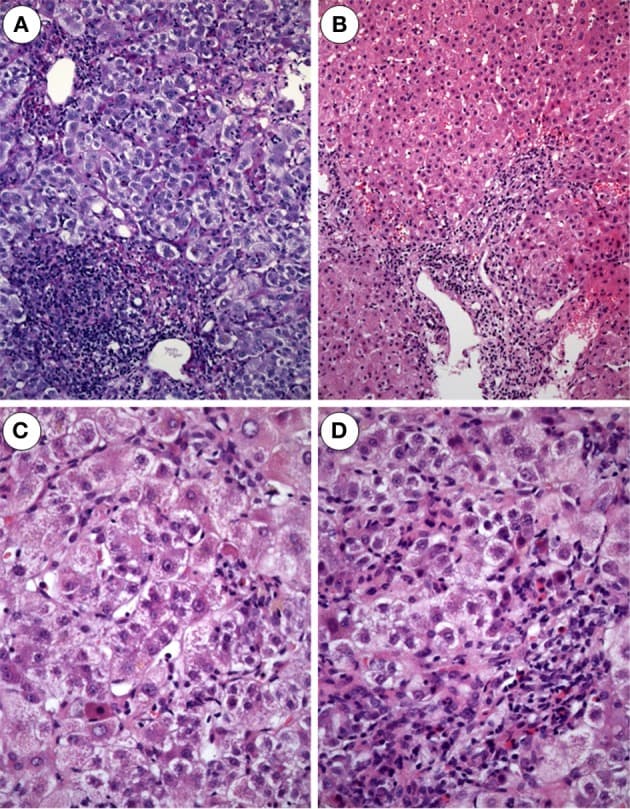
H&E stain: liver biopsy showing portal tract expansion with mixed inflammatory infiltrate, lobular disarray, and hepatocellular ballooning consistent with viral hepatitis. Image adapted from Aggarwal et al., Frontiers in Physiology (2014), CC BY.
Question 1
What is the most likely diagnosis?
Select one answer to view the rationale and peer response data.
Question 2
Which test best confirms chronic HEV infection in this patient, and how is chronic infection defined?
Select one answer to view the rationale and peer response data.
Question 3
HEV RNA returns positive. Three months later, RNA remains detectable. What is the correct treatment approach?
Select one answer to view the rationale and peer response data.
Rationale locked
Answer the question above to reveal the rationale.
Rationale locked
Answer the question above to reveal the rationale.
References
European Association for the Study of the Liver. EASL Clinical Practice Guidelines on hepatitis E virus infection. Journal of Hepatology. 2018;68(6):1256-1271.
EASL: Clinical Practice Guidelines on Hepatitis E Virus Infection
Kamar N, Abravanel F, Lhomme S, et al. Ribavirin for hepatitis E virus infection after organ transplantation: a large European retrospective multicenter study. Clinical Infectious Diseases. 2020;71(5):1204-1211.
Kamar N, Garrouste C, Haagsma EB, et al. Factors associated with chronic hepatitis in patients with hepatitis E virus infection who have received solid organ transplants. Gastroenterology. 2011;140(5):1481-1489.
Kamar et al.: Factors Associated with Chronic HEV in Transplant Recipients
Aggarwal R, Shukla R, Jameel S, Bhatt P. Hepatitis E in liver biopsies from patients with acute hepatitis of clinically unexplained origin. Frontiers in Physiology. 2014;4:351.
Aggarwal et al.: Hepatitis E in Liver Biopsies (image source, CC BY)