The Shoulder That Wouldn't Heal
Clinical Vignette
A 68-year-old man presents with persistent, dull right shoulder pain and stiffness 8 months after right total shoulder arthroplasty. He reports gradual onset over the past 3 months, initially attributed to physical therapy, but the pain has progressively worsened despite conservative measures including acetaminophen and nonsteroidal anti-inflammatory drugs.
He is a retired mechanic with no history of trauma, fever, or chills. He denies systemic symptoms but notes occasional night pain that disrupts sleep. His shoulder arthroplasty was performed for advanced osteoarthritis and was reportedly uncomplicated; he received standard perioperative antibiotics. He has a history of moderate acne during his youth. He has no other joint replacements and takes no immunosuppressive medications.
Vital signs are normal. Examination of the right shoulder reveals mild swelling and warmth over the anterior joint line with tenderness to palpation. Active range of motion is limited to 90° forward flexion (compared to 160° on the left) and 30° external rotation. Passive range is similarly restricted and reproduces pain. There is no overlying erythema, drainage, or sinus tract. Neurovascular examination is intact.
Laboratory studies show erythrocyte sedimentation rate (ESR) 22 mm/hr (normal <20), C‑reactive protein (CRP) 1.2 mg/dL (normal <0.8), and normal white blood cell count. Shoulder radiographs demonstrate well‑positioned components without evidence of loosening, osteolysis, or periosteal reaction. Ultrasound reveals a moderate joint effusion. Arthrocentesis yields 15 mL of turbid synovial fluid with white blood cell count 3,200/μL (70% neutrophils). Gram stain shows rare gram‑positive rods.
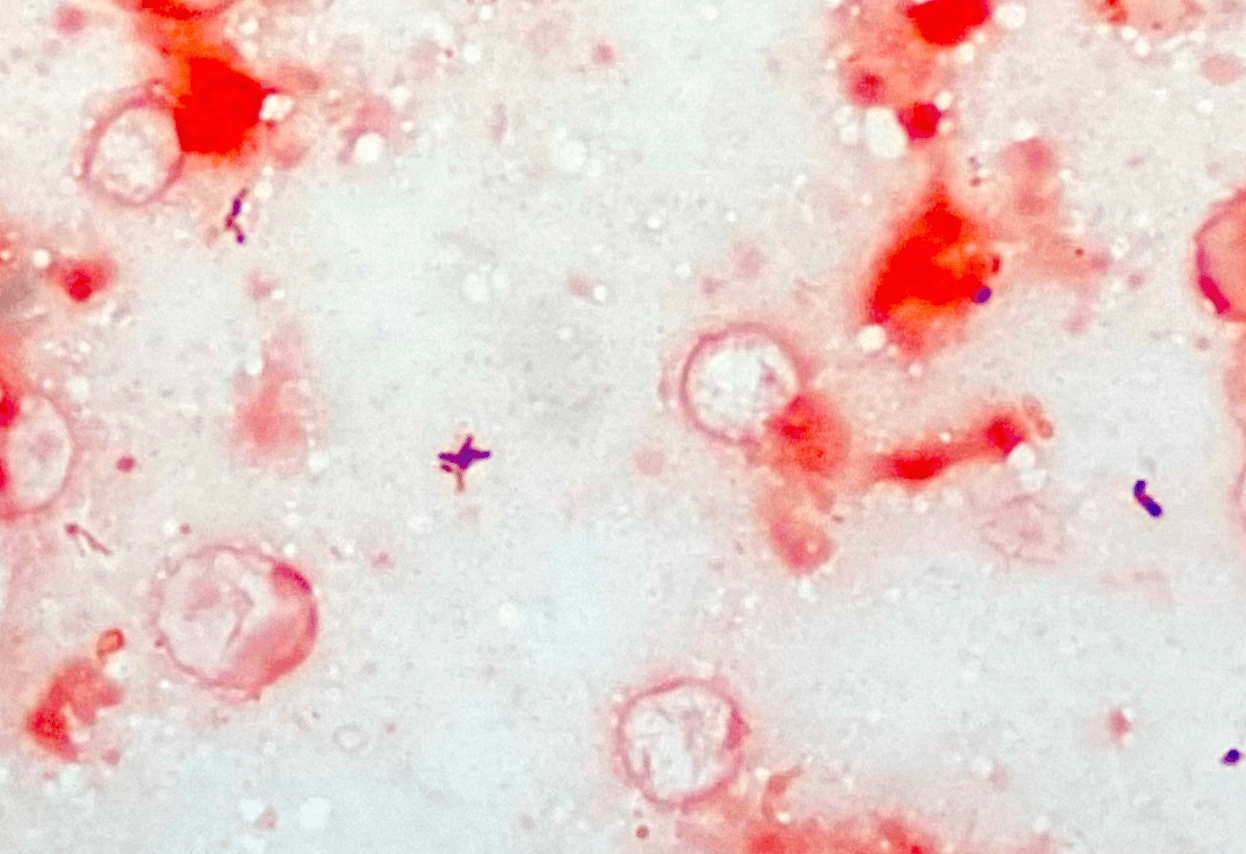
Gram stain of synovial fluid aspirate demonstrating scattered gram‑positive rods.
Question 1
Which organism is most likely responsible for this prosthetic joint infection?
Select one option to submit your answer and view live poll results.
Question 2
What is the most appropriate next step in management?
Select one option to submit your answer and view live poll results.
References
Osmon DR, Berbari EF, Berendt AR, et al. Diagnosis and management of prosthetic joint infection: clinical practice guidelines by the Infectious Diseases Society of America. Clin Infect Dis. 2013;56(1):e1‑e25.
Portillo ME, Corvec S, Borens O, Trampuz A. Cutibacterium acnes: an underestimated pathogen in prosthetic joint infection. J Clin Microbiol. 2013;51(7):2248‑2253.
Patel A, Calfee RP, Plante M, Fischer SA, Green A. Cutibacterium acnes colonization of the human shoulder. J Shoulder Elbow Surg. 2009;18(6):897‑902.