Heart Failure from the Andes
Clinical Vignette
A 58-year-old man originally from rural Colombia presents to the emergency department with progressive shortness of breath and fatigue over the past 4 months. He reports worsening dyspnea on exertion, initially able to walk 2 blocks but now becoming breathless after climbing a single flight of stairs. He also notes bilateral leg swelling that has gradually increased, requiring larger shoes and difficulty wearing his usual pants.
The patient immigrated to the United States 20 years ago and works as a construction laborer. He reports no history of hypertension, diabetes, or coronary artery disease. He recalls spending childhood in a mud-walled home in the Santander region of Colombia where he was frequently bitten by "kissing bugs" (vinchucas) at night. He shows a picture of the insect (shown below) that he says would bite him and his family members. He has never received blood transfusions and does not use intravenous drugs. There is no family history of cardiomyopathy or sudden cardiac death.
On examination, he appears comfortable at rest but becomes dyspneic when speaking in full sentences. Vital signs: temperature 36.8°C, heart rate 110 bpm (regular), blood pressure 102/68 mmHg, respiratory rate 22/min, oxygen saturation 94% on room air. Jugular venous pressure is elevated to 8 cm H₂O. Cardiac exam reveals diffuse apical impulse, S3 gallop, and a 2/6 holosystolic murmur at the apex radiating to the axilla. Lung exam shows bibasilar crackles. Abdomen is soft without hepatomegaly. Lower extremities have 2+ pitting edema bilaterally.
Laboratory studies show normal complete blood count, comprehensive metabolic panel, and thyroid function tests. B-type natriuretic peptide (BNP) is elevated at 850 pg/mL. Electrocardiogram reveals sinus tachycardia, right bundle branch block, and frequent premature ventricular contractions. Echocardiogram demonstrates severe biventricular systolic dysfunction with left ventricular ejection fraction of 30%, apical aneurysm, and apical thrombus. Chest X-ray shows cardiomegaly with pulmonary vascular congestion.
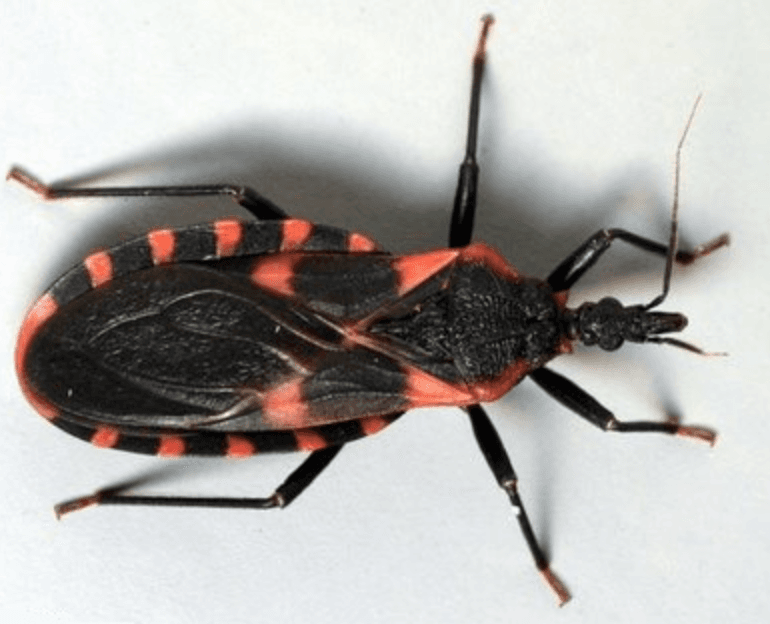
Triatomine bug (kissing bug).
Question 1
What is the most likely cause of this patient's cardiomyopathy?
Select one option to submit your answer and view live poll results.
Question 2
What is the most appropriate initial diagnostic test to confirm the suspected diagnosis?
Select one option to submit your answer and view live poll results.
Question 3
Which treatment is indicated for this patient's condition?
Select one option to submit your answer and view live poll results.
References
Bern C, Montgomery SP, Herwaldt BL, et al. Evaluation and treatment of Chagas disease in the United States: a systematic review. JAMA. 2007;298(18):2171-2181.
Morillo CA, Marin-Neto JA, Avezum A, et al. Randomized trial of benznidazole for chronic Chagas' cardiomyopathy. N Engl J Med. 2015;373(14):1295-1306.
Pérez-Molina JA, Molina I. Chagas disease. Lancet. 2018;391(10115):82-94.