The Waning Shield
Clinical Vignette
A 58-year-old man with type 2 diabetes and hemodialysis-dependent end-stage renal disease presents to the emergency department with three days of fever, rigors, and diffuse myalgias. He underwent tunneled hemodialysis catheter placement at an outside facility six weeks ago. On examination, temperature is 39.2°C, heart rate 110/min, blood pressure 96/62 mmHg, respiratory rate 20/min, and oxygen saturation 97% on room air. He appears acutely ill and diaphoretic. The catheter exit site is erythematous with a small amount of purulent drainage.
Two sets of blood cultures drawn from peripheral venipuncture grow gram-positive cocci in clusters within 16 hours; susceptibility testing confirms methicillin-resistant Staphylococcus aureus (MRSA) with a vancomycin minimum inhibitory concentration (MIC) of 1 mg/L by broth microdilution. Vancomycin is initiated with area-under-the-curve (AUC)-guided dosing, and the tunneled catheter is removed. Follow-up blood cultures on day 4 remain positive for MRSA. Transthoracic echocardiography (TTE) is performed.
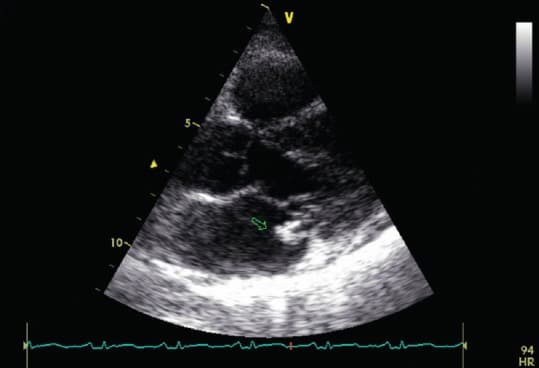
Transthoracic echocardiogram: a mobile echogenic vegetation (arrow) attached to the posterior leaflet of the mitral valve, measuring 12 × 10 mm. Image from Castiglioni et al., Cardiology and Therapy 2022 (CC BY-NC-SA 4.0).
The TTE confirms a mobile 12 × 10 mm vegetation on the posterior mitral leaflet with no abscess or valve perforation. Blood cultures on day 7 remain positive. On day 9, a repeat vancomycin MIC by broth microdilution returns at 2 mg/L. The infection team is asked to reassess the diagnosis and management.
Question 1
Which mechanism best explains the emergence of intermediate vancomycin susceptibility in this isolate?
Select one answer to view the rationale and peer response data.
Question 2
The decision is made to change therapy. Which agent is most appropriate for this patient with VISA bacteremia and mitral valve endocarditis?
Select one answer to view the rationale and peer response data.
Question 3
Per the 2020 ASHP/IDSA/SIDP consensus guidelines, which pharmacokinetic/pharmacodynamic target should guide vancomycin dosing in serious MRSA infections such as bacteremia and endocarditis?
Select one answer to view the rationale and peer response data.
Rationale locked
Answer the question above to reveal the rationale.
Rationale locked
Answer the question above to reveal the rationale.
References
Rybak MJ, Le J, Lodise TP, et al. Therapeutic monitoring of vancomycin for serious methicillin-resistant Staphylococcus aureus infections: a revised consensus guideline and review by the American Society of Health-System Pharmacists, the Infectious Diseases Society of America, and the Society of Infectious Diseases Pharmacists. American Journal of Health-System Pharmacy. 2020;77(11):835–864.
Rybak et al.: 2020 Vancomycin Therapeutic Monitoring Consensus Guidelines (ASHP/IDSA/SIDP)
Baddour LM, Wilson WR, Bayer AS, et al. Infective endocarditis in adults: diagnosis, antimicrobial therapy, and management of complications. Circulation. 2015;132(15):1435–1486.
AHA/ACC: Infective Endocarditis Management Guidelines (2015)
Howden BP, Davies JK, Johnson PDR, Stinear TP, Grayson ML. Reduced vancomycin susceptibility in Staphylococcus aureus, including vancomycin-intermediate and heterogeneous vancomycin-intermediate strains: resistance mechanisms, laboratory detection, and clinical implications. Clinical Microbiology Reviews. 2010;23(1):99–139.
Howden et al.: VISA and hVISA — Mechanisms, Detection, and Clinical Implications (CMR 2010)
Castiglioni M, Ceruti S, Melisurgo G, et al. Native-valve endocarditis detected by point-of-care echocardiography. Cardiology and Therapy. 2022;11(4):557–566.
Castiglioni et al.: Point-of-care Echocardiography in Native-valve Endocarditis (2022)